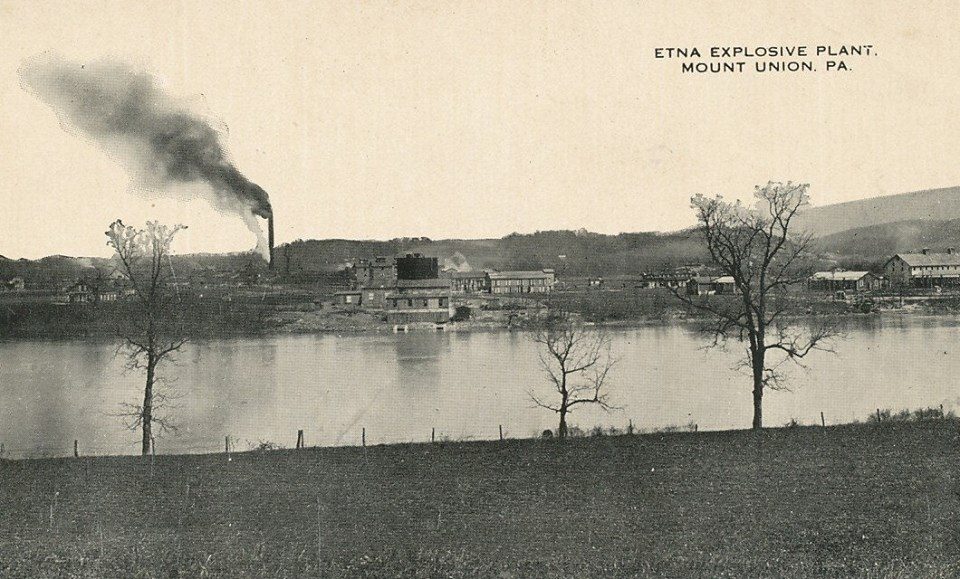
The documented corporate name was Aetna Explosives Company. “Etna” appears on period imagery and in some later local references. This page uses Aetna for the company and preserves Etna only when describing how a particular source labeled the plant.
A Wartime Plant in the River Loop
The National Park Service's survey of the Juniata River corridor places the plant on Silverford Farm in the river loop east of Mount Union and dates its construction to 1915. Before the United States entered World War I, the plant produced gunpowder for European armies. Contemporary coverage of the new works described a large facility being erected just below town and expected to employ several hundred people.
The plant brought jobs and rapid wartime growth, but powder production placed workers beside volatile materials, acids, solvents, machinery, and drying buildings.
Six Men Killed at Daybreak
At about 6 a.m. on September 20, 1916, an explosion destroyed the plant's C cotton dry house. The Harrisburg Telegraph reported six men killed and several injured. The blast came while shifts were changing; according to the newspaper, members of the night shift who had just left the building escaped.
The same report said twenty-one men worked in the building, which stood roughly 400 yards from the other plant structures along the river. Debris was found more than half a mile away. A neighboring dry house was damaged and briefly caught fire. The newspaper described the amount of powder involved as “said to be 100,000 pounds”—an early estimate that should be read as the report's figure, not as a later engineering finding.
The September 20 Harrisburg Telegraph identified the dead as George Stair, Elmer Pyle, Clayton Clark, Elmer Bair, William Lehman, and Charles Ulsch. Other contemporary accounts used different spellings and, in some cases, different names or home communities. Until personnel, death, or burial records resolve those conflicts, this list is presented as the Telegraph's published account rather than a final genealogical identification.
The Danger Continued
The September catastrophe was not the last serious incident. On October 2, 1916, an air-compressor explosion injured two men. Follow-up reporting described severe cuts and burns and said the victims were taken to Huntingdon Hospital. By December, another report stated that an eye injured in an Aetna powder explosion could not be saved.
In January 1917, another explosion destroyed a recovery building. Contemporary reporting repeated local speculation about how it began, but did not establish an official cause. This page therefore records the destruction without presenting that speculation as fact.
A Brief, Dangerous Boom
The National Park Service survey says the Aetna operation boosted the local and regional economy until 1918 and officially closed on November 11, 1918, when the war ended. The property was later sold to Hercules Powder. Surviving company housing and industrial remnants kept the plant's physical presence visible long after its short operating life.
For Mount Union, the Aetna years were both a period of explosive growth and a record of repeated workplace danger. The September 1916 blast is the clearest documented catastrophe, but the surrounding reports show that fire, burns, machinery accidents, and explosions were recurring risks rather than a single isolated event.
Sources
- Juniata River Corridor: An Inventory of Historic Engineering and Industrial Sites, National Park Service/America's Industrial Heritage Project; Aetna Powder Plant site history and surviving resources.
- “New Powder Mill,” Altoona Mirror, June 16, 1915.
- “Six Men Killed By Explosion At Mount Union,” Harrisburg Telegraph, September 20, 1916.
- “Two Are Injured at Mount Union,” Altoona Mirror, October 3, 1916.
- Altoona Mirror, October 5, 1916; follow-up report on the air-compressor explosion.
- Altoona Mirror, December 6, 1916; report on an eye injury from a powder explosion.
- Altoona Mirror, January 30, 1917; recovery-building explosion.
- Kris Hocker, “1916 Aetna Explosives Co. Explosion at Mt. Union, PA”; comparison of conflicting contemporary victim lists and links to the underlying reports.
- The Daily News, June 6, 1967, viewer p. 57; local centennial retrospective on the powder plant. This later source supplements, but does not override, the contemporary accident reports above.