Every town’s history is really its people’s history. These biographies are grouped by each person’s primary era of influence in Mount Union—from the founding settlement and canal years through borough building, industrial growth, the Bricktown boom and the postwar community. Because many lives crossed these boundaries, the dates are guides rather than strict limits. Within each era, people are alphabetized by surname, and every profile retains its own sources.
Find a Person A–Z
Choose a name to open that person’s biography.
Founding Settlement and Canal Era
Early landholders, canal merchants and town planners helped turn a rural crossroads into the settlement that became Mount Union.
Major John C. ShaverEarly settler & builder of the 1818 Stone House, 1762–1829
John C. Shaver was born September 11, 1762. A Pennsylvania “Associators and Militia” index card lists “Shaver, John—Major” and directs researchers to Militia Book volume 2, page 674. The underlying entry has not yet been examined, so his unit and specific service are still being researched.
Charles Howard Welch’s 1909 “Shaver Kindred” account identifies Shaver as the progenitor of the local Shaver family and one of the area’s original landholders. Welch says he came from Aughwick Valley about 1795 and purchased land from William Morris. A 1922 Daily News retrospective gives the slightly earlier arrival estimate of about 1790 and reports that Shaver built the large stone residence about 1818. The house predated Mount Union’s canal development and formal town plan. It later became the Sheaffer family home, refractory company offices and the American Legion Memorial Home.
Shaver’s will, dated October 16, 1829 and published by the Mount Union Times in 1920, calls him Major John Shaver and identifies him as a resident of Shirley Township. It names his wife Mary and children Samuel, Peter, John, Catherine, Ann Morrison, George, Henry, Nicholas and William. Its property clauses describe land near a mill race and Chestnut Ridge, a substantial Stone Creek tract and other Shirley Township holdings. The continuation protects water rights needed for the sawmill and appoints Mary with sons John, Henry and William as executors. These provisions demonstrate the breadth and working character of the family estate without explicitly identifying which clause covered the Stone House.
Shaver died October 16, 1829 and is buried in Mount Union Cemetery. The small Shaver Cemetery behind his former home contains other family and community burials. Read the complete Stone House history →
Sources: “The Last Will and Testament of Major John Shaver,” Mount Union Times, March 19, 1920, p. 1, continued on p. 4; Charles Howard Welch, “Mount Union: The Original Settlers—The Shaver Clan,” Mount Union Times, October 22, 1909, p. 1; “Old Stone House Being Remodeled,” The Daily News, July 14, 1922; “Shaver, John—Major,” Associators and Militia index card, vol. 2, p. 674, reproduced in Ancestry.com’s Pennsylvania, U.S., Revolutionary War Battalions and Militia Index, 1775–1783; Frederick L. Richards, “Mount Union Historic District,” National Register nomination (1994).
James Kelley & Dr. William BrewsterCanal merchants & founders of the Santa Fe settlement
In 1848, James Kelley and Dr. William Brewster built a warehouse along the Pennsylvania Canal, together with a store and tavern a short distance below John Sharrar’s warehouse. J. Simpson Africa’s 1883 county history records that they named the place “Santa Fe.”
The warehouse, store and tavern made Santa Fe more than a single business: they created a recognizable commercial settlement at the eastern end of the developing village. For a time, Santa Fe and Mount Union were neighboring names before Mount Union became the identity of the combined community.
The surviving sources document Kelley and Brewster’s shared role more clearly than their individual lives. They are included together because their canal enterprise helped form one of the settlements from which modern Mount Union emerged. Read the complete Santa Fe story →
Sources: J. Simpson Africa, History of Huntingdon and Blair Counties (1883), Mount Union borough chapter; Welch, History of Mount Union, printed pp. 127–128.
Col. William PollockFirst postmaster, surveyor & town-name figure, 1799–1881
William Pollock was born in 1799 on land that family accounts called the Mount Union farm. A federal commission dated April 9, 1833 appointed him Mount Union’s first postmaster; a 1933 Mount Union Times retrospective reported that Postmaster General William T. Barry issued the commission.
Pollock also helped give the emerging town its physical form. Local historian W. O. Fields Welch records that he surveyed the original town plot in 1840. Welch and J. Simpson Africa both associate Pollock with the name “Mount Union,” explaining it as a reference to the mountains coming together around Jacks Narrows. The surviving sources are not unanimous, however: Welch also preserves a competing tradition crediting John Dougherty. Pollock is therefore presented as the leading documented figure in the town’s naming history, not as its uncontested namer.
Pollock married Phoebe Skinner Hubbell. Their son Andrew Belle Pollock was born at Mount Union on January 17, 1835 and was described in the family record as the first, or among the first, children born here. William later lived at Winchester Furnace before moving west to Wisconsin and then Iowa. He died at Andrew, Iowa, on March 9, 1881.
Sources: “Col. William Pollock, Mount Union’s First Postmaster,” Mount Union Times, April 28, 1933, p. 1; Welch, History of Mount Union, printed pp. 2, 124, 126–127; Africa, History of Huntingdon and Blair Counties, printed pp. 353–354
John SharrarCanal-era merchant & builder of Mount Union’s early commercial nucleus
John Sharrar was one of the principal builders of canal-era Mount Union. A 1909 Mount Union Times retrospective records that he built the stone house on Water Street in 1841 and kept a store there. The building combined a dwelling with commercial space at a time when Water Street bordered the Pennsylvania Canal.
That same year, Sharrar constructed a warehouse on Division Street directly west of the house. The paired store and warehouse connected the emerging settlement to canal commerce and helped establish the business nucleus later remembered as “Mount Union proper.” The surviving Sharrar House is recognized as the town’s oldest commercial building and is now preserved by the Mount Union Area Historical Society.
Sharrar’s importance lies in the transition he represents: Mount Union was changing from scattered farms and an early post-office settlement into a recognizable canal village. His buildings gave that development a durable commercial center before the town was formally laid out in 1849. See the Landmarks page for the surviving house.
Sources: Mount Union Times, October 22, 1909, p. 1; Welch, History of Mount Union, printed pp. 126–127; Frederick L. Richards, “Mount Union Historic District,” National Register nomination (1994).
Borough Building and the Civil War Generation
These residents shaped the incorporated borough’s government, churches, medicine, commerce and first industries. Several carried Civil War experience into Mount Union’s civic life.
Hon. Thomas H. Adams (Sr.)Merchant, banker & state legislator
Thomas H. Adams was born near Orbisonia on February 10, 1830, to Irish immigrants John and Mary Quirk Adams. After teaching school, he entered a mercantile partnership with P. M. Bare in Mount Union in 1861 and later acquired a store of his own.
Adams helped organize Mount Union’s Central Banking Company in 1873 and became its president in 1875. He also served as chief burgess and spent nine years as president of the school board, placing him at the center of the borough’s commercial, financial and educational development.
In 1882 he won election to the Pennsylvania House of Representatives by 322 votes despite Huntingdon County’s strong Republican majority. His son J. Frank Adams later continued the family tradition of law and public service as a Colorado legislator and Denver official.
Source: Africa, History of Huntingdon and Blair Counties, pp. 441, 445
Thomas J. ChilcottBrick-maker & minister
Thomas J. Chilcott was born in Huntingdon in 1845 to Darby and Susan Chilcott. At about eighteen he enlisted in Company A of the 22nd Pennsylvania Cavalry and served until the end of the Civil War. Returning to Huntingdon, he entered the red-brick business and married Harriet Thompson.
After farming in Smith Valley, Chilcott moved his family to Mount Union around 1881 and settled near the Ewing brick kiln, close to the later Harbison-Walker plant. For years he made brick during the summer and taught school during the winter, completing twenty-three years in education. He was also ordained in the progressive Dunkard, or Brethren, tradition.
Chilcott later supervised a large brick plant at Richlands, Virginia, worked as an accountant for a Philadelphia fertilizer manufacturer and moved to Glendora, California, in 1904, where he manufactured wire goods with two sons. His life joined four themes central to Mount Union’s story: Civil War service, education, religious leadership and brickmaking.
The DeFrehn FamilyChair manufacturers who rebuilt after the 1892 factory fire
William DeFrehn and his sons came to Mount Union around 1889 after flooding damaged the family’s chairmaking operation at Williamsport, Maryland. They converted a former tannery west of town into the DeFrehn Chair Company, using the Pennsylvania Railroad to obtain materials and ship finished wood-seat chairs beyond the region.
The factory employed more than forty people before a February 1892 fire destroyed its principal manufacturing and storage buildings. Contemporary reporting placed the loss at approximately $25,000, with only $8,000 in insurance. The family rebuilt, and the company continued to provide industrial employment during the decade before Mount Union’s refractory boom.
A 1910 biographical account identifies Frank DeFrehn and his brothers A. I. and George C. DeFrehn with the family trade. The DeFrehns left Mount Union around 1898 and continued chair manufacturing in Johnstown. Their Mount Union company entered receivership by 1901, after which the property passed into the Moudy era. Read the complete Chair Company history →
Sources: Mount Union Times, February 25, 1892, p. 3; Mount Union Times, January 28, 1910, p. 4; Mount Union Times, October 6, 1950, p. 1.
Richard J. Faust (Sr.)Tannery manager & twice Burgess
Richard J. Faust Sr. was born in Upper Macungie Township on October 9, 1848, into a Pennsylvania-German family experienced in tanning. At fifteen he apprenticed in the tannery of his father, Alvin D. Faust, learning the production and business sides of the trade.
Father and son purchased Mount Union’s Hoffmann tannery in the fall of 1873. Richard assumed full management the following spring, and the business became A. D. Faust & Son. The enterprise was one of the borough’s important pre-refractory industries and helped anchor the Faust family in local commercial life.
Faust was twice elected chief burgess by large majorities and also served on Common Council. His son Richard Jr. carried the family’s business experience into a banking career that eventually reached New York City.
Source: Africa, History of Huntingdon and Blair Counties, pp. 435, 440
Michael HineyJustice of the Peace
Michael Hiney was born in Lancaster County on October 27, 1829, to Isaac and Susan Laub Hiney. His family moved to Mifflin County in 1839, where he attended school and learned shoemaking.
Hiney enlisted in Company C of the 45th Pennsylvania Volunteers in September 1861, reenlisted in December 1863 and remained in service until July 1865. He was wounded at Cold Harbor, at the Petersburg mine explosion on July 30, 1864, and again in the final fighting at Petersburg. Twice selected for promotion, he finished the war as a second lieutenant.
After returning to Pennsylvania, Hiney was elected register and recorder of Mifflin County and worked in the doorkeeper’s department of the U.S. House of Representatives in 1870–1871. He moved to Mount Union in April 1871, resumed shoemaking and was elected justice of the peace in February 1892, an office he continued to hold when Welch’s history was published.
George W. LukensTown Council secretary
George W. Lukens was born in Wayne Township, Mifflin County, on August 20, 1846, the only child of John and Sarah E. Lukens. The family later lived at Aughwick Mills, where a flood destroyed his father’s crops. Lukens entered Mount Union’s mercantile life in 1869 by purchasing John Rouse’s grocery.
His public service reached several essential borough institutions. He served as a school director and borough assessor and spent thirty years as secretary of Town Council, preserving continuity in local government through Mount Union’s early growth. As the borough’s 1880 census enumerator, he recorded a population of 812.
Lukens married Elizabeth Hoffman in 1869; after her death he married Annie C. Smith in 1876. Their family included children who later worked in Pittsburgh, Harrisburg and Mount Union, continuing the links between local commerce and the Pennsylvania Railroad economy.
Alexander MaxwellDeveloper of two suburbs
Alexander Maxwell was born at Fairview in Perry County on January 11, 1849, to Andrew and Hannah Kelly Maxwell. He left home at fifteen to work in a McVeytown tannery and arrived in Mount Union on February 3, 1867. After working in the local tannery, he developed a successful teaming and contracting business specializing in heavy hauling.
Maxwell’s lasting mark is visible in the borough’s geography. In 1882 he purchased the former Smawley, or Pollock, farm and kept it until selling to the Union Realty Corporation in 1905; that land became Jefferson Heights. He also acquired the former Speer farm and adjoining acreage in 1883, property that became part of North Mount Union.
By the early twentieth century he owned farms in Long Hollow, substantial borough property and a home on Water Street. His movement from tannery labor to transport contractor, farmer and land developer paralleled Mount Union’s transformation from a compact river-and-rail settlement into a larger industrial borough.
James Andrew Jackson PostlethwaiteCivic and church leader, 1823–1879
Born in Mifflin County on July 4, 1823, James learned carpentry before working principally as a farmer and in responsible positions with the Pennsylvania Canal and Pennsylvania Railroad. The family settled in Huntingdon County in 1851 and moved to Mount Union's Shaver farm, at the lower end of town, in 1855. During his years here, James worked for several years in the railroad's freight department and served as a Huntingdon County Justice of the Peace.
Postlethwaite was also central to Mount Union's early Presbyterian life. When the local congregation was formally organized in 1865, he was chosen as its first elder. He became the first superintendent of the Sunday school organized the following year. He and his wife, Elizabeth Jane Gayton, raised the family whose sons later became prominent in railroading, banking, law, and public service.
He died in Altoona on October 19, 1879, and is buried in Oak Ridge Cemetery there. View the linked cemetery memorial.
Welch 1909-1910, printed pp. 558–563; J. Simpson Africa, History of Huntingdon and Blair Counties (1883); cemetery dates and burial location cross-referenced with the linked Find a Grave memorial
George W. Speerd. c. 1861 · Town Founder, Canal-Era Merchant and Landholder
George W. Speer was one of the business and landholding figures active during Mount Union’s transition from scattered canal-side settlements into a formally planned town. He succeeded James Kelley and Dr. William Brewster in operating the Old Warehouse business at Santa Fe, the commercial settlement established along the Pennsylvania Canal at the eastern end of the developing community.
Speer later joined John Dougherty in purchasing a large tract extending west from Division Street. Charles Howard Welch credited the two men with laying out Mount Union in 1849 and naming its streets. The original Speer-and-Dougherty survey became the core town plan, with later additions made by neighboring landowners. This 1849 planning work preceded Mount Union’s formal incorporation as a borough in 1867.
Speer and his wife, Jane Ann Brewster, also owned land later known as the Alexander Maxwell farm. Maxwell purchased it from the Speer heirs, and portions eventually became part of North Mount Union and Pennsylvania Railroad property. These transactions connected Speer’s influence to both the early canal settlement and the borough’s later geographical expansion.
George and Jane were among the pioneer members of Mount Union’s Methodist congregation. Welch also described George as one of the community’s pioneer businessmen and recorded his death at about 1861.
Their sons included Robert Walter Speer, who later served three terms as mayor of Denver, and George Speer, who also moved to Denver. Welch’s George W. Speer profile mistakenly calls the future mayor “Walter Speer,” but Welch’s separate mayoral biography, Robert’s public record and later biographical indexes identify him as Robert Walter Speer, son of George W. and Jane Ann Brewster Speer.
Read the history of the Santa Fe settlement →
Sources: Charles Howard Welch, History of Mount Union, Shirleysburg and Shirley Township (1909–1910), printed pp. 124–130, 149–150 and 575–578; J. Simpson Africa, History of Huntingdon and Blair Counties, Pennsylvania (1883), printed pp. 353–354; The Political Graveyard, Robert Walter Speer family record.
Lieut. Frank D. Stevensb. 1841 · Civil War Officer, Merchant and Benefactor
Frank D. Stevens was born in Springfield Township on March 30, 1841, the twelfth of Benedict and Eve Orr Stevens’s fifteen children. After common school and two terms at Rainsburg Academy, he learned carpentry. He enlisted in Company I of the 12th Pennsylvania Reserves on March 24, 1862, alongside his brother David, who was later killed in the Wilderness.
Stevens was captured at Mechanicsville and confined at Castle Thunder, returned to duty and suffered two wounds at Fredericksburg. Promoted to first lieutenant, he was captured again during the 1864 Overland Campaign, held at Libby Prison and Macon, and became one of the Union officers remembered as the “Immortal 600” after being confined under Federal artillery fire at Charleston. He was mustered out on April 17, 1865.
In 1867 Stevens established Mount Union’s first dedicated hardware store. He participated actively in the Methodist congregation and helped with construction of its church; the church bell was his gift. Moving west in 1884 for his first wife’s health, he continued the hardware business in Pasadena and became one of that city’s earliest long-serving merchants, as well as a water-company director and oil-company investor.
Sources: Welch, History of Mount Union, printed pp. 652–657; J. Simpson Africa, History of Huntingdon and Blair Counties (1883), pp. 440–441
G.W.R. SwoopeCivil War veteran turned furnace superintendent
George W. R. Swoope was born in Huntingdon on December 27, 1846. Near the end of the Civil War, at about eighteen, he enlisted in Company B of the 192nd Pennsylvania Volunteers. Afterward he learned telegraphy, a skill that opened the way into the region’s expanding railroad and coal industries.
Swoope advanced through coal-mining management along the Huntingdon & Broad Top Railroad. In September 1881 he became junior partner and superintendent of Lucy Furnace, located across the Juniata River from Mount Union in Mifflin County.
Although the furnace stood outside the borough line, Africa explained that Mount Union was its shipping station and business point. Swoope therefore belongs to the larger industrial story of the river corridor, where furnaces, mines, canals and railroads depended upon Mount Union’s transportation connections.
Source: Africa, History of Huntingdon and Blair Counties, pp. 434–435
Dr. George W. ThompsonPhysician & Chief Burgess
George Washington Thompson was born in Half-Moon Township, Centre County, on May 16, 1826. He worked on the family farm until age twenty-three, attended Allegheny College and studied medicine under his older brother before graduating from Jefferson Medical College on March 11, 1854.
Thompson practiced for fourteen years in Mill Creek and relocated to Mount Union in 1868. J. Simpson Africa described him as one of the Juniata Valley’s prominent physicians, a judgment reflecting both the breadth of his practice and the limited medical infrastructure of the period.
His influence crossed from medicine into borough government: Thompson served as Mount Union’s chief burgess in 1870, only a few years after incorporation. His brother, the Rev. Henry A. Thompson, became president of Otterbein University in Ohio.
Source: J. Simpson Africa, History of Huntingdon and Blair Counties, Pennsylvania (1883), pp. 429, 434
Railroads and Early Industry
Railroads, telegraphy, banking and new industries connected Mount Union to wider markets. These people built local institutions or carried experience gained here into influential careers elsewhere.
Hon. J. Frank AdamsAttorney, Legislator and Civil-Service Commissioner
J. Frank Adams was born and raised in Mount Union, the son of merchant, banker and state legislator Thomas H. Adams. He attended the borough schools and worked in his father’s store until age fourteen, when he left for the Lawrenceville School in New Jersey. He later graduated from Princeton University and studied law at the University of Pennsylvania.
Adams established his legal career in Denver and soon entered public life. He served in the Colorado House of Representatives in 1899, represented Denver’s First Senatorial District in the state Senate during the 1901 and 1903 assemblies, and worked as an assistant city attorney. Under Denver’s new charter he joined the Civil Service Commission and served as its president beginning in 1906.
His Denver interests extended beyond law and government: Welch recorded him as a director of the Denver Athletic Club and a charter member and director of the Colorado Golf Club. His career represents a second generation of the Adams family moving from Mount Union commerce and Pennsylvania politics into public leadership in the West.
J. Simpson AfricaRegional Historian, Surveyor & State Official
John Simpson Africa was born in Huntingdon on September 15, 1832, and remained closely identified with Huntingdon County throughout his life. Trained in surveying by his father and uncle, he worked as an engineer for the Huntingdon and Broad Top Mountain Railroad, served as Huntingdon County surveyor and built a statewide reputation for his knowledge of Pennsylvania land titles.
Africa also served Huntingdon in borough government, represented the county in the Pennsylvania House in 1860 and became Pennsylvania secretary of internal affairs from 1883 to 1887. His later work included the presidency of Philadelphia’s Union Trust Company and service as Grand Master of the Grand Lodge of Pennsylvania.
His most direct contribution to this project is the 1883 History of Huntingdon and Blair Counties, Pennsylvania. The volume preserves early accounts of Mount Union, Shirley Township and neighboring communities and remains a foundational reference for local historians and genealogists. Africa is included here for that regional legacy; he was a lifelong Huntingdon resident rather than a resident of Mount Union.
Sources: Pennsylvania House Archives, “John Simpson Africa”; Huntingdon County Historical Society, “Africa’s History Index”; Africa, History of Huntingdon and Blair Counties (1883); The Daily News, August 21, 2026, p. 6.
Harry L. Beers, M.D.School principal turned physician
Harry Lynn Beers was born in the Tuscarora Valley near Nossville, the fourth son of Anderson and Mary Beers. His family came to Mount Union in 1889, and after two years in the high school he began teaching at the Sheridan school in Trough Creek in 1891. Assignments in Henderson Township, Mifflin County and Juniata Borough followed.
Beers returned to teach Mount Union’s grammar school and was promoted to principal. He supplemented his work with study at Lock Haven’s Central State Normal School and Dickinson College, then spent five years as principal at Osceola. There he helped raise funds for a public library collection of nearly one thousand volumes.
In 1905 he entered the University of Michigan Medical Department. He earned a coveted senior-year hospital appointment and graduated in 1909 before opening a practice in Youngstown, Ohio. He married Hope E. Miller of Newton Hamilton in 1900; their son was David Lynn Beers.
Rev. Edward Irvin CampbellMinister, following his father
Edward Irvin Campbell was born at Ansonville, Clearfield County, on July 14, 1884, to the Rev. David H. Campbell and his wife. He came to Mount Union as an infant while his father served the Presbyterian congregation and grew up in the borough, graduating from Mount Union’s schools in 1899.
Preparing for the ministry, Campbell studied for two years at Blair Presbyterial Academy, entered Lafayette College in 1901 and earned his A.B. in 1905. He graduated from Princeton Theological Seminary in May 1908 and became assistant pastor of First Presbyterian Church in Newburgh, New York, as well as superintendent of the William K. Hall Memorial Chapel.
In Newburgh he served on the Associated Charities board of managers and a Red Cross committee working against tuberculosis. His biography illustrates the influence of Mount Union’s churches and schools in preparing a second generation for professional ministry and organized social service.
D. Sterrett DrakeTelephone-industry pioneer
D. Sterrett Drake was born in 1854 at the Drake homestead in Long Hollow near Mount Union. He was the great-grandson of Samuel Drake Sr., who established Drake’s Ferry in the Narrows in 1783, making his career a link between two eras of local transportation and communication.
Drake worked as a Pennsylvania Railroad telegraph operator in Mount Union during 1873 and 1874 and remained with the railroad for several years. In 1881 he entered the telephone business and became, in Welch’s account, a pioneer in extending telephone service through this part of central Pennsylvania. He retained substantial interests in rural telephone companies that he had helped organize and develop.
After leaving daily telephone work, Drake joined the Raystown Water Power Company during construction of its hydroelectric project at Hawn’s Bridge. He also served as vice president and a director of Huntingdon’s New Era Publishing Company, carrying his communications experience into both electric-power development and publishing.
Richard J. Faust, Jr.Banker
Richard J. Faust Jr. was born in Mount Union on August 22, 1877, into the Faust family that operated one of the town’s major tanneries. He graduated from Mount Union High School in 1893 at age sixteen and completed a business course at Philadelphia’s Pierce School the following year.
He first joined his father and uncles in Faust Brothers and became a partner, but banking soon became his profession. After managing supplies for the Central Banking Company, he was promoted to assistant cashier in 1898. He became cashier of the Reedsville National Bank in 1902 and the Plymouth National Bank in 1903, remaining at Plymouth for nearly six years as its business expanded.
In 1909 Faust briefly served as president of the First National Bank of Appalachia, Virginia, before moving to New York’s Irving National Exchange Bank as manager of its Transit Department. The bank elected him an assistant cashier in January 1910. He and his wife, Mamie J. Cowden of Altoona, lived in Westfield, New Jersey, with their children Richard Lotham and Elizabeth Caroline.
Franz HeidelGerman immigrant, Philadelphia political figure
Franz Heidel was born in Freudenberg, Baden, Germany, on February 16, 1843. Orphaned at nine, he lived with an aunt in Neustadt before apprenticing as a cabinetmaker at Wörth, Bavaria, at fourteen. He emigrated in 1865 on an Atlantic voyage that lasted eighty days and survived a severe storm.
After a year in Newark, Heidel moved to Philadelphia. He worked for furniture dealer John Hinkle, entered a cabinetmaking partnership and opened his own business in 1873. In 1894 he became a cabinetmaker at Philadelphia City Hall during the Warwick and Ashbridge administrations.
Heidel also became active in German-American civic and political organizations. Welch identified him as an officer of a German charitable society, a member of the Seventeenth Ward Republican Executive Committee, president of its Republican Club and an organizer of the German Republican League who campaigned in German-speaking districts across Pennsylvania.
Source: Welch, History of Mount Union, printed pp. 690–692. The modern spelling of his birthplace is Freudenberg; Welch printed “Freidenberg.”
Albert Gayton PostlethwaiteCivil War veteran and railroad executive, 1845–1924
Born in Wayne Township, Mifflin County, on January 28, 1845, Albert was the eldest son of James A. J. and Elizabeth Jane Gayton Postlethwaite. He attended schools near Mapleton and in Mount Union, beginning railroad-related work as a water carrier during repairs to the Aughwick dam in 1857.
He enlisted as a private in Company D of the six-month 22nd Pennsylvania Cavalry on July 17, 1863, and was promoted to regimental sergeant major on August 5. He served in southern Pennsylvania, Maryland, and Virginia's Shenandoah and Loudoun valleys before mustering out in February 1864.
His long transportation career carried him from Pennsylvania Canal toll collection and the Erie Railroad to the Pennsylvania Railroad. In 1883 he became comptroller of the St. Paul and Northern Pacific Railway and also served as its land commissioner; after leaving the comptrollership, he continued for several years as a Northern Pacific general land agent. He served five terms on the St. Paul Board of Education from 1886 through 1891, including two terms as president. He married Elizabeth Rebaugh Shirey in 1866, and the couple had four daughters, three of whom survived infancy.
Postlethwaite died in Passaic, New Jersey, on May 14, 1924, and was buried in The Woodlands Cemetery in Philadelphia. View the linked cemetery memorial.
Welch 1909-1910, printed pp. 563–566; Pennsylvania Adjutant General's 22nd Cavalry roster; Northern Pacific Railway Company land commissioner records; The Daily News, May 24, 1924; cemetery details cross-referenced with the linked Find a Grave memorial
Clarence Elmer Postlethwaiteb. 1865 · Railroad and Steel-Car Executive
Clarence Elmer Postlethwaite was born in Mount Union on August 19, 1865, the youngest surviving son of James A. J. and Elizabeth Jane Gayton Postlethwaite. He attended Mount Union’s public schools from 1871 until the family moved to Altoona in 1878, then graduated from the Altoona schools on May 25, 1883.
He entered Pennsylvania Railroad service that June as a rodman on an engineering corps. After learning telegraphy, he became an Altoona Yard operator in 1884, moved to the railroad’s main telegraph office in 1886 and then advanced through the superintendent’s office to division car clerk. In October 1890 he left Pennsylvania Railroad service to become chief clerk to the Norfolk & Western’s general superintendent in Roanoke.
When steel freight-car construction was emerging as a major industry, Postlethwaite joined the Schoen Pressed Steel Car Company in 1897. After that concern became part of the Pressed Steel Car Company, he rose to manager of sales for the Central District, with a Pittsburgh office. He and his wife, Charlotte L. Stratton, made their home in Sewickley and raised three children: Edna, Virginia and Clarence Gayton.
Edward Thomas PostlethwaitePennsylvania Railroad executive, 1850–1917
Born near Newton Hamilton on July 4, 1850, Edward spent much of his boyhood in Mount Union. He entered the Pennsylvania Railroad's Canal Department as a timekeeper in 1863, later serving as a clerk, assistant toll collector at Columbia, and collector at Lock Haven before moving into railroad motive-power administration.
After joining railroad executive Frank Thomson's office in Altoona, Postlethwaite advanced alongside him as Thomson moved through the posts of general manager, vice president, and president. On February 10, 1897, Edward became assistant to the president of the Pennsylvania Railroad—the most senior corporate position held by a Mount Union native profiled in Welch's history. A contemporary Philadelphia directory of notable citizens also identified him in that role.
He married Eliza F. Denning of Harrisburg, and their son, William Wallace Postlethwaite, later worked in Colorado Springs. Edward remained in the railroad president's office under Samuel Rea. When he died in Philadelphia on November 14, 1917, the Harrisburg Telegraph remembered him as a former Harrisburg resident and a senior Pennsylvania Railroad official. He is buried in Oak Ridge Cemetery in Altoona. View the linked cemetery memorial.
Welch 1909-1910, printed pp. 570–571; King's Notable Philadelphians; Harrisburg Telegraph, November 15, 1917; Philadelphia Inquirer, November 17, 1917; cemetery details cross-referenced with the linked Find a Grave memorial
John Calvin PostlethwaiteKansas banker and judge, 1848–1910
Born near Newton Hamilton on August 22, 1848, he attended school in Mount Union and began working for the Pennsylvania Canal Company at age twelve. After work in its machine shops and a Mount Union store, he went west and became cashier and bookkeeper at the Blue Valley Bank in Manhattan, Kansas. He homesteaded in Jewell County in 1870, was admitted to the bar in 1873, and opened a Jewell City law office in 1878.
In 1880 he organized the Jewell County Bank, remembered locally as the county's first bank. He later served as president of the First National Bank of Formoso, vice president of the First National Bank of Jewell City, and a director of the First National Bank of Beloit. Calvin Township in Jewell County was named for him. Governor William Stanley appointed him to the Kansas Court of Visitation in 1899, a tribunal created to oversee railroad matters.
His public life also extended through churches and fraternal organizations. He helped organize Manhattan's First Presbyterian Church and served as its first Sunday-school superintendent, then helped organize the Presbyterian congregation at Jewell City. After that church disbanded, he became a Methodist Sunday-school superintendent for twenty-one years and served as a trustee of Baker University and Kansas Wesleyan University. His Masonic offices included Grand Master of the Grand Lodge of Kansas in 1890, Grand High Priest in 1892, and statewide Cryptic and Knights Templar leadership in 1904.
He died at Jewell City on November 26, 1910, and is buried in Wallace Cemetery. His contemporary obituary noted his widow, daughter, sons, and three surviving brothers. View the linked cemetery memorial.
Welch 1909-1910, printed pp. 566–570; Altoona Mirror, November 28, 1910; 1911 Masonic Token; Kansas York Rite records; Jewell County's First Bank historical marker; cemetery details cross-referenced with the linked Find a Grave memorial
John Albert Smithb. 1868 · Panama Railroad Superintendent
John Albert Smith was born in Blacklog Valley on October 26, 1868, to Philip and Margaret Smith. His family moved to Mount Union when he was four, and he attended the local schools before learning telegraphy from Mount Union operator Rose Boyle.
Smith first worked as a telegraph operator in the West, then joined the Norfolk & Western Railroad in Virginia. Experience as an operator, train dispatcher and yardmaster prepared him for a federal appointment in the Panama Canal Zone. The United States government sent him to manage the Panama Railroad, and on December 1, 1909, promoted him to general superintendent of the railroad and its steamship lines—a transportation system essential to construction and supply during the canal-building era.
He married Lina Ferg, and the couple raised five children. His path from a small-town telegraph office to responsibility for a strategically important international railroad exemplifies how Mount Union’s railroad culture trained workers for careers far beyond the Juniata Valley.
Hon. Robert W. Speer1855–1918 · Three-Term Mayor of Denver
Robert Walter Speer was born at Cassville on December 1, 1855, and was brought to Mount Union by his parents, George and Jane Speer. He grew up in the brick Speer home on Pennsylvania Avenue, worked as a Shirleysburg ticket agent and served as the local Adams Express agent. Poor health eventually led him west to Colorado, where he began an extraordinary public career.
Speer served Denver as city clerk, United States postmaster, police commissioner, fire commissioner and president of the Board of Public Works before voters elected him mayor in 1904. He served two consecutive terms through 1912, returned to office in 1916 and died while serving his third term on May 14, 1918.
Associated with the City Beautiful movement, Speer promoted Denver’s Civic Center, parks and parkways, mountain-park system, street paving, public auditorium, zoo and urban forestry program. Speer Boulevard still carries his name. His record was consequential but politically complex: the powerful Democratic organization he built helped deliver public improvements while drawing persistent criticism for machine politics.
Sources: Welch, History of Mount Union, printed pp. 575–578; National Park Service, Denver Park and Parkway System documentation
Charles Howard Welchb. 1880 · Historian, Newspaper Editor, Poet and Merchant
Charles Howard Welch was born in Germany Valley, Huntingdon County, on November 9, 1880, the only child of Allen Stanley and Annie Kyper Welch. His family moved to Mount Union in the spring of 1882. His father’s farm-implement business expanded into hardware, lumber and building supplies, and Charles later joined him in both the family’s mercantile work and the editing and publication of the Mount Union Times.
The biographical sketch in Welch’s A Book of Poems records that he completed the Mount Union public-school course in May 1898 and entered Juniata College that autumn. He graduated from its Normal Course in June 1901, returned for further study and received a Bachelor of Arts degree in 1905. The sketch also reports an earlier Master in English degree following a thesis and additional study. Although he hoped to pursue university graduate work, family business responsibilities brought him back to work with his father. His college activities included serving as class poet and giving lectures on Abraham Lincoln and the advancement of generations.
Welch’s literary work grew directly out of the newspaper. Published in Mount Union in March 1909, A Book of Poems gathered verse originally written largely for Times readers. Its subjects included politics, patriotism, religion, school and college life, and local occasions. In his introduction, Welch described collecting the poems to preserve them and make them available to friends. He also acknowledged the openly partisan character of the political verse.
His most enduring work was History of Mount Union, Shirleysburg and Shirley Township, printed at the Mount Union Times office in 1909–1910. Welch explained that the project began as newspaper installments, appearing in successive issues from September 10, 1909, before public interest encouraged him to assemble a book. He was particularly concerned that older residents were dying and that their recollections would disappear unless someone recorded them.
The resulting volume preserves accounts of settlement, transportation, schools, churches, businesses, industries and local families, alongside photographs and biographical sketches. It records Mount Union during its transformation into an industrial town while also looking back to its canal-era origins. Welch’s position in the community gave him access to people and memories that later researchers could not recover firsthand. His work remains a foundation of this site’s town history, business histories and accounts of local landmarks.
Welch should be read as both a valuable recorder and a writer of his time. His books reflect civic pride, political commitments and period attitudes; recollections and family accounts require comparison with contemporary records. This site uses his work as evidence, not as an infallible account. His later life and death date remain to be documented before they are added here.
Sources: Charles Howard Welch, A Book of Poems (Mount Union, March 1909), title page, introduction, pp. 9–12, and “Biographical,” pp. 15–18; Welch, History of Mount Union, Shirleysburg and Shirley Township (1909–1910), title page, preface and newspaper history, pp. 302–306. The two works give differing dates for the Welch newspaper purchase; no exact transaction date is asserted here.
The Bricktown Boom and Civic Institutions
At the height of Mount Union’s refractory prosperity, business owners, physicians, industrial leaders and benefactors strengthened the town’s commercial and civic institutions.
Fred B. ApplebyPharmacist and Namesake of Appleby’s Drug Store
Fred B. Appleby’s name became attached to one of Mount Union’s most enduring independent businesses. Appleby’s Drug Store traces its service to 1929, when the town’s industrial growth supported a busy downtown of locally owned stores and professional services. Public pharmacy records identify Appleby as a Pennsylvania pharmacist, while the business continued under the corporate name Fred B. Appleby, Inc.
The drug store developed into more than a prescription counter. For generations it served as a familiar downtown stop for health needs, gifts and everyday services. Its continued operation at 133 East Shirley Street makes the Appleby name a living link between Mount Union’s early twentieth-century commercial district and the present community. Current records identify Troy Parsons as the pharmacy’s owner, preserving a distinction between Appleby’s historical legacy and its modern management.
The family and business also participated in community recreation. Appleby’s Drug Store was listed among the local supporters of the 1959 Mount Union Open golf tournament. In 1962, Fred Appleby Jr. served on the committee for the twelfth annual Mount Union Invitational at the American Legion Country Club, showing the next generation’s involvement in an event that drew golfers and visitors to town.
Sources: Appleby’s Drug Store business history; National Provider Identifier record for Fred B. Appleby, Inc.; Pennsylvania pharmacist-license index; The Daily News, July 31, 1959, p. 5; The Daily News, August 24, 1962, p. 5
Dr. Merrill D. Cunningham1900–1975 · Physician and Member of the McClain Medical Family
Merrill D. Cunningham was born at New Grenada in Fulton County on March 3, 1900, to Newton Galbraith Cunningham and Priscilla Belle McClain Cunningham. He became a physician and belonged to the extended McClain family whose doctors and dentist provided care in and around Mount Union across much of the twentieth century.
Cunningham’s mother, Priscilla Belle McClain Cunningham, was a sister of Mount Union physician Dr. Charles Arthur Rowe McClain. Cunningham was therefore Dr. Charles McClain’s nephew and a first cousin of dentist Frederick Hunter McClain Sr. This relationship connects his story directly with the three-generation McClain medical family profiled on this page.
He married Verna Yocum Cunningham. Cunningham died in Huntingdon on February 28, 1975, five days before his seventy-fifth birthday, and was buried in Mountainview Cemetery at Mill Creek. His inclusion here preserves both his own place in the region’s medical history and the wider family network through which several generations entered health care.
Sources: Merrill D. Cunningham memorial and family record; McClain family memorial records linked in the related profile below
Roy Paul Miller “R.P.M.” Davis1874–1964 · Industrialist, Inventor and Community Builder
Roy Paul Miller Davis, generally known by his initials R.P.M., was born in 1874 and graduated from Princeton University in 1898. He became one of the most consequential business figures associated with Mount Union during the refractory era, combining banking, manufacturing, mechanical invention and ambitious community development.
Davis served as president of Mount Union’s Central National Bank; a 1920 national banking directory confirms him at the head of the institution. After work with Harbison-Walker, he and Clinton V. Hackman organized Mount Union Refractories in 1911-12. The company became U.S. Refractories and eventually part of North American Refractories. Federal patent records connect Davis to improvements in brickmaking machinery: a 1926 mold-handling patent assigned to him references his earlier brick-machine patent, No. 1,498,614. The American Legion Country Club’s historical account credits him with interests in more than two hundred patents over his inventive and manufacturing career.
In 1924 Davis called together Mount Union-area citizens and business leaders to consider creating a country club on the Walter Gifford farm. That effort developed into the Juniata Valley Colony Club. Golf architect Tom Bendelow planned the course, and Pennsylvania’s first registered woman architect, Anna Wagner Keichline, designed its clubhouse. Davis envisioned more than a golf course: the project was intended as a mountain resort and social community tied to the region’s industrial prosperity. The present American Legion Country Club grew from that initiative.
Davis and his wife raised three daughters and maintained homes in Kistler and at the Juniata River estate correctly known as Blue Springs. The Blue Springs property included elaborate gardens, hosted family weddings and offered river recreation. Community accounts remember a bridge connecting the estate side of the river with the Colony Club grounds; the crossing was later lost to flooding. The estate subsequently became part of the property developed for a camp serving blind and visually impaired people. That program began in 1948 as Vacations for the Blind and eventually became Pennsylvania Lions Beacon Lodge Camp.
Later in life Davis became president of Sta-Neet Corporation, which marketed an adjustable razor-comb for home hair cutting. Contemporary trade reporting shows the company pursuing national radio and television advertising by 1948. The product’s commercial reach, Davis’s support of employment for workers with disabilities, the country club and the later use of Blue Springs for an accessible camp give his legacy an unusual span—from refractory machinery and banking to recreation, invention and disability inclusion. Davis died in 1964.
Sources: American Legion Country Club, “R.P.M. Davis”; Rand McNally Bankers Directory, January 1920; U.S. patent record for brick-mold machinery; Kim E. Wallace, Brickyard Towns, printed pp. 105, 109–130; Pennsylvania Lions Beacon Lodge Camp history; Altoona Mirror, August 16, 1969, p. 22; community and family history supplied to Bricktown, PA regarding Blue Springs
Oliver L. Etnier1868–1950 · Educational Benefactor
Oliver Leslie Etnier was born in Mount Union on December 15, 1868, into one of the community’s early merchant families. His father, David Etnier, operated stores and mills and was among the residents who signed the petition for the borough’s incorporation. Oliver attended Mount Union’s schools and Pennsylvania State College before entering the paper industry.
Etnier first worked for the Morrison-Cass Paper Mills at Tyrone and then entered the wholesale paper business with Morrison, Bare and Cass Company in Pittsburgh. In 1890 he joined the Dearborn Paper Company of Chicago, later purchasing and operating it in connection with the Calumet Paper Company. He remained with Dearborn until 1917. His 1950 obituary remembered a long and successful business career, extensive travel and a large circle of friends and associates.
Etnier established a family trust with Wilmington Trust Company in 1930. After the final family beneficiary died, the trust began carrying out his larger educational purpose. In 1989 the Mount Union Area School Board approved the John S. Morrison Scholarship program, named for the uncle who had supported Etnier after his mother’s death and introduced him to the paper business. The first awards were made for the 1990 academic year.
The scholarships give priority to qualified Mount Union Area High School graduates pursuing engineering, computer science or physical science at Carnegie Mellon, Cornell, MIT, Rensselaer Polytechnic Institute, Stevens Institute of Technology or Yale. The original program covered tuition, room, board, books and supplies for as many as four undergraduate years. The project’s working recipient register documents 72 Mount Union recipients from 1990 through 2025.
Etnier’s bequest also supports the school district itself. The trust directs twenty percent of designated net income toward the moral, physical and intellectual development of its pupils. The trust remains active more than seventy-five years after Etnier’s death; its 2025 federal filing reported approximately $15.9 million in net assets and more than $931,000 in charitable disbursements. Few Mount Union legacies have combined such longevity, scale and direct investment in future generations.
Sources: Elaine Peck Africa, High Vision for a Home Town (February 1990), supplied Morrison Scholarship archive; The Daily News, August 14, 1950, p. 10, and August 29, 1989, pp. 10–11; BrickTownPA working Morrison Scholarship recipient register, 1990–2025; Mount Union Area School District, John S. Morrison Scholarship description; MUASD 2023–2024 proposed budget, Morrison Trust section; IRS filings for the Oliver L. Etnier Trust via ProPublica Nonprofit Explorer; J. Simpson Africa, Mount Union borough history
David Clair “D.C.” Goodman1888–1967 · Businessman, Tradesman and Local Historian
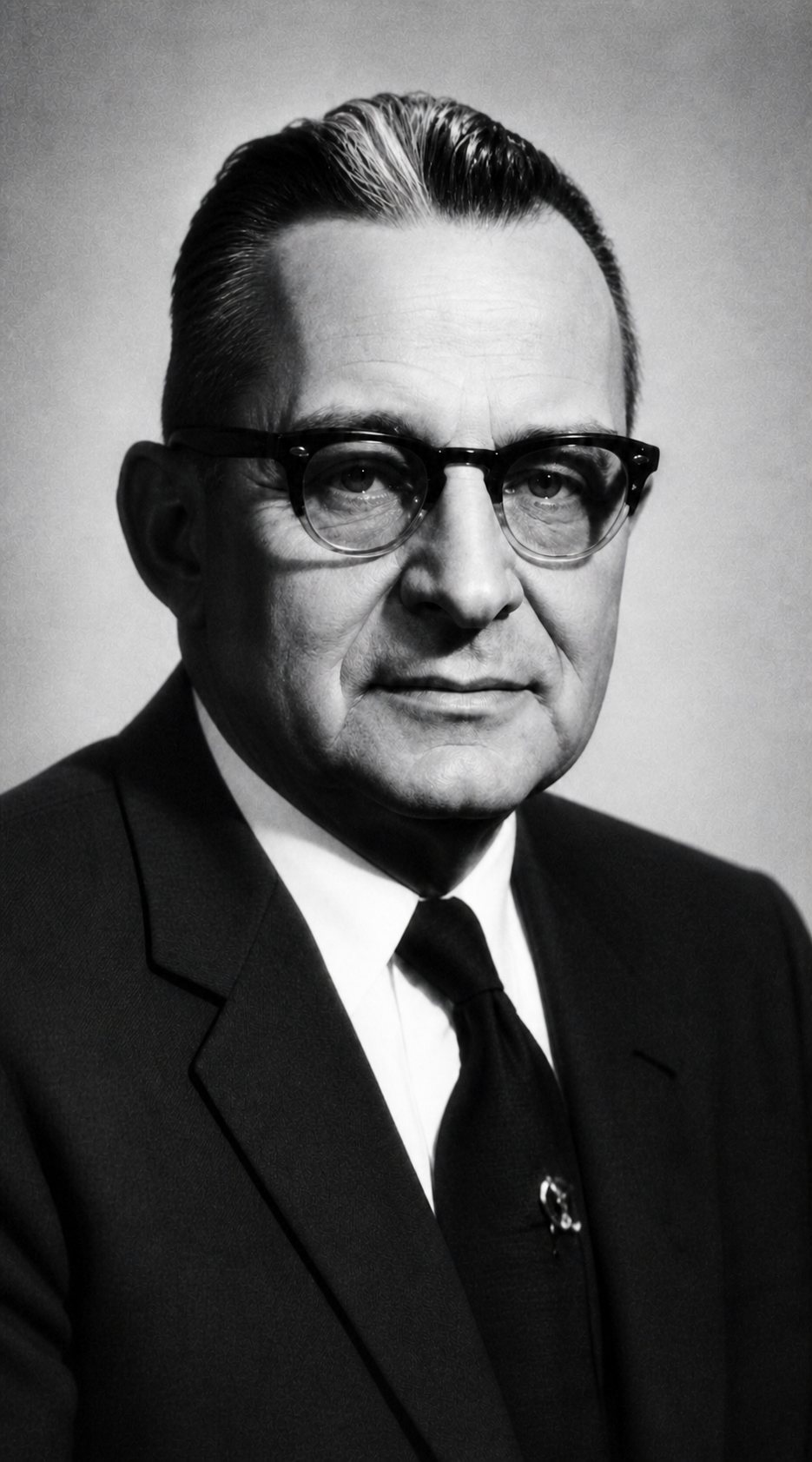
David Clair Goodman was born September 18, 1888, in Sinking Valley, Blair County. He later settled in Mount Union and married Ethel May Kyper there on June 19, 1918. They were the parents of Robert C. Goodman and David Kyper Goodman.
In 1914, Goodman established the local plumbing and hardware operation that developed into D.C. Goodman & Sons. His sons later joined him in the business. The company traces its beginning to Goodman’s Mount Union enterprise and continues to serve Central Pennsylvania as a mechanical contractor more than a century later.
Goodman’s interests extended beyond commerce. A 1962 newspaper account introduced him as a well-known Mount Union businessman and historian, documenting his place among the community members who preserved and interpreted the town’s past. Research into the subjects he studied and any surviving historical work remains ongoing.
Goodman died in November 1967 at age seventy-nine and was buried in Mount Union.
Sources: D.C. Goodman & Sons, company history; David Clair Goodman family and vital-record index; “Newton-Wayne Lions Hear David Goodman,” The Daily News, January 25, 1962.
Clinton V. HackmanRefractory Executive and Kistler Founder
Clinton V. Hackman brought experience from Harbison-Walker to the new Mount Union Refractories Company, which he organized with R.P.M. Davis in 1911-12. The plant opened beside the Juniata River with eight kilns and expanded dramatically during World War I. Its later corporate line ran through U.S. Refractories and North American Refractories.
Hackman’s most visible local contribution was Kistler. As company president, he wanted employees to have housing that surpassed conventional brickyard rows. He and Davis engaged nationally known town planner John Nolen and the architectural firm Mann & MacNeille to create the model industrial village begun in 1916. Kistler’s curving plan, central green, varied houses and separation from the plant made it an unusually ambitious company-town project for this region.
The village also embodied the contradictions of its era. Its housing, school, playground, gardens and nursing services offered substantial amenities to a diverse workforce, while company-directed social programs tried to regulate domestic life and press immigrant and African American residents toward contemporary ideas of “Americanization.” Hackman’s legacy is therefore both architectural and social: he helped create a community whose physical plan survives, but within the paternalistic framework of early twentieth-century industrial welfare.
Sources: Library of Congress, Town of Kistler survey; Kim E. Wallace, Brickyard Towns, printed pp. 105 and 108–131
John & Zelda “Deed” HancockHill Valley storekeepers & community fixtures, 1935–2002
John L. Hancock Sr. opened Hancock’s Service Station in Hill Valley on June 1, 1935, when he was nineteen. After he married Zelda McCartney in 1939, the couple operated the business together, supplying groceries, gasoline, general merchandise, treats and everyday necessities to generations of nearby families.
Known affectionately to customers as “Johnny” and “Deed,” the Hancocks kept their neighborhood business open for sixty-seven years. Newspaper coverage described the store as a Hill Valley institution and documented the couple still serving customers seven days a week late in its history.
John also served on the Mount Union Area School District Board of Education and the Union National Bank board, belonged to the Allenport Lions Club and maintained a baseball field on his property for area teams. Together, John and Zelda represent the small family businesses that served as both stores and social centers in Mount Union’s surrounding communities. Visit the Hancock’s Store page →
Sources: The Daily News, February 3, 1999, p. 7, and June 8, 2000, p. 12; John L. Hancock Sr. obituary, The Daily News, November 2002; Hancock family information and photographs supplied for this community-history project.
The McClain Medical FamilyThree Generations of Medicine, Dentistry and Public Service
Three generations of the McClain family became closely associated with health care in Mount Union. Their combined story begins with physician Dr. Charles Arthur Rowe McClain (1875–1966), continues through his son, dentist Frederick Hunter “Fred” McClain Sr. (1896–1978), and reaches a third generation with physician Dr. Fred Hunter McClain Jr. (1920–1989).
Dr. Charles McClain, the son of Samuel Henry and Eveline Shore McClain, practiced medicine in Mount Union and was listed in Pennsylvania’s medical register at 117 West Shirley Street. His son Fred Sr. entered dentistry and also assumed a major wartime public-safety responsibility when he was appointed Huntingdon County’s chief air-raid warden in 1942.
Fred Jr., a 1944 graduate of the University of Pennsylvania School of Medicine, built an approximately forty-year medical career. He served as an administrator of the Mount Union Area Medical Center and as a deputy coroner. A community testimonial honored him at the Mount Union Country Club in 1988. When he died in 1989, his obituary observed that he, his father and his grandfather had provided medical and dental care across nearly nine decades.
The family’s medical connection extended beyond these three generations. Dr. Charles McClain’s sister, Priscilla Belle McClain Cunningham, was the mother of physician Dr. Merrill D. Cunningham. Cunningham was therefore Dr. Charles’s nephew and Fred Sr.’s first cousin. His separate profile above preserves that relationship from both sides of the family history.
Sources: Dr. Charles Arthur Rowe McClain memorial and family record; Frederick Hunter McClain Sr. memorial and family record; Dr. Fred Hunter McClain Jr. memorial and obituary; Medical Register of Pennsylvania (1947); The Daily News, April 18, 1988, p. 9; The Daily News, September 3, 1942
Carl Joseph “Spug” Peduzzi1904–1991 · Businessman, Athlete and Civic Leader · Sports Hall of Fame, 1998
Born in Youngstown, Ohio, on May 12, 1904, Carl Peduzzi was the son of T.C. and Lena Cerasa Peduzzi and grew up in the family whose landmark confectionery stood at Jefferson and Shirley streets. He graduated from Mount Union High School in 1922 after establishing a Mount Union League basketball scoring record that stood for 39 years.
Peduzzi graduated from Gettysburg College in 1927, where contemporary accounts called him “Spug” and identified him as captain of the Orange and Blue basketball team. He remained in Gettysburg for nine years as assistant manager of the Hotel Gettysburg before returning home. On April 1, 1937, he became proprietor of Peduzzi’s Confectionery Store, the family soda fountain, lunch counter and community gathering place that he continued to operate until his death.
His civic service reached across Mount Union. Peduzzi was an honorary member of the Mount Union Fire Company, a charter member of the Mount Union Lions Club, a member of the Chamber of Commerce and chairman of the board of directors of Penn Central National Bank’s Mount Union branch. A longtime Knight of Columbus and member of St. Catherine’s Roman Catholic Church, he received the local council’s Citizen of the Year Award in 1985. He also contributed a March 1989 oral-history interview to the federal Historic American Buildings Survey study of America’s refractory company towns.
Peduzzi died at his Jefferson and Shirley streets home on August 4, 1991, at age 87, and was buried in St. Catherine’s Cemetery in Shirleysburg. His life connected Mount Union’s immigrant-built commercial district, school athletics, downtown social life and civic institutions across most of the twentieth century. The Huntingdon County Sports Hall of Fame inducted him with its inaugural class in 1998. Read the complete Peduzzi’s Soda and Lunch history →
Sources: The Daily News, August 5, 1991, p. 2; Library of Congress, Refractories Company Towns; Mount Union Historic District description
Bruce Welington “B.W.” Reeder1887–1968 · Hardware Merchant and Community Figure
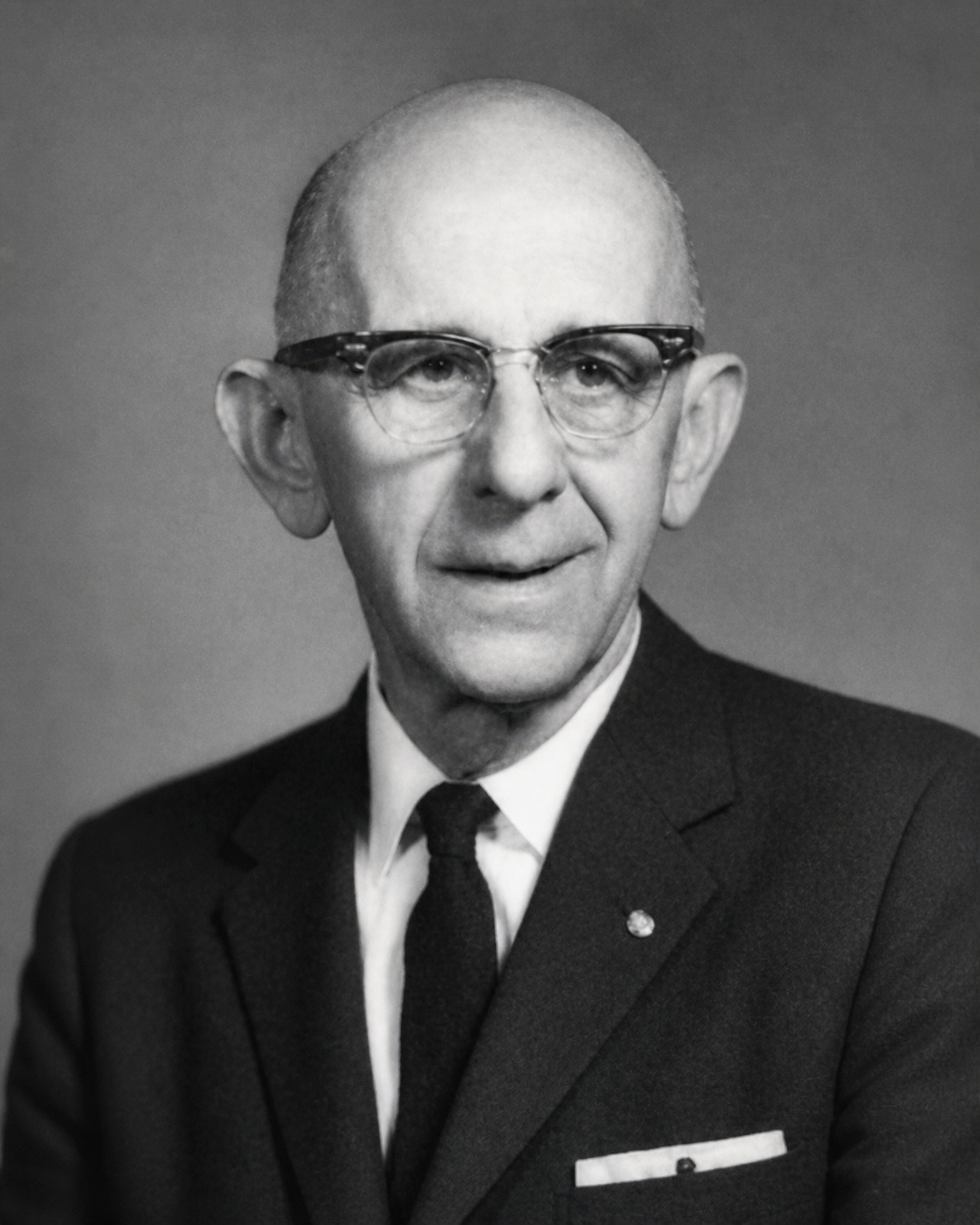
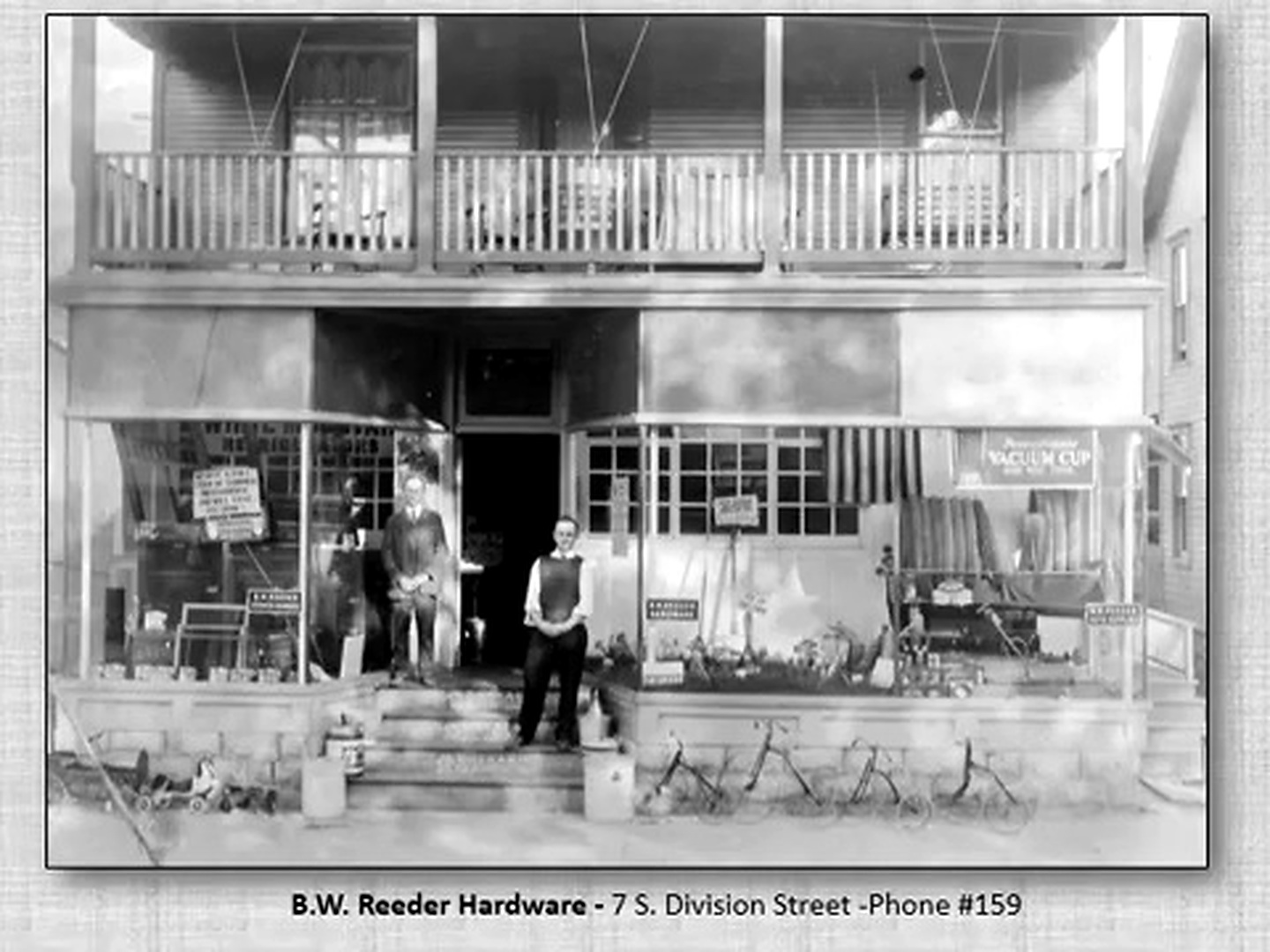
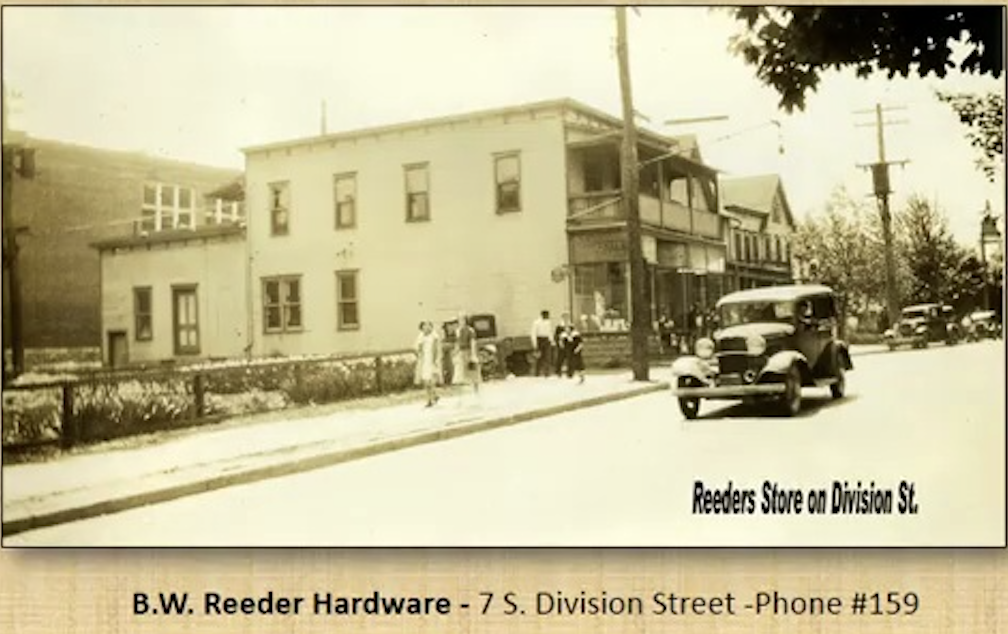
Store photographs courtesy of the Bryan Donaldson Collection.
Bruce Welington Reeder was born June 15, 1887, at Blairs Mills, a son of Martin Luther and Isabell Jones Reeder. A federal World War I draft-registration index records his middle name as “Welington.” A 1959 business retrospective also described him as a native of Shade Valley.
At age twenty-two, Reeder purchased O.E. Harrison’s Mount Union tinsmithing and plumbing business for $750 on May 11, 1909. Harrison had also sold paints, oils and varnishes, giving Reeder the foundation for a general hardware enterprise. A later local-history account gives the purchase date as May 10, a one-day difference that remains unresolved.
Reeder constructed a new store in 1913 at 7 South Division Street and moved the business from Harrison’s former location. He acquired the adjoining property in 1940, doubling the store’s area. By its fiftieth anniversary in 1959, B.W. Reeder Hardware had grown in three principal stages while remaining at its 1913 location.
The business became a family enterprise. Max P. Reeder joined his father as a partner in 1939, followed by Glenn L. Reeder in 1940. Bruce retired as the firm’s active head in 1959, although contemporary coverage said he continued to maintain an active role. His sons subsequently conducted the business, extending the Reeder name in Mount Union commerce.
Reeder was also closely identified with Mount Union’s Methodist community. A 1963 church tribute called him “Mr. Methodist of Mount Union,” reflecting service that reached beyond his store. He died May 14, 1968, at J.C. Blair Memorial Hospital after a five-day illness. Funeral services were held at Clark Funeral Home, and he was buried in Mount Union I.O.O.F. Cemetery.
Sources: “Reeder Hardware Marks Its 50th Anniversary,” The Daily News, May 7, 1959, p. 17; “Mount Union Businessman Dies Tuesday,” The Daily News, May 15, 1968, p. 1; The Daily News, October 17, 1963, “Mr. Methodist of Mount Union” tribute; Bruce Welington Reeder, World War I draft-registration record; Bruce W. Reeder cemetery memorial; Bryan Donaldson Collection; submitted local-history photographs.
The Shapiro FamilyRetail, Entertainment, Hospitality and Civic Leadership
The Shapiro family helped shape Mount Union’s commercial and social life through furniture sales, theater operation and roadside hospitality. The family enterprise began with Joseph S. Shapiro (1875–1936), whose sons Joseph Cook Shapiro (1905–1987) and Robert Oliver Shapiro (1908–1966) later continued and expanded the business.
A 1914 construction notice identified the elder Joseph Shapiro as the developer of a three-story Shirley Street building designed by Huntingdon architect J. Herbert Hall to contain a theater, store and apartments. The Shapiro Theatre opened on January 30, 1917. A contemporary account reported approximately 1,000 seats, including eight boxes and eight loges, and a stage equipped for traveling productions as well as motion pictures. Later theater references list a smaller capacity of about 600, apparently reflecting subsequent alterations.
After their father’s death, Joseph Cook and Robert Oliver operated the furniture store and theaters as partners in J. S. Shapiro and Sons. Joseph, a 1924 Mount Union High School graduate who pursued additional college and business-school study, built and operated Motel 22 in 1947 and added its restaurant and swimming pool in 1950. He also chaired Huntingdon County’s World War II bond drive, helped organize the Mount Union Rotary Club and served local banking, charitable, Masonic and Methodist organizations.
Robert studied at Mount Union High School, Gettysburg Academy, Perkiomen Academy and the Advertising School in Chicago. He served with the U.S. Army’s 67th Quartermaster Company during World War II and belonged to the American Legion, Captain Jack Lions Club and Mount Union First Methodist Church. He assumed control of the family furniture-store and theater operation in 1964 and remained a prominent Mount Union businessman until his death in 1966.
The Shapiro Theatre survived a serious 1957 fire and reopened after an approximately $25,000 rebuilding project. It closed in 1970, later served other uses and was demolished in 1997. Its long presence on Shirley Street, together with the family store and Motel 22, made the Shapiro name part of Mount Union’s transition from an industrial boomtown to an automobile-era commercial center.
Sources: Robert Oliver Shapiro memorial and transcribed Daily News obituary; Joseph Cook Shapiro memorial and transcribed obituary; Cinema Treasures, Shapiro Theatre; Mount Union Historic District documentation; Huntingdon County Heritage Plan (2015); Mount Union Times, February 2, 1917, p. 4
Postwar Community and Modern Achievement
These civil-rights leaders, entrepreneurs, veterans, educators, musicians and athletes brought distinction to Mount Union through public service, business and professional achievement in the postwar era and beyond.
Joseph F. Barrett1925–1999 · Decorated Marine, Educator, Grocer and Civic Leader
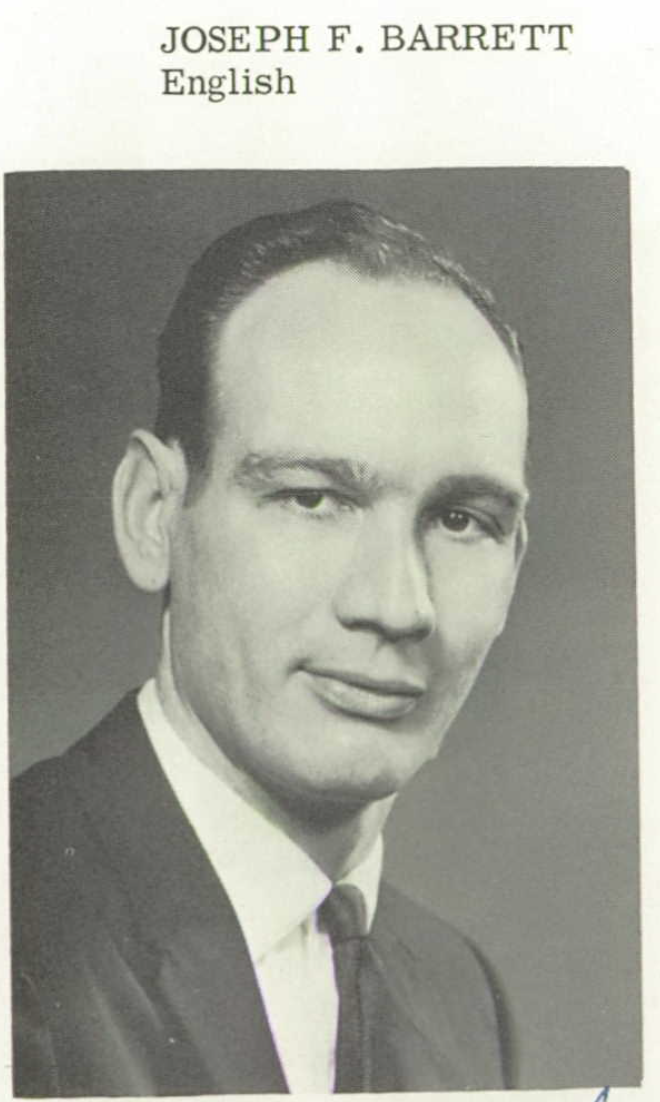
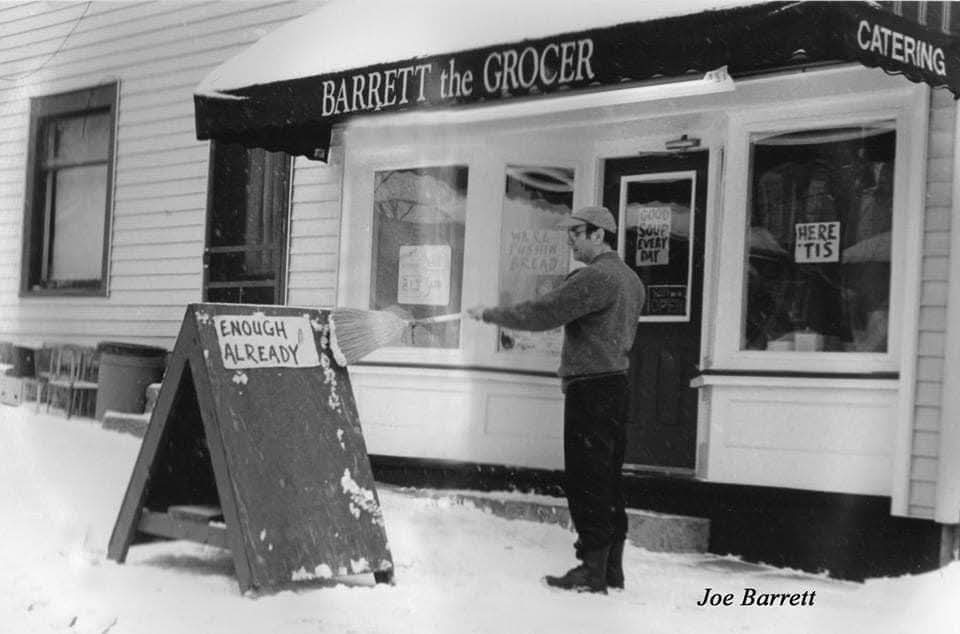
Joseph Frye Barrett was born January 6, 1925, in State College to Joseph T. and Edna Frye Barrett. He made Mount Union his home and graduated from Mount Union High School with the Class of 1942. His wartime registration card records him at 214 South Jefferson Street and employed at Middletown Airport before entering military service.
Barrett enlisted in the United States Marine Corps on February 26, 1943, and trained at Parris Island, South Carolina. By January 1945 he was serving in the South Pacific as an aerial gunner and had been promoted to sergeant. His obituary records participation in the South Pacific Theater of Operations and three Air Medals before his honorable discharge in 1945.
After the war, Barrett married Mount Union High School graduate Maxine E. Yocum on August 23, 1946. Their three children were Patricia L. Summers, Joseph C. Barrett and Cathy Barrett Sroka. At the time of the marriage, Barrett was studying at Dickinson College in Carlisle. He graduated in 1950 with a bachelor’s degree in psychology, earned his teaching certification from Juniata College and later completed graduate work at Penn State University.
Barrett taught English at Chief Logan High School, later Indian Valley High School, for fourteen years before retiring in 1976. He and Maxine also owned and operated Barrett’s Grocery in Mount Union for thirty-eight years.
Barrett worked at Creation festivals from the event’s late-1970s beginnings through the 1980s, supplying food and necessities to the temporary communities that formed around the gatherings. Newspaper coverage from 1985 preserves one especially detailed snapshot of that longer involvement: at Creation on Agape Farm, he stocked a festival grocery stand, invested more than $23,000 in inventory and worked with two helpers from early morning until around midnight. The article called him “Barrett the Grocer,” but his service to Creation extended well beyond that single year.
His civic service included membership in American Legion Post 107, the Mount Union Lions Club and the Rotary Club, as well as service on the Mount Union Area School Board. He belonged to First United Methodist Church and was remembered as an avid baseball fan. Barrett died October 31, 1999, at age seventy-four and was buried in Mount Union Cemetery.
Explore the history of the Creation Festival at Agape Farm →
Sources: The Daily News, Joseph F. Barrett obituary, November 2, 1999, p. 2; The Daily News, “Maxine Yocum Is Bride of Joseph Barrett,” August 29, 1946, p. 10; The Daily News, “Joseph Barrett Has Rank of Sergeant,” January 31, 1945; The Daily News, “Barrett the Grocer,” June 27, 1985, p. 3; Joseph Frye Barrett World War II registration card; Chief Logan High School yearbook portrait; Barrett family information and storefront photograph supplied to BrickTownPA.
Dr. Charles BrooksPhysician and Black Medical Pioneer
Charles Brooks was a Virginia native who earned his medical degree from Howard University in Washington, D.C., in 1910. He first established a practice in Frederick, Maryland, and later relocated to Baltimore as that practice grew. After moving to Altoona, he settled permanently in Mount Union in 1936.
Brooks practiced from an office attached to his home at 322 North Jefferson Street. He was Mount Union’s only Black physician serving the town’s Black community, but the range of care remembered by his family—from treating injuries to delivering babies—shows that his work reached across the community’s everyday medical needs.
He continued practicing in Mount Union until his death in May 1952. J.C. Blair Memorial Hospital later included Brooks among the area doctors honored in its Hall of Fame, recognizing a career that joined professional achievement with service during an era when Black physicians faced substantial barriers to medical education and practice.
Brooks and his wife adopted her niece Jane when the child was eighteen months old. Jane later married Donald Winfree Sr. and became a pioneer in her own right as the first Black teller at Penn Central National Bank in Huntingdon and Mount Union. The Brooks home remained in the family and was later occupied by great-niece Carol Winfree Jackson, whose family history supplied the newspaper’s account.
Source: Rebecca Berda, “MU residents reflect those who made history,” The Daily News, February 28, 2015
J. Richard BurkholderBand Director and Multigenerational Educational Legacy
Explore the full biography and photograph collection →
J. Richard Burkholder helped build the musical tradition of Mount Union’s schools. A February 1943 newspaper column reported that he had supervised music in the Mount Union schools for nine years, independently placing the beginning of his local music service in 1934. The same report recorded that he earned his pilot wings on Thanksgiving Day 1942 at Mount Union Airport, where Brinton H. Hamman and flight instructor Lester Gashaw presented them. Newspaper coverage later confirms that J. Richard was directing the Mount Union High School band by 1946.
His bands represented the community publicly. In August 1946, the Altoona Mirror reported that Mount Union’s band made a strong showing at Chambersburg’s Old Home Week parade while debuting blue-and-gold uniforms donated by Simpson-Hunt American Legion Post. Burkholder’s influence can also be seen through former student Martha Jean “Martye” Awkerman, who advanced from Mount Union to first-chair solo cornet honors at the Pennsylvania Schools State Band Competition and a scholarship to the Cincinnati Conservatory of Music.
In family recollections shared with BrickTownPA in October 2026, his granddaughter Gretchen Burkholder Crouse dates his teaching career to 1934–1974 and describes generations of educators and musicians. Her account includes E. Christine Chilcote Burkholder’s teaching from 1932 to 1964, Mary Alice Burkholder’s service from 1972 to 2004, and Gretchen’s own start in 2004. Read Gretchen’s family history →
View J. Richard Burkholder in Educators Through the Years →
Sources: The Daily News, February 19, 1943, p. 12; Altoona Mirror, August 14, 1946, p. 12; Martha Jean “Martye” Awkerman biography; Gretchen Burkholder Crouse, public statement to the Mount Union Area School Board, community-provided transcript; J. Richard Burkholder memorial.
Jeremy CrouseCommunity Organizer, Planet LoveJoy Founder and CHAMP Creator
Jeremy Crouse is the son of Francis and Pamela Crouse. He grew up in Hill Valley with his five brothers and sisters, across from the neighborhood store operated by his grandfather and remembered as Hancock’s. He later made his home in Mount Union with his wife, music educator Gretchen Burkholder Crouse, and their daughter.
Crouse turned a local effort to help children with cancer into one of Huntingdon County’s largest sustained charitable movements. He co-founded the Mount Union nonprofit Planet LoveJoy, which organized benefits for several area children facing serious illnesses in 2012 and 2013. Those children were first known as the “Fab Four” and later the “Spectacular Seven.”
From that work Crouse created CHAMP—Creating Hope and Making Progress—a student-led countywide dance marathon inspired in part by Penn State THON. CHAMP brings together Mount Union and five other Huntingdon County secondary schools, with student captains, school advisers and community volunteers raising money for families confronting cancer and other life-threatening illnesses. Huntingdon County recognized his founding role when commissioners proclaimed March 1, 2019, as CHAMP Day.
By 2025 the organization had raised more than $850,000 and assisted over 110 local families. In its twelfth year, CHAMP crossed the million-dollar threshold: the 2026 campaign raised a record $259,631.54, bringing the reported cumulative total to $1,124,372.94. Mount Union students contributed more than $96,000 to that campaign. The organization reports that its first twelve years supported more than 120 families and engaged more than 5,000 students.
Crouse’s local work has also included helping establish Mount Unity Day, coordinating community cleanups and activities, participating in Mount Union’s strategic revitalization planning and advancing the proposed Mount Union Riverwalk through Planet LoveJoy. At the third Mount Unity celebration in 2014, Planet LoveJoy coordinated the two-day program with Mount Union Little League and other organizations, organized a borough-wide cleanup and dodgeball tournament, and presented its second annual Bricktown Believer awards to community volunteers. Professionally, Crouse advanced at Letterkenny Army Depot from a power-support-system mechanic leader to deputy director of supply and transportation. His record links charitable leadership, student service and community development across Mount Union and Huntingdon County.
Sources: U.S. Army, “Letterkenny employee’s initiative benefits local children”; CHAMP Huntingdon County; Mount Union Area School District, 2026 CHAMP report; Huntingdon County Commissioners, February 26, 2019 minutes; The Sentinel, July 10, 2013; Huntingdon County Planning Commission, 2016 Annual Report; Rebecca Berdar, “Community comes together: Longtime coach, volunteers honored at Mount Unity Day,” The Daily News, May 5, 2014.
Wilson Robert DeVecchis1917–2010 · Concrete Manufacturer and Industry Leader
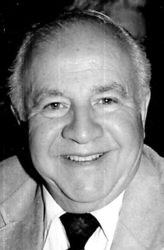
Wilson Robert DeVecchis was born October 18, 1917, in Mount Union to Ettore and Gilda Giardine DeVecchis. His father began the concrete-block enterprise that became one of the town’s important twentieth-century manufacturers. Wilson graduated from Mount Union High School in 1937.
A 1967 company history reported that Wilson entered partnership with his father and brothers Philip and Samuel in 1941. The firm expanded from its early work behind 208 West Poplar Street to a plant at Small and Washington streets, then established operations serving Burnham, McKee and State College. By 1967, the company reported capacity to manufacture 24,000 standard concrete blocks per day.
Wilson became co-owner and president of E. DeVecchis & Sons and helped expand the concrete-products company to four manufacturing plants in central Pennsylvania. He was an original member of the Pennsylvania Concrete Masonry Association, served as its president in 1972–73 and received its Distinguished Service Honorary Member designation. At the association’s twentieth-anniversary gathering in 1989, he was one of five veteran industry representatives invited to speak about its history. He also belonged to Associated Builders and Contractors and the National Concrete Masonry Association.
His service in Mount Union included Borough Council and the Chamber of Commerce. He was a member of the Knights of Columbus and attended St. Catherine of Siena Roman Catholic Church. Outside work, he enjoyed golf at the American Legion Country Club and followed Penn State football.
Wilson married Jean Arlene Stump on August 3, 1937. They celebrated seventy-three years of marriage in 2010 and were the parents of Loretta, Trudy and Tonya. Wilson died December 8, 2010, at age ninety-three and was buried in Saint Catherine Cemetery in Shirleysburg. His career helped carry the company founded by his immigrant father from a small Mount Union operation into a regional building-materials enterprise. Read the documented E. DeVecchis & Sons history →
Sources: The Daily News, June 6, 1967, E. DeVecchis & Sons company feature; Wilson Robert DeVecchis memorial and transcribed Lewistown Sentinel obituary, December 9, 2010; Masonry Magazine, December 1989, Pennsylvania Concrete Masonry Association twentieth-anniversary report; submitted portrait.
James DiCosimo1930–2003 · County Commissioner, Veteran and Bypass Namesake
James DiCosimo was born in Mount Union on February 17, 1930, to Angelo and Antoinette Corda DiCosimo. He served in the United States Army during the Korean War and attained the rank of corporal. In 1957 he married Arlene Ruth Hollibaugh.
DiCosimo entered Huntingdon County government when he was appointed county commissioner on February 13, 1969. A county chronology compiled from courthouse records lists him with the commissioners elected in both 1972 and 1976, documenting public service that continued through the 1970s.
Pennsylvania formally preserved his name on the local landscape in 1998. Act 140 designated the Mount Union Bypass—from Juniata Avenue in Allenport north to U.S. Route 22 in Wayne Township—as the James DiCosimo Bypass, placing his name on the principal bypass serving Mount Union and its neighboring communities.
DiCosimo died in Huntingdon on June 19, 2003, at age seventy-three. He is buried in Saint Catherine Cemetery in Shirleysburg.
Sources: The Daily News, March 21, 1989, printed p. 11 (NewspaperArchive image 15), “Complete list of all county commissioners is compiled”; James DiCosimo memorial; Pennsylvania Act 140 of 1998, section 5, James DiCosimo Bypass.
Mike E. Dimoff Sr.1924–2019 · Navy Veteran, Businessman and Local Historian
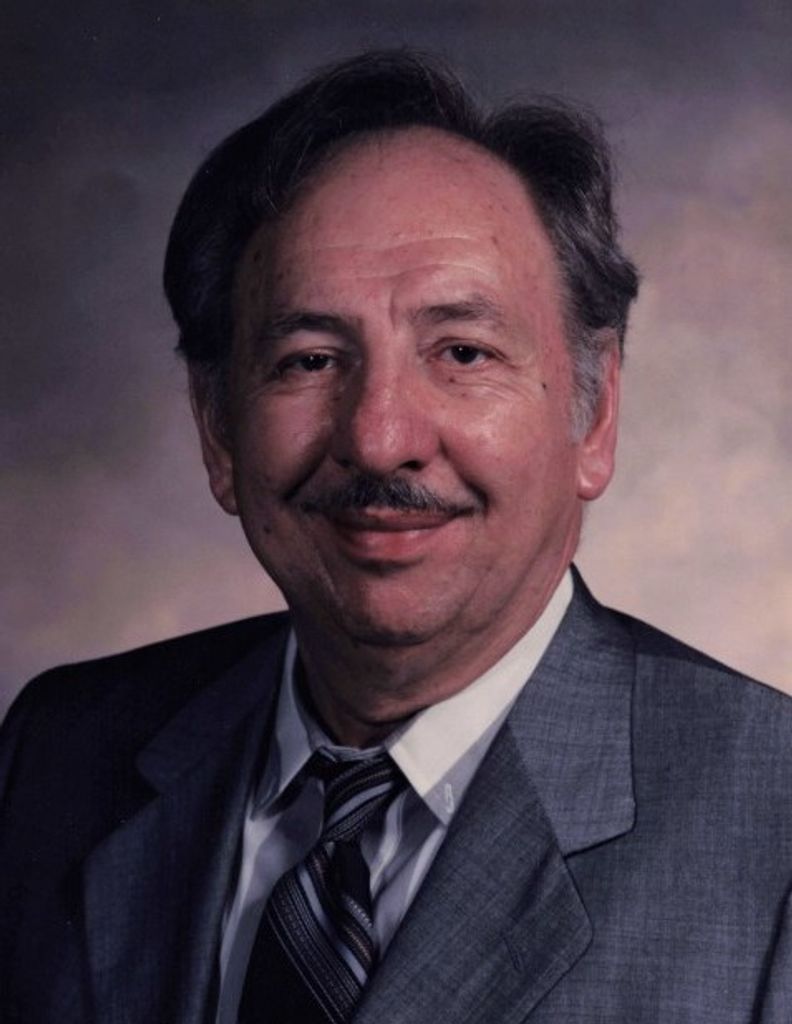
Read the complete documented profile: Mike E. Dimoff Sr.
Mike E. Dimoff Sr. was born in Mount Union on June 5, 1924, to Elia and Angelina Taliff Dimoff. During World War II he served as a gunner’s mate aboard the light cruiser USS Houston (CL-81). Navy muster rolls place him aboard when Japanese aircraft torpedoed the cruiser off Formosa on October 14 and 16, 1944. He advanced to gunner’s mate second class before leaving active service in February 1946.
After the war, Dimoff entered retail management in Berkeley Springs, West Virginia. Records identify him with Dave Saxe’s clothing business by 1948, with Bowman Stores in 1952 and later as vice president and general manager of Saxe’s Corporation. He was also chosen chief of the Berkeley Springs fire department.
Back in Mount Union, Dimoff served veterans’, fraternal, church and historical organizations. His most enduring contribution may be the record he helped preserve: he selected Bicentennial marker sites, participated in a federal oral-history project on the region’s brickyard towns and recorded a two-part interview about the East Broad Top Railroad’s Mount Union operations.
Sources: Anderson Family Funeral Homes obituary; Naval History and Heritage Command, USS Houston; Navy muster rolls and Pennsylvania veterans’ records via Ancestry; Historic American Buildings Survey, Refractories Company Towns; Timber Transfer index.
Charlie FieldsGolf Player and Coach · Sports Hall of Fame, 2016
Charlie Fields, a 1962 graduate of Captain Jack High School, built a long record of achievement in golf as a player, college coach and community mentor. He played for Shippensburg University and served as the team’s captain during his senior year.
Fields later returned to Shippensburg as head golf coach for eight seasons. The Huntingdon County Sports Hall of Fame credited him with mentoring twelve players who went on to earn PGA cards. Fields earned his own PGA card in 1999.
From 1980 through 1999, Fields coached golf at Mount Union. His work with young golfers continued through the American Legion Country Club’s junior golf program, extending his influence beyond school competition and into the wider community.
Fields also compiled a distinguished playing record at the American Legion Country Club. He won club championships in 1979, 1987 and 1991 and captured the Pennsylvania State American Legion Tournament title in both 1997 and 2001.
In 2016, Fields was elected to the Huntingdon County Sports Hall of Fame. He joined his late father, Alton “Bud” Fields, a member of the Hall’s Class of 2004, making them one of the organization’s parent-and-child combinations.
Source: “County Hall of Fame announces Class of 2016,” The Daily News, March 9, 2016.
Donald “Donnie” Fortson Sr.Volunteer Youth Coach and Multigenerational Mentor · Sports Hall of Fame, 2008
Donald “Donnie” Fortson Sr. grew up playing Little League and belonged to Mount Union’s first winning All-Star team in 1958, hitting a home run in its 7–1 victory over Tyrone. He later earned letters in baseball, football and basketball during his Mount Union school years.
Fortson helped establish Mount Union’s Pee Wee Football League in 1976 and began coaching the Indians’ Teener League baseball team in 1980. He continued with the Vikings football team and the Indians for decades; by November 2024, alumni supporting public recognition of his work described a forty-eight-year coaching legacy.
Supporters estimated that Fortson had coached approximately 2,000 young athletes. Tim Sunderland, a former assistant baseball coach under Fortson and later his co-worker at SCI Smithfield, estimated that most Mount Union athletes of his generation had played for Fortson before joining the Trojans. Sunderland said Fortson taught baseball while also teaching young men how to become better people.
Former players and community members emphasized the consistency behind those numbers. Fortson encouraged his athletes to succeed in school and provided stability for children who did not always have it at home. His decades of coaching were voluntary, and he also served as the lead fundraiser for his teams, making the work a sustained act of community service rather than a professional assignment.
Fortson also connected Mount Union’s younger players with the community’s athletic past. For a Mount Union Vikings postseason banquet, he invited his former Captain Jack teammate and Canadian Football Hall of Famer John Helton to speak with players and parents. Helton described the visit as a personal opportunity to support Fortson and the children he coached. Fortson, in turn, called it an emotional occasion that allowed young athletes who knew Helton only from his school photograph to meet him and hear his story. Both men had played on the 1964 Captain Jack Trojans football team.
At Mount Unity Day on May 3, 2014, Mount Union Little League presented Fortson with a Lifetime Achievement Award for helping establish youth sports programs and for thirty-eight years of coaching. The honor included a glass trophy, a gold coach’s whistle and a commemorative banner for the ball fields. The Huntingdon County Sports Hall of Fame inducted Fortson in 2008. He redirected the attention toward his young players and the satisfaction of watching them become productive citizens.
Beginning in April 2023, Fortson’s 1965 classmate Tom Krouse led an alumni campaign to name Mount Union’s football field in his honor. The group returned to the school board in November 2024 with more than 400 supporting signatures from area residents and former students.
In January 2025, the board formally voted not to rename any district building, athletic field, auditorium or other property while the district lacked a naming-rights policy. Board vice president Curt Whitesel said the decision did not necessarily close the question and that a policy might be considered in the future. Krouse pledged to continue the campaign. The debate nevertheless assembled a substantial public record of Fortson’s influence.
Retired teacher and coach Dayton Shugarts remembered knowing Fortson since his days as a young Mount Union football player. The testimony of Shugarts, Sunderland, former players and area residents portrays a coach whose lasting achievement lies in the generations he mentored. See the expanded sports context on Area Notable Sports.
Sources: Rebecca Berdar, “Community comes together: Longtime coach, volunteers honored at Mount Unity Day,” The Daily News, May 5, 2014; Berdar, “MU alumni again propose honoring coach,” November 21, 2024; updated January 3, 2026; Berdar, “MUASB votes on naming facilities,” January 23, 2025; updated February 27, 2026; “A legend lends his support,” undated newspaper clipping supplied to BrickTownPA.
Capt. Joseph S. “Joe” Giacobello1919–2019 · Decorated World War II Officer and Community Servant · Sports Hall of Fame, 2001
Joseph Samuel “Joe” Giacobello was born in Mount Union on June 30, 1919, to Santo and Mary J. Giacobello. He graduated from Mount Union High School in 1938 and attended Shippensburg State Teachers College, where he distinguished himself in football and basketball before being drafted into the United States Army on June 17, 1942.
After infantry training at Camp Pickett and Officer Candidate School at Fort Benning, Giacobello deployed with Company F, 2nd Battalion, 137th Infantry Regiment of the 35th Infantry Division. He arrived in Normandy on July 5, 1944, and entered combat in the hedgerows near Saint-Lô six days later. Wounded during a July 13 assault, he refused medical attention until his patrol had secured its objective, an action for which he received the Silver Star. He received a second Silver Star for establishing a bridgehead under heavy fire on September 11.
At Hellimer, France, on November 21, Giacobello helped stop German armored resistance and knocked out a Panther tank. On December 10 at Sarreguemines, he crossed the Saar River with two enlisted men, assaulted German positions inside a factory and continued fighting until the rest of his company arrived. That action earned him the Distinguished Service Cross, the United States Army’s second-highest decoration for valor. His wartime honors included the Distinguished Service Cross, two Silver Stars, two Purple Hearts and the Combat Infantryman Badge.
Giacobello returned to Mount Union after the war and owned and operated J. S. Giacobello Distributor for many years. His obituary remembers his strong support of Mount Union and the surrounding community, particularly its youth activities and sports. He was a member of St. Catherine of Siena Catholic Church.
He married Helen L. Rohrer in Winchester, Virginia, on October 26, 1948. They had four children—Joan Althouse, Joseph S. Giacobello, James S. Giacobello and Michelle Booher—and ten grandchildren. Helen died in 2013. Giacobello died unexpectedly on February 16, 2019, at age 99 and was buried in Mount Union Cemetery’s Garden of Honor.
In 2019, Pennsylvania designated the Route 747 bridge over the Juniata River as the Captain Joseph S. Giacobello Memorial Bridge. The General Assembly cited both his combat record and his service to Mount Union’s veterans and youth. The Huntingdon County Sports Hall of Fame inducted Giacobello in 2001; he was also inducted into the 35th Infantry Division Association Hall of Fame and Shippensburg University’s ROTC Hall of Fame. On November 11, 2022, Hellimer, France, inaugurated a bilingual memorial honoring Giacobello, Private Julian Osborne and the men of Company F who liberated the village on November 21, 1944. The memorial record identifies Giacobello as Company F’s commander and recognizes him and Osborne as the village’s first liberators.
Sources: Joseph Samuel Giacobello memorial and complete transcribed obituary; Pennsylvania Act 59 of 2019, Captain Joseph S. Giacobello Memorial Bridge findings; Military Times Hall of Valor award citations; 35th Infantry Division Association Hall of Fame; American War Memorials Overseas, Hellimer memorial; Shippensburg University News, August 15, 2024.
Robert C. “Bob” Goodman1924–2001 · Businessman, Veteran and Civic Leader
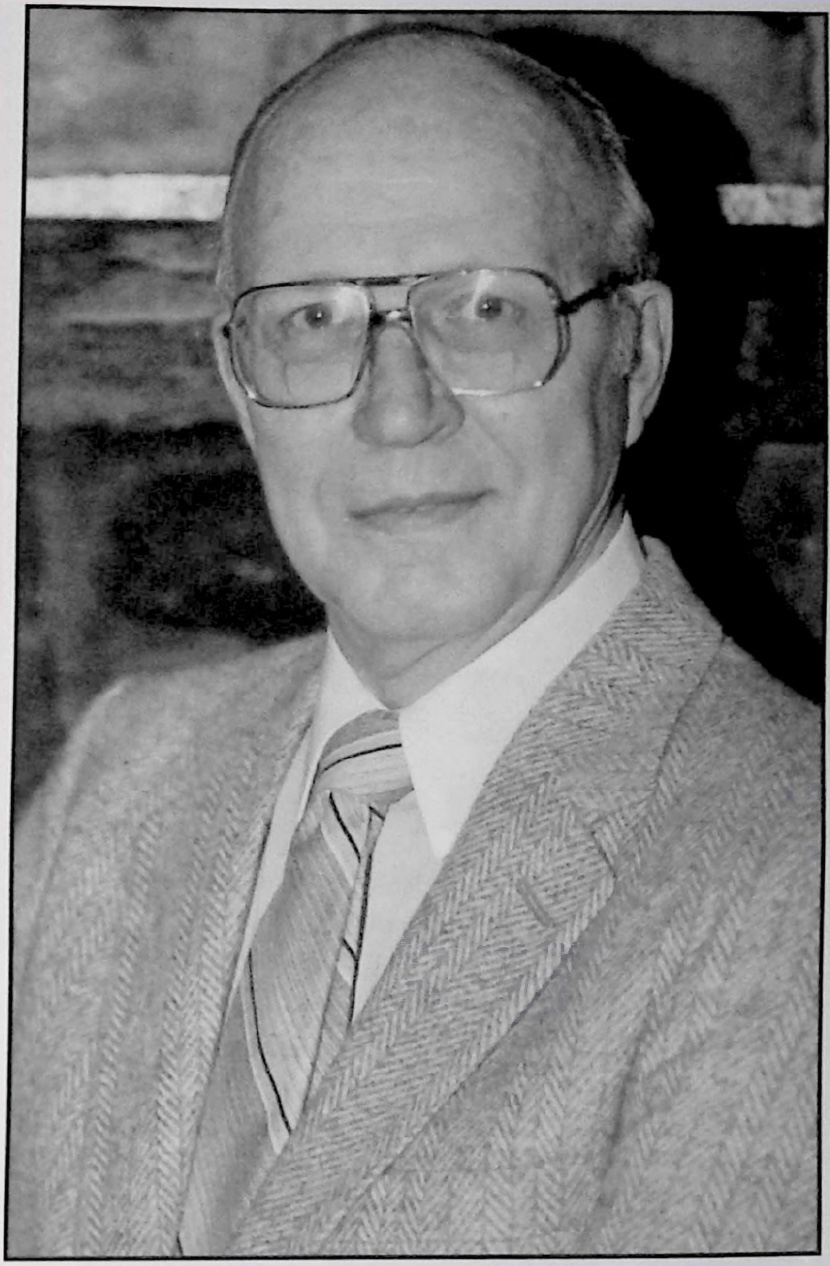
Robert C. “Bob” Goodman was born in Mount Union on October 3, 1924, to David C. and Ethel Kyper Goodman. A 1941 graduate of Mount Union High School, he attended Juniata College before entering the United States Navy during World War II. Goodman served aboard the aircraft carrier USS Cowpens with the Pacific Fleet. Following his honorable discharge, he graduated from Duff’s Business College in Pittsburgh.
In 1948, Goodman joined his father and brother at D.C. Goodman and Sons in Mount Union. He remained with the family business until it closed in 1985. He then served as Mount Union tax collector for twelve years, formally retiring in 1997. His public service also included membership and a term as president of Mount Union Borough Council.
Goodman’s community work extended across many local organizations. He was an honorary member of the Mount Union Volunteer Fire Company, cubmaster of Pack 76, a member of the Mount Union Area Historical Society, a life member of VFW Post 5754 and a member of American Legion Post 107. His obituary credits him with helping form and organize the Mount Union Area Alumni Association. It also states that he was responsible for the design and construction of the Mount Union Youth Baseball Park and served as the youth-baseball organization’s president for many years.
Music was another important part of his community life. Goodman served as secretary and treasurer of the Big Band Sound and played saxophone with the group for more than twenty years. He transcribed musical arrangements and participated in musical workshops and readings at Mount Union Area elementary schools.
A member of Mount Union Presbyterian Church, Goodman served as a deacon, elder and trustee. For many years he taught the men’s Sunday school class, worked on church committees and served as a lay speaker. He was also a frequent master of ceremonies for community events and was remembered for his comedic character, “Billy Bob.”
Goodman married Elizabeth S. “Ish” Smyers at Mount Union Presbyterian Church on June 19, 1948. They had three sons—Robert D., Michael C. and Timothy F. Goodman—and six grandchildren.
Goodman died unexpectedly at J.C. Blair Memorial Hospital on March 23, 2001, at age 76. He was buried in Mount Union Cemetery.
Sources: Robert C. Goodman memorial and complete transcribed obituary; The Daily News, February 26, 1987, page 8.
Clayton T. Grice1970–2021 · State Wrestling Champion, Two-Time ACC Champion and Coach · Sports Hall of Fame, 2023
Clayton T. Grice was born in Huntingdon on September 6, 1970, to Ronald “Chuck” Davis and Phyllis Grice. A 1988 graduate of Mount Union Area High School, he became one of the most accomplished wrestlers in Trojan history.
Grice was a three-year starter for coach Dan Brown and compiled a 67–15–1 high-school record with eighteen pins. As a junior, he won the District 6 Class AA championship at 126 pounds and finished the season 26–2–1. His senior season culminated in the 1988 PIAA Class AA 126-pound state championship, secured with an 8–3 decision over Mantle Roth of Benton. Teammate Troy Sunderland also won a state title that year, helping Mount Union finish third in the Class AA team standings. Grice was subsequently named honorable mention on Wrestling USA magazine’s 1988 All-American team.
At North Carolina State University, Grice became a two-time Atlantic Coast Conference champion and a four-time NCAA Division I Championships qualifier. NC State’s conference record book lists his ACC titles at 126 pounds in 1991 and 134 pounds in 1992 and includes him among the program’s multiple conference champions. Contemporary Hall of Fame coverage also credits him as a four-time All-ACC student-athlete and notes that he finished as conference runner-up at 134 pounds in 1992 and 1993.
After college, Grice served an enlistment in the United States Air Force and later worked in automobile sales in the Omaha, Nebraska, area. Wrestling remained central to his life. He coached numerous teams and helped train his sons Gabriel and Garrett, both of whom became Nebraska state champions and nationally recognized wrestlers. The family’s Team Grice program also trained with Olympic wrestlers and Division I coaches and competitors.
Grice was inducted into the District 6 Wrestling Hall of Fame in 2014. In 2023, the Huntingdon County Sports Hall of Fame selected him posthumously for its twenty-fifth induction class, recognizing a career that carried Mount Union wrestling success from the PIAA championship mat to the ACC and NCAA Division I level.
Grice died unexpectedly in Omaha on March 3, 2021, at age fifty. A celebration of his life was held at Riverside Park in Mount Union that September. He was survived by his mother and his sons Cashon, Gabriel and Garrett.
Explore Mount Union wrestling history →
Sources: Jeff Norris, “Huntingdon County’s Sports Hall of Fame to celebrate Class of 2023 inductees,” The Daily News, March 10, 2023; Jeff Norris, “grice,” The Daily News, June 6, 2023; Anderson Family Funeral Homes, Clayton T. Grice obituary; PA-Wrestling.com, Clayton Grice career statistics; NC State Wrestling, ACC record book; The Sentinel, “Mifflin County’s last champ among Hall of Fame inductees,” February 20, 2014.
John Helton Sr. and FamilyHauling, Delivery and Sanitation Entrepreneurs
Beginning with determination and a single truck, John Helton Sr. built one of Bricktown’s notable midcentury family businesses. He and his sons John “Baby John,” Richard and Cletus made deliveries, moved household furnishings and hauled rubbish for Mount Union families and businesses. The enterprise, remembered as John Helton Sr. & Sons, operated from the family home at 78 East Water Street.
Granddaughter Jennette Stennett estimated that the hauling business began during the 1940s. It was a family effort carried on alongside other employment: John Sr. and his wife, Dorthea Mae, worked in custodial service for a State College family and lived in Centre County during the week before returning to Mount Union on weekends. Cletus worked at Letterkenny Army Depot and later as a State College mechanic, while daughters Jean and Helen also shared the hauling work.
The business adapted as the town changed. Richard took the lead after Dorthea Mae’s death in 1968. When a borough ordinance required refuse haulers to use compacting equipment, the cost was beyond the family operation, so the Heltons left trash collection and concentrated on delivery and moving work. The business continued until Richard’s death in the mid-1980s. Before the hauling enterprise, John Sr. had worked in construction and roofing; the family also provided outdoor-privy cleaning services, including at the Huntingdon County Fair.
The Heltons’ community life centered on Mount Hope Baptist Church. Dorthea Mae’s parents, Domer and Bessie Morris, were among the congregation’s founders, and later generations remained active there. The family’s business legacy also continued through descendants, including grandson Brian Stennett Sr., a 1989 Mount Union Area High School graduate who built a nationally recognized career in sales and later operated insurance offices in Centre County.
Source: Rebecca Berda, “MU residents reflect those who made history,” The Daily News, February 28, 2015
John Heltonb. 1947 · Canadian Football Hall of Fame · County Sports Hall of Fame, 1998
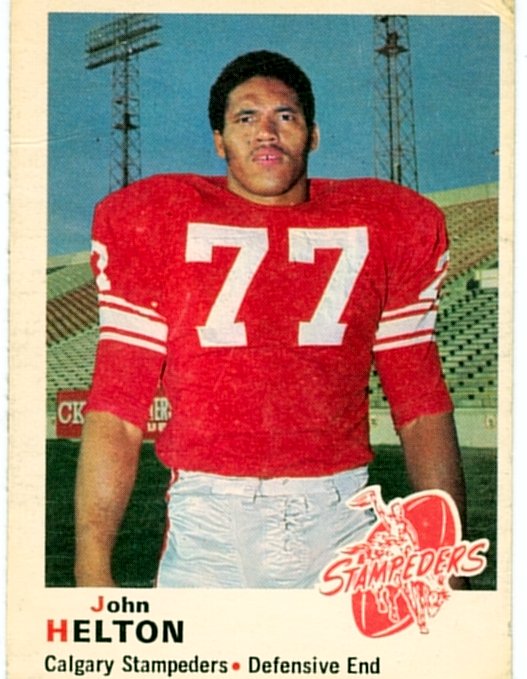
From Captain Jack to Canadian football
John “Biggie” Helton was born in Mount Union on May 23, 1947, and graduated from Captain Jack High School in 1965. A standout in football and wrestling, he went from small-town Pennsylvania to a fourteen-season professional career and a place in the Canadian Football Hall of Fame.
Helton and Don Fortson were teammates on the 1964 Captain Jack Trojans football team, later inducted collectively into the Huntingdon County Sports Hall of Fame. The official 1965 Pennsylvania Big 33 roster lists Helton as representing Mount Union.
Arizona State and the choice of Calgary
At Arizona State University, Helton played offense as a fullback and tight end before moving to the defensive line. The Buffalo Bills selected him in the seventh round of the 1969 NFL/AFL draft, 157th overall, but he began his professional career with the Calgary Stampeders.
In a 2010 Stampeders retrospective, Helton recalled that teammates-to-be Herm Harrison and Bob Lueck helped persuade him to choose Calgary. He also joked about preferring Calgary’s cold winters to the heat, humidity and mosquitoes he remembered from Pennsylvania. The decision led to a lasting connection with the city, extending well beyond his playing days.
A championship and lasting recognition
Helton played for Calgary from 1969 through 1978 and Winnipeg from 1979 through 1982, appearing in 219 CFL games. He earned twelve West Division All-Star selections and nine CFL All-Star selections: 1971–1976, 1978, 1979 and 1982. His regional recognition began as a rookie defensive end in 1969 and continued after his move to defensive tackle.
He helped Calgary win the 1971 Grey Cup, received the league’s Most Outstanding Lineman award in 1972 and was its Most Outstanding Defensive Player in 1974. The Canadian Football Hall of Fame also identifies him as the first recipient of the Norm Fieldgate Trophy, honoring the West’s outstanding defensive player. Helton later credited veteran linemen Don Luzzi and Granville “Granny” Liggins with helping him learn professional defense.
A second chapter in Winnipeg
A contract disagreement preceded Helton’s 1979 move to Winnipeg. Calgary traded him and offensive lineman John Malinosky for running back Richard Crump and defensive back Merv Walker. In a later interview with the Blue Bombers, Helton said he had contacted coach Ray Jauch to express his willingness to play in Winnipeg.
Helton quickly demonstrated that he still belonged among the league’s best. In his first Winnipeg season, he was a CFL All-Star, won the Norm Fieldgate Trophy and received the Tom Pate Memorial Award for sportsmanship and contributions to his team, community and players’ association. He finished his playing career with another CFL All-Star selection in 1982.
Wrestling, retirement and home
Football was not his only connection to Calgary sports. In an interview with Slam Wrestling, Stu Hart named Helton among the athletes he had introduced to professional wrestling. Helton also joined former performers in the ring at the December 15, 1995 celebration of Hart’s eightieth birthday.
Calgary placed Helton on its Wall of Fame in 1985. His Canadian Football Hall of Fame induction followed in 1986, the year recorded by the Hall itself. Other honors include the Alberta Sports Hall of Fame in 1993, the Huntingdon County Sports Hall of Fame’s charter class in 1998 and the Winnipeg Blue Bombers Hall of Fame in 2016. TSN ranked him No. 12 in its 2006 selection of the CFL’s top fifty modern-era players. He returned to Calgary as an assistant coach in 1988 and also worked in investment and life insurance.
Years later, Fortson invited Helton back to speak at a Mount Union Vikings postseason banquet. Helton asked the young players to recognize the sacrifices their parents made for them and recalled that his own parents had driven through the night to see him play at Wisconsin—the only college game they attended—where he scored a touchdown as a tight end. He described family as life’s essential foundation and Mount Union as the best home in which he could have grown up. The appearance also allowed him to thank and support Fortson, his former teammate and the Vikings’ longtime coach. See Football.
Trading-card gallery
These six issues trace Helton’s Calgary and Winnipeg years and a later Grey Cup centennial tribute. Fronts and backs are paired where available. Select an image to examine the full scan.
1970 O-Pee-Chee CFL No. 92
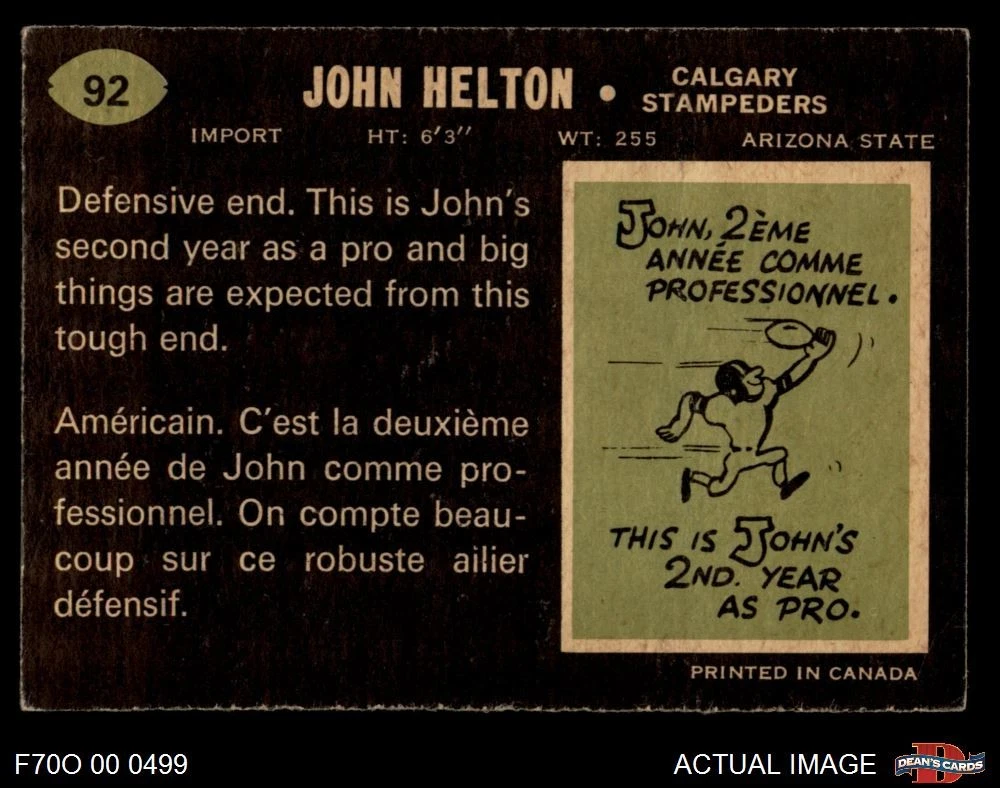
1971 O-Pee-Chee CFL No. 125
1972 O-Pee-Chee CFL No. 57
1972 O-Pee-Chee sticker panel Nos. 49–51
1981 JOGO No. 37
2012 Extreme CFL Grey Cup 100 Years
Card scans from the research collection supplied to BrickTownPA. Original card designs and scan markings are retained. This is a selection of available images, not a complete checklist of every Helton card.
Sources: Big 33, 1965 Pennsylvania roster; Canadian Football Hall of Fame, Class of 1986; Bill Powers, “Stamps Legacy: John Helton,” July 28, 2010; Calgary Stampeders, “Helton Was An All-star Performer,” January 22, 2015; Ed Tait, “Honouring John Helton,” September 20, 2016; Blue Bombers, 2016 Hall of Fame class; Slam Wrestling, Stu Hart interview, part 2; Slam Wrestling, “Helen Hart: A friend’s recollection”; Pro Football Archives; “A legend lends his support,” undated newspaper clipping supplied to BrickTownPA.
Nicholas Michael “Nick” Imperioli1943–2025 · Championship Baseball Coach · Sports Hall of Fame, 2011
Nicholas Michael Imperioli was born in Mount Union on November 5, 1943, to Michael and Anella Ambrosino Imperioli. A 1961 Captain Jack High School graduate, he earned bachelor’s and master’s degrees in English from Shippensburg University. After one year in Hollidaysburg, he returned to spend the rest of his teaching career at Mount Union Area.
From 1973 through 2016, Imperioli built Mount Union baseball into one of Pennsylvania’s most successful small-school programs. His Trojans reached twenty-seven District 6 championship games, won seventeen district titles and advanced to five PIAA finals. Mount Union won state championships in 1988, 1993 and 1995 and finished second twice. The 1988 championship team, which gave Imperioli his first state gold medal, was honored with the Huntingdon County Sports Hall of Fame’s Team Achievement recognition in 2012.
The Huntingdon County Sports Hall of Fame inducted Imperioli in 2011. He retired with a record of 767 wins, 208 losses and three ties. His teams were known for fundamentals, pitching and defense, and his English background inspired the affectionate description “Shakespeare of the diamond.” Even after retiring as head coach, he stayed close to the program as an assistant and mentor. He died on April 13, 2025, leaving a coaching legacy that reached generations of Mount Union players. See Baseball.
Sources: Nicholas Imperioli obituary; The Sentinel, “‘Shakespeare’ of the diamond dies at age 81”; The Sentinel, “Trojans deliver 700th for coach”; Terry Bowser, “Trojans’ 1988 state title team got hot at right time,” The Daily News, June 16, 2012.
C. Arnold McClurePublisher, Historian, Vietnam Veteran and Alumni Association Founder
C. Arnold McClure graduated from Captain Jack Joint High School in 1964. His leadership was already visible as a student: a January 10, 1964 Daily News report named him president of both the Captain Jack band and the Student Council. He helped found the Mount Union alumni association and is recognized on the high school’s Wall of Honor.
McClure enlisted in the Army in 1966, trained for the Army Security Agency and volunteered for Vietnam service, arriving in July 1967. His publisher’s biography dates his Army Security Agency service to 1966–1969 and records his 1971 Penn State bachelor’s degree in secondary social studies education. His career instead took him into sales with 3M and later into business ownership.
In 1980, an opportunity to become a central Pennsylvania 3M dealer led to Centre Business Products. McClure also founded The Valley Log, the Orbisonia newspaper. In his alumni interview, he credited his wife, Linda, as essential to their business success.
His historical writing includes A History Between the Rivers: The Susquehanna, the Juniata, and the Potomac, 1609–1959. A 2009 bookseller’s description explains that the volume arranges regional events chronologically, drawing on newspapers, personal accounts, government records and earlier histories. The school district’s March 29, 2010 meeting agenda recognized his donation of the book to the high school library. His books also include Little Known Historical Facts of Pennsylvania and the World, published by Xlibris on November 17, 2009. Its subjects range from Pennsylvania sports and industry to frontier life, politics, education and medicine.
McClure maintained his connection to Mount Union through alumni and church work. In May 1992, The Daily News identified him as vice president of the Mount Union Area Schools Alumni Association when he introduced John Sweatlock as its Distinguished Alumnus. The 2006 Yearbook of the Greek Orthodox Archdiocese of America, in its directory of the American Carpatho-Russian Orthodox Diocese, lists Deacon Arnold McClure at Saints Peter and Paul in Mount Union.
His public life also included electoral politics. On March 13, 2006, he announced his candidacy for the Republican nomination in Pennsylvania’s 30th Senate District at the Huntingdon County Courthouse. The official primary returns record 7,097 votes for McClure, placing him third behind John Eichelberger and incumbent Robert Jubelirer; Eichelberger won the nomination. A 2018 court filing identifies McClure as chairman of the Huntingdon County Republican Party.
Sources: Sydnee Harris, “Alumni Spotlight: C. Arnold McClure,” Mount Union Student Journalism, December 20, 2025; Lord Nelson’s Gallery, Spring 2009 newsletter, p. 3; Mount Union Area School District, March 29, 2010 meeting agenda, p. 7; Bruce Reeder, “Arnold McClure President of Capt. Jack Band,” The Daily News, January 10, 1964; The Daily News, May 18, 1992, honor-student dinner report; Xlibris, book details and author biography; Greek Orthodox Archdiocese, 2006 Yearbook, p. 176; George Germann, “C. Arnold McClure formally announces,” The Daily News, March 14, 2006, p. A1; The Pennsylvania Manual, 2007, official 2006 primary results, p. 7-9; March 5, 2018 court filing, intervenor biography, p. 9.
Willie MortonMerchant Mariner, Service-Station Owner and Entrepreneur
Willie Morton was born in Milton, North Carolina, to Fletcher Sr. and Daisy Morton. The family moved north when Mount Union’s brickyards and other industries offered employment; Fletcher worked in the brickyards, and the family made its home on Walnut Street. All five Morton sons served their country, with Willie serving in the United States Merchant Marine.
Morton began in business with a small neighborhood store in a house at Filbert and Washington streets, where his merchandise included Ka-Vee Ice Cream from Belleville. In the late 1930s or early 1940s, he opened Morton’s Service Station at North Jefferson and Walnut streets, on the later site of Tuscarora Intermediate Unit 11’s offices. Selling Texaco products and offering U-Haul rentals, it was the first—and, as of the newspaper’s 2015 account, the only—automotive service station in Mount Union operated by an African American.
Willie’s brothers Elvis and Fletcher worked with him, and the business remained in operation into the 1970s. Morton expanded the property with a custard stand whose pinball machines and convenient location made it a popular gathering place for high-school students and employees of the nearby sewing factory. In a town without a community center, the stand served an important social role as well as a commercial one.
Entrepreneurship extended through the Morton family: Willie’s sister Jane operated a Harrisburg beauty shop, and his elder daughter Martha sold records. Willie was married first to Charlotte, with whom he had two sons and a daughter, and later to Violet. His several businesses transformed a modest beginning into decades of visible Black enterprise in Mount Union.
Source: Rebecca Berda, “MU residents reflect those who made history,” The Daily News, February 28, 2015
Charles J. “Buckwheat” Secrest1935–2019 · Professional Baseball · Sports Hall of Fame, 1998
Charles Jackson “Buckwheat” Secrest was born in Mount Union on January 9, 1935, to Jackson L. and Bessie F. Arnold Secrest. A 1954 Captain Jack High School graduate, he earned letters in three sports and became widely known in the community for his athletic ability. Baseball-Reference records him as a 5-foot-9, 170-pound outfielder who batted and threw left-handed.
Secrest entered professional baseball at age nineteen in 1954, appearing briefly with the Ada Herefords in the Baltimore Orioles’ system before spending much of his career in the Kansas City Athletics’ minor-league organization. With the Seminole Oilers in 1955, he batted .307, scored 102 runs, collected 153 hits, 29 doubles and 12 triples, drove in 88 runs and walked 107 times.
His breakthrough came with the Double-A Little Rock Travelers in 1958. Secrest batted .281 across 154 games, recording 160 hits, 82 runs, 33 doubles, eight triples, 21 home runs and 99 runs batted in. A contemporary Oregon report called him one of the league’s fastest players and described him as a challenger for Portland’s center-field job. He advanced to the Triple-A Portland Beavers in 1959 and batted .287 in 90 games.
Topps issued a 1959 baseball card, No. 140, for “Charlie Secrest.” He reached baseball’s highest minor-league level but did not appear in a major-league regular-season game. Across ten professional seasons from 1954 through 1963, he played 992 minor-league games and recorded 967 hits, 172 doubles, 56 triples, 49 home runs, 478 runs batted in and a .282 batting average.
The Huntingdon County Sports Hall of Fame inducted Secrest with its inaugural class in 1998. After baseball, he worked at Standard Steel and retired in 1998 as a crane operator. He and Nancy Hancock Secrest were married for 63 years and had two children, Rodney M. Secrest and Lori Secrest Artman. He belonged to Sugar Run Church of the Brethren and enjoyed woodworking and antiques. Secrest died on October 10, 2019, at age 84. See Baseball.
Sources: Henderson-Bohn Funeral Home obituary; Baseball-Reference minor-league register; Herald and News, March 31, 1959; PSA record for 1959 Topps No. 140.
Carl Lloyd Shoemaker1916–1984 · Beacon Lodge Founder and Advocate for People with Visual Impairments
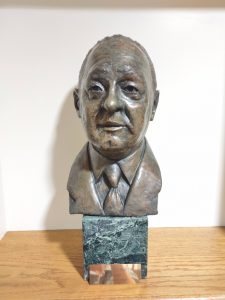
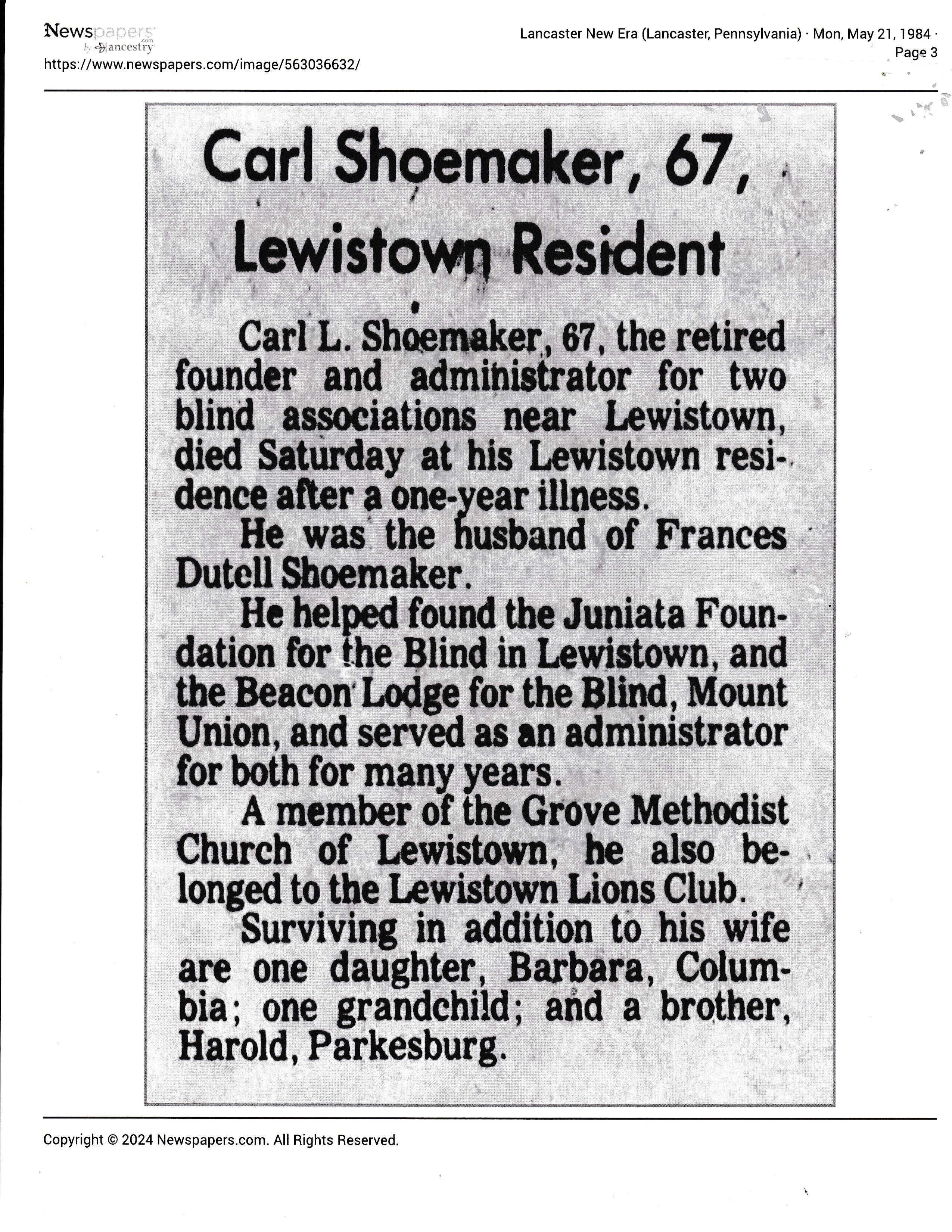
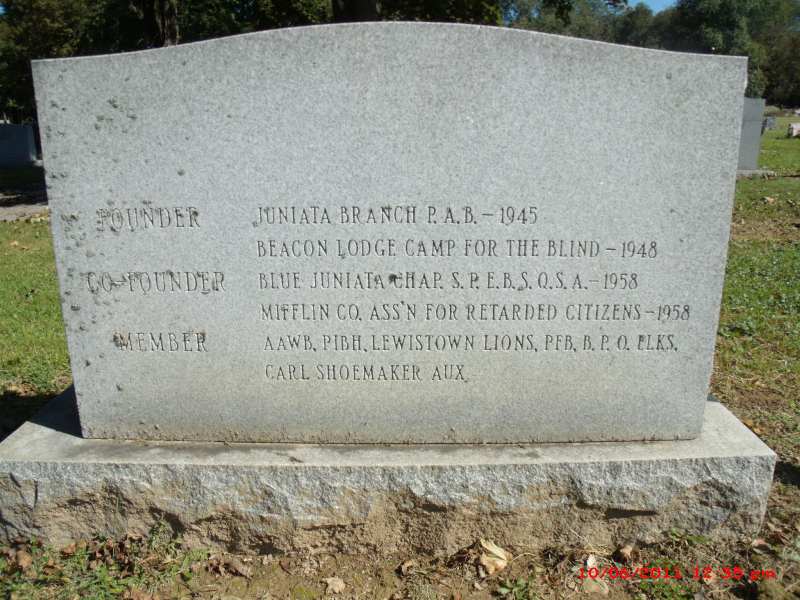
Carl Lloyd Shoemaker was born May 23, 1916, in Parkesburg, Chester County, Pennsylvania, according to the supplied Ancestry family-tree record. Later based in Lewistown, he helped make the Mount Union area a destination for blind children and adults seeking recreation and companionship. Himself blind, he founded the camp that became Pennsylvania Lions Beacon Lodge. His work connected practical services for people with vision loss to a belief that outdoor experiences should be available to them as well.
In February 1946, Shoemaker became the first executive director of the Juniata Foundation for the Blind, the organization now known as NuVisions Center. The foundation had opened a workshop in Lewistown the previous November, producing goods sold in the community. His leadership there placed him within a regional effort to expand opportunities for blind and visually impaired people.
In 1948, Shoemaker began developing a Pennsylvania summer camp for blind campers. He reviewed approximately sixteen comparable programs around the country, then inspected an available property near Mount Union with a research team. A corporation, Vacations for the Blind, Inc., was established to oversee the purchase and development. According to Beacon Lodge’s institutional history, the first group of blind children attended within the following year.
The camp became known as Beacon Lodge Camp for the Blind in 1953 and Pennsylvania Lions Beacon Lodge Camp in 1994. Its later expansion, supported by Lions Clubs and other volunteers, extended the founding mission to campers with a wider range of disabilities. The story of the grounds and their transformation from the former Blue Springs estate is explored on the Beacon Lodge page.
His obituary identifies him as Carl L. Shoemaker and credits him with helping found both the Juniata Foundation for the Blind and Beacon Lodge, serving as an administrator of both for many years. He belonged to Grove Methodist Church in Lewistown and the Lewistown Lions Club. He died at his Lewistown home on May 19, 1984, after a year-long illness, aged 67. The obituary, published the following Monday, names his wife, Frances Dutell Shoemaker; daughter Barbara of Columbia; one grandchild; and brother Harold of Parkesburg as survivors.
Shoemaker’s name remains part of the institution through the Carl Shoemaker Fellowship, a recognition program that supports the camp through donations made in someone’s honor or memory. His local legacy is an enduring place where access to recreation, friendship and the outdoors is central to the camp experience.
Obituary and submitted records: “Carl Shoemaker, 67, Lewistown Resident,” Lancaster New Era, May 21, 1984, p. 3 (newspaper page); submitted photographs of the bust and memorial inscription; and an Ancestry family-tree screenshot supplied September 3, 2026, identifying his full name, birth date and birthplace. The underlying birth record has not been examined. The obituary reports death on Saturday, establishing May 19 as the date; the supplied birth date is consistent with his reported age of 67.
Sources: NuVisions Center, organizational history; Beacon Lodge, “The Birth of Beacon Lodge”; Lions District 14-C newsletter, January 2023, Beacon Lodge anniversary history; Beacon Lodge, Carl Shoemaker Fellowship.
John Anthony Sweatlock1920–2005 · Football Player, Navy Veteran and Educator
Read the illustrated story: John Anthony Sweatlock
John Anthony Sweatlock was born in Mount Union in January 1920, the son of Andrew Sweatlock and Madeline Ocel. A 1939 Mount Union High School graduate, he distinguished himself in football and basketball. He played center on Coach Clyde Bowser’s 1937 Trojans, who finished 8–2. A 1967 newspaper retrospective recalled that a knee injury forced him out of the team’s 13–6 victory over Hollidaysburg, with halfback Adam Mitchell moving to center in his place.
Sweatlock continued his education and football career at Muhlenberg College in Allentown. A July 1946 hometown report described him as an All-Conference center in both of his prewar playing seasons and credited him with three scores on interceptions and six blocked extra-point attempts in 1941. He left college after his third year to join the Navy on April 23, 1942, and served aboard the USS Ticonderoga during World War II. He married Mildred May Davidson in Allentown on February 27, 1945.
After three and a half years of Navy service, Sweatlock returned to his education and football. Local newspapers announced his signing with the Bethlehem Bulldogs in July 1946. The following spring, The Record identified him as the center and captain of the Muhlenberg team that defeated St. Bonaventure in the Tobacco Bowl at Lexington, Kentucky, on December 14, 1946, by a score of 26–25, as confirmed by NCAA bowl records. Pro Football Archives also records one appearance with the Bloomfield Cardinals of the American Football League in 1947.
In May 1947, Ramsey High School in New Jersey selected Sweatlock as its football coach and athletic director. His career there included teaching and coaching football, track and wrestling. He moved to Lehigh Acres, Florida, in 1984, but retained his connection to Mount Union. In 1992, the Mount Union Area Schools Alumni Association named him its Distinguished Alumnus. Speaking at the school district’s academic achievement banquet, he congratulated students and encouraged them to continue their education and become role models.
Building Ramsey’s football program
His first four Ramsey seasons produced a documented 21–14–1 record: 4–6 in 1947, 5–3–1 in 1948, 7–2 in 1949 and 5–3 in 1950. This is a four-season total, not his complete career coaching record. The first three seasons are recorded in a December 4, 1949 newspaper feature; the 1950 results appear in Ramsey’s 1951 yearbook.
After the 7–2 season in 1949, The Ridgewood News named Sweatlock its Coach of the Year. The award was presented at Ramsey’s December 3 football banquet. A newspaper headline summed up the program’s progress: “Sweatlock Built Rams Into Power.” This was the newspaper’s award, rather than a statewide or national title.
Coaching sources: The Sunday News, December 4, 1949, printed p. 60; Ramsey High School yearbook, 1951, football season account. Bowl date: NCAA bowl records; these correct the New Year’s Day reference in the 1947 newspaper report.
Sweatlock died in Lehigh Acres on August 25, 2005, at age 85. His life carried him from Trojan athletics to college football, wartime service and a career guiding young people. See Mount Union football history.
Sources: The Daily News, October 2, 1942, “Our Men in Service”; Nick Imperioli, “Best Grid Records Were 1937–1964,” The Daily News, June 6, 1967, special edition, printed p. 16; Mount Union Times, July 4, 1946, p. 2; Pennsylvania marriage record, February 27, 1945, via Ancestry; The Record, May 19, 1947, p. 14; Pro Football Archives player record; Toni Hancock, “Mount Union honor students feted at dinner,” The Daily News, May 18, 1992, printed p. 15; News-Press, August 28, 2005, obituary.
Birth-date note: His 1941 draft registration gives January 16, 1920; the Social Security Applications and Claims Index gives January 15. This profile uses January 1920 pending a birth record.
John J. Trice Jr.1921–1983 · Civil-Rights Leader and NAACP Chapter President
John J. Trice Jr. was born in Gordonsville, Virginia, on December 4, 1921, to John J. Sr. and Queen Victoria Hughes Trice. He married Eula Mae Grice in Kistler on February 27, 1941, served in the United States Army during World War II and became an active member of Mount Hope Baptist Church.
Trice emerged as one of Mount Union’s pioneering civil-rights advocates. He pressed for fair access to employment and built relationships across racial lines, helping local residents pursue jobs and opportunity. Through Mount Union Community Concern, he recruited Juniata College students for community projects and helped establish a community garden on the north side of town.
He was instrumental in organizing the Huntingdon County chapter of the NAACP in 1967 and served for many years as its president. Trice represented the county at national NAACP conventions, including the organization’s seventieth-anniversary convention in Louisville in 1979, and participated in civil-rights rallies in Washington, D.C., Watts and Pennsylvania. He brought his family to the August 1963 March on Washington and joined a 1979 demonstration at Penn State in which participants formed a human chain around the university president’s home.
Family members remembered that his advocacy rested on friendship and concern for people of every background. Away from organizing, he was an enthusiastic Penn State fan who worked at Nittany Lions sporting events as an usher. Trice died at the Veterans Administration hospital in Altoona on September 11, 1983, at age sixty-one. His daughter Esther succeeded him as president of the county NAACP chapter, extending the family’s civil-rights work into the next generation.
Source: Rebecca Berda, “MU residents reflect those who made history,” The Daily News, February 28, 2015
Elinor H. Wible1924–2012 · Amateur Golf Champion · Sports Hall of Fame, 1998
Elinor Hudson Wible was born in Three Springs on September 2, 1924, the only child of Edgar A. and Mary Cutshall Hudson. She graduated from Saltillo High School in 1941 and earned a bachelor of science degree in business education from Bucknell University in 1945. She taught for one year at Mount Union High School and then for five years at Saltillo High School.
Wible built one of central Pennsylvania’s most accomplished amateur golf records. Across nearly five decades, she won 48 American Legion Country Club championships and 25 Central Counties championships. Her first ALCC title came in 1940, and she won the first 45 consecutively. In 1951, she competed in the Women’s Western Open alongside leading professionals including Patty Berg, Babe Didrikson Zaharias, Louise Suggs and Betsy Rawls. Sports Illustrated recognized her in its “Faces in the Crowd” feature on November 10, 1986, after she won her forty-fifth ALCC championship.
Wible and her husband, Clair C. Wible, owned and operated Wible Bottling Works in Three Springs and the Coca-Cola Bottling Company of Lewistown from 1962 until the businesses were sold in 1984. The couple, married in 1948, had three daughters: Patricia Scott, Marcia Kuhns and Sheryl Flick.
She served First Baptist Church of Three Springs as a youth leader, deaconess, Sunday school teacher and pianist. She was also active in the Three Springs Historical Society and was an honorary member of the Three Springs Volunteer Fire Company. Wible was inducted with the first class of the Huntingdon County Sports Hall of Fame in 1998. She died at her Three Springs home on August 4, 2012, at age 87. The annual Elinor Wible Memorial tournament at ALCC continues her name. See Golf, Track & More.
Sources: The Daily News obituary, August 6, 2012; American Legion Country Club, “Elinor H. Wible”; Altoona Mirror, “Wible was region’s top women’s golfer”; American Legion Country Club, Elinor Wible Memorial Golf Tournament program, 2026 (local archive).
Donald Winfree Sr.1931–2003 · Air Force Veteran and Custom-Drapery Proprietor
Donald Winfree Sr. grew up in Kistler, across the Juniata River from Mount Union. He was one of five children of Charles Winfree, a native of Lynchburg, Virginia, and Helen Morris Winfree. He later served in the United States Air Force.
Winfree developed his knowledge of furnishings through a long retail career. He worked for twenty years at the Ethel Meserve Gift Shop on College Avenue in State College, followed by another ten years at C.H. Miller in Huntingdon. Drawing on those three decades of experience, he opened his own custom-drapery shop at 522 Washington Street in Huntingdon in the early 1970s.
Donald and his wife Jane raised six children: Donald Jr., Carol, Arlene, Connie, April and Shelba. Jane—the adopted daughter of Mount Union physician Dr. Charles Brooks—also broke a local employment barrier as the first Black teller at Penn Central National Bank in Huntingdon and Mount Union. In later years, Mount Union residents knew her as the morning coffee hostess at Sheetz and as a hall monitor at Mount Union Area High School.
Donald Winfree Sr. died in November 2003 at age seventy-two; Jane died in February 2005 at age seventy-one. Their careers connect Kistler and Mount Union’s Black family history to the wider commercial life of Huntingdon and State College.
Source: Rebecca Berda, “MU residents reflect those who made history,” The Daily News, February 28, 2015
Shared Foundational Sources
Each biography includes its own citations. These three works provide broader historical context across multiple eras and profiles.
- J. Simpson Africa, History of Huntingdon and Blair Counties, Pennsylvania (Philadelphia: Louis H. Everts, 1883), PDF scan pp. 429, 434–435, 440–441, 445.
- Charles Howard Welch, History of Mount Union, Shirleysburg and Shirley Township (Mount Union, Pa.: Mount Union Times Office, 1909-1910), printed pp. 558–724.
- Kim E. Wallace, Brickyard Towns: A History of Refractories Industry Communities in South-Central Pennsylvania (National Park Service, 1993), especially printed pp. 98–135; Library of Congress, Town of Kistler survey.