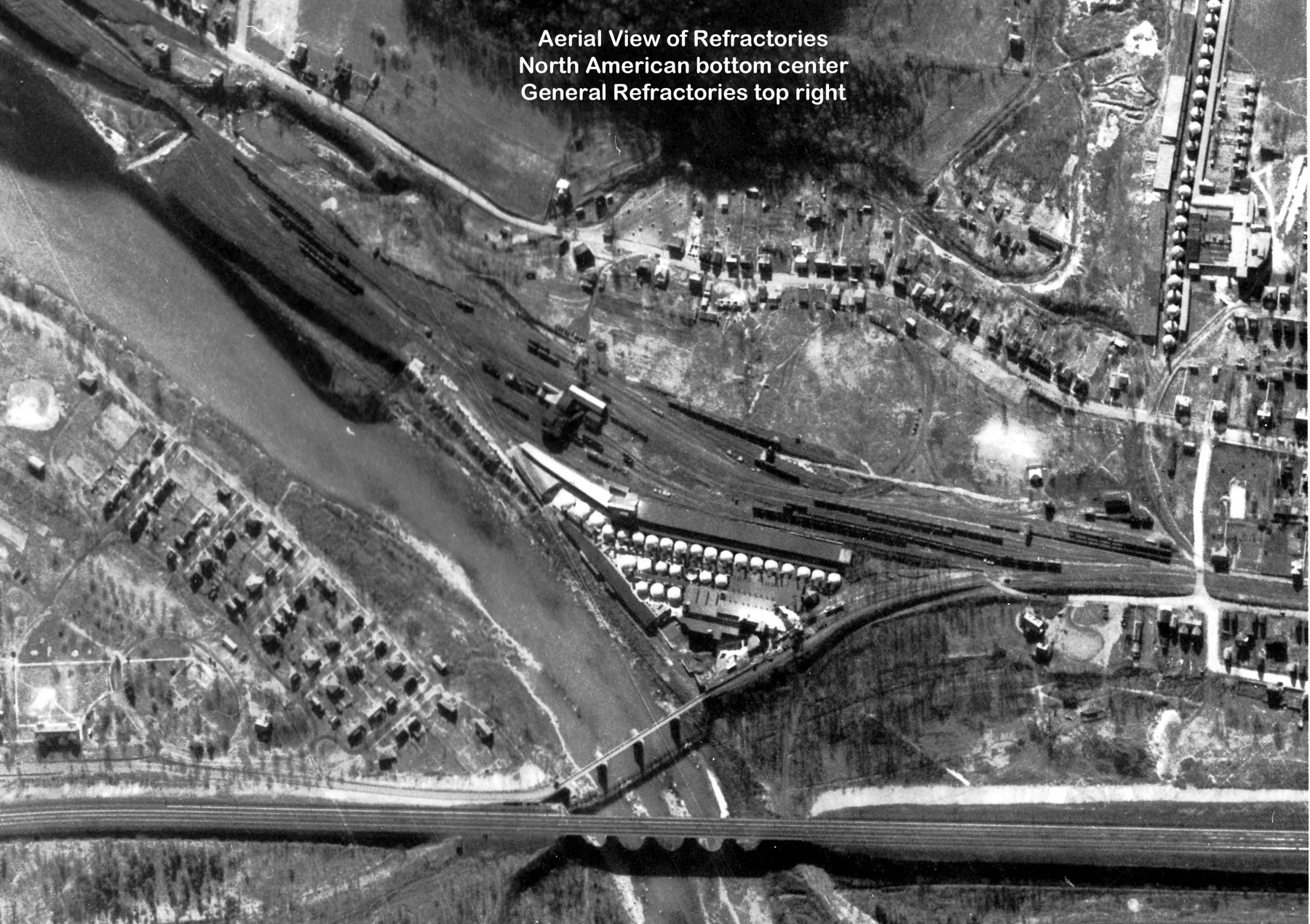
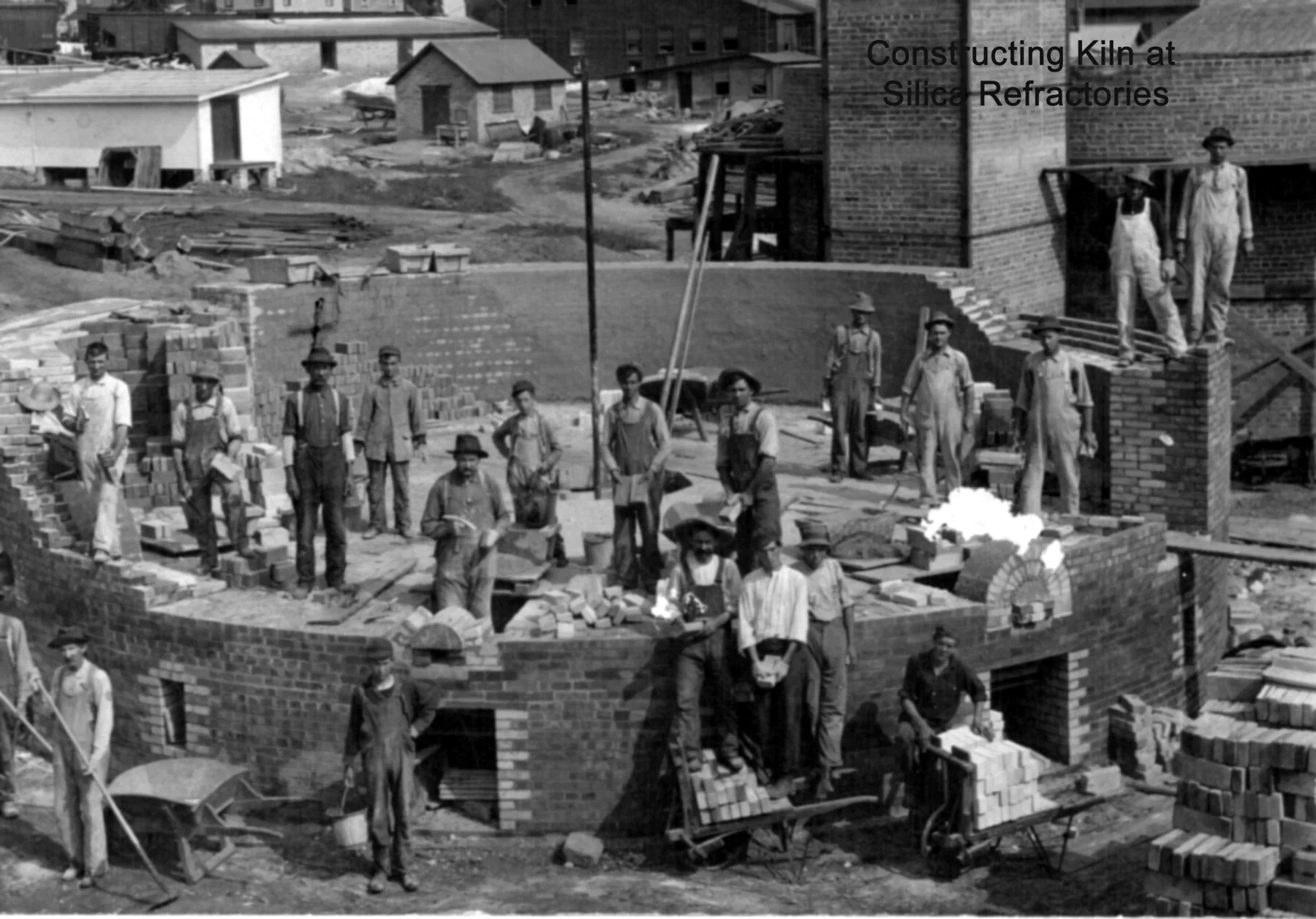
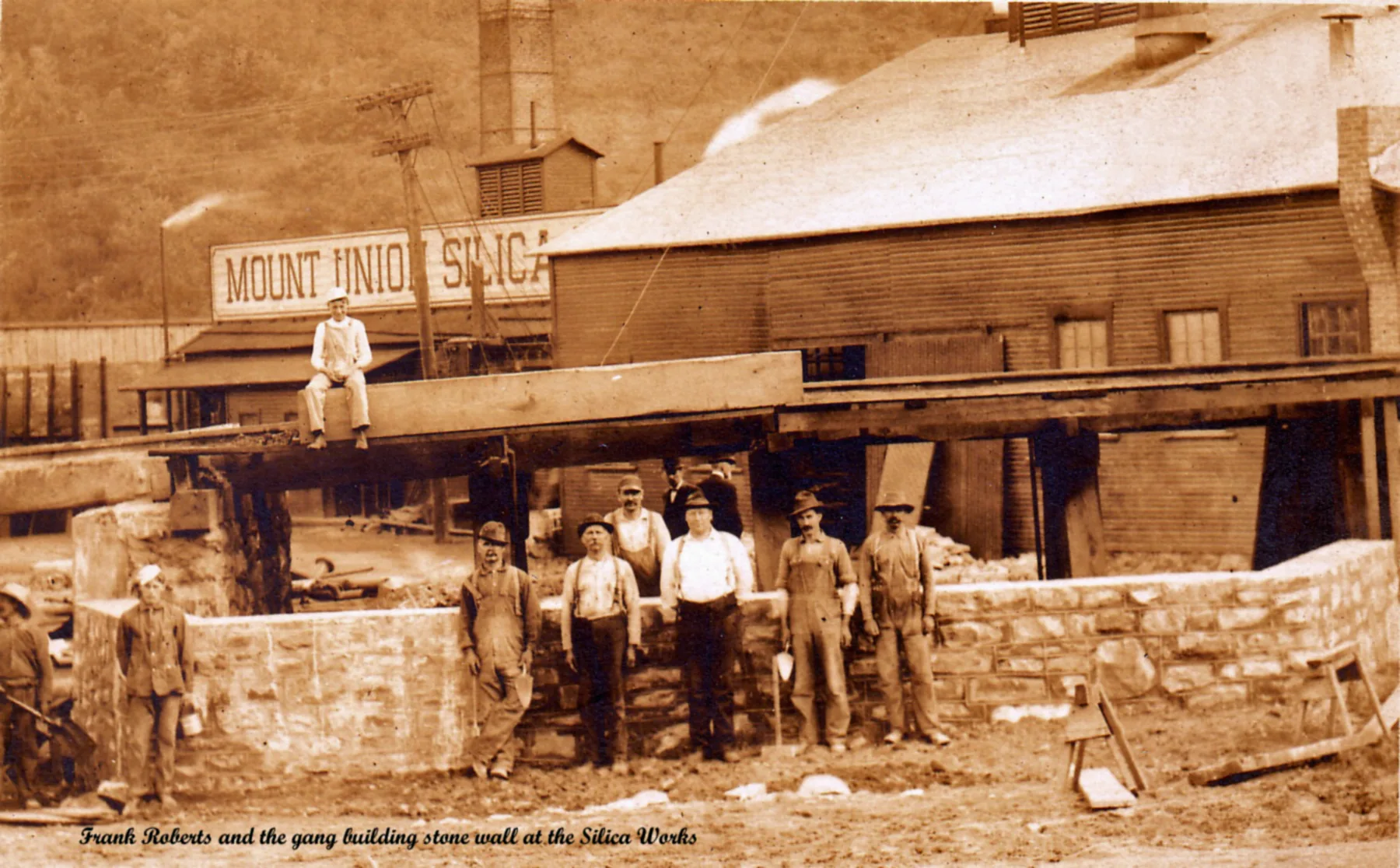
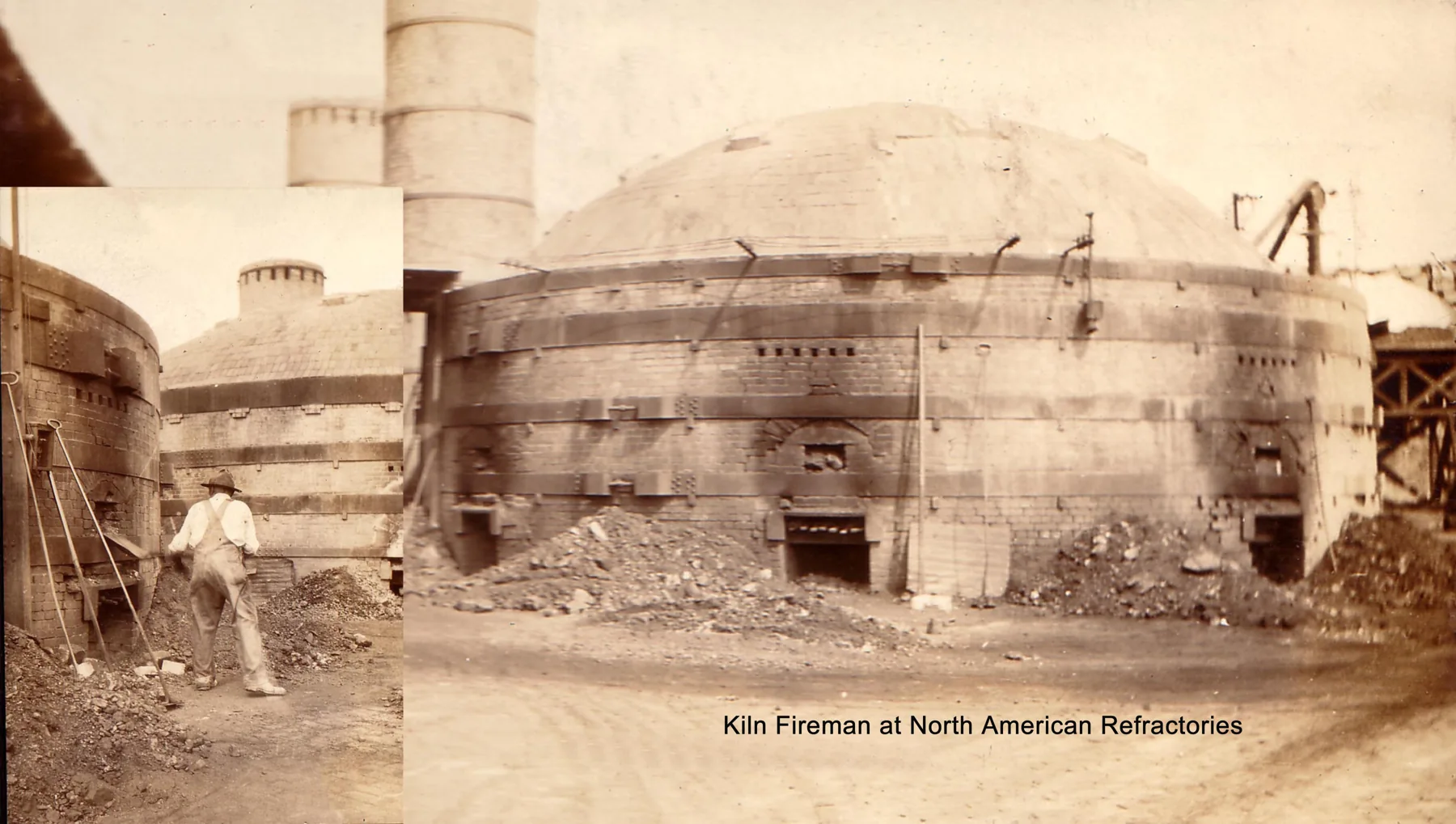
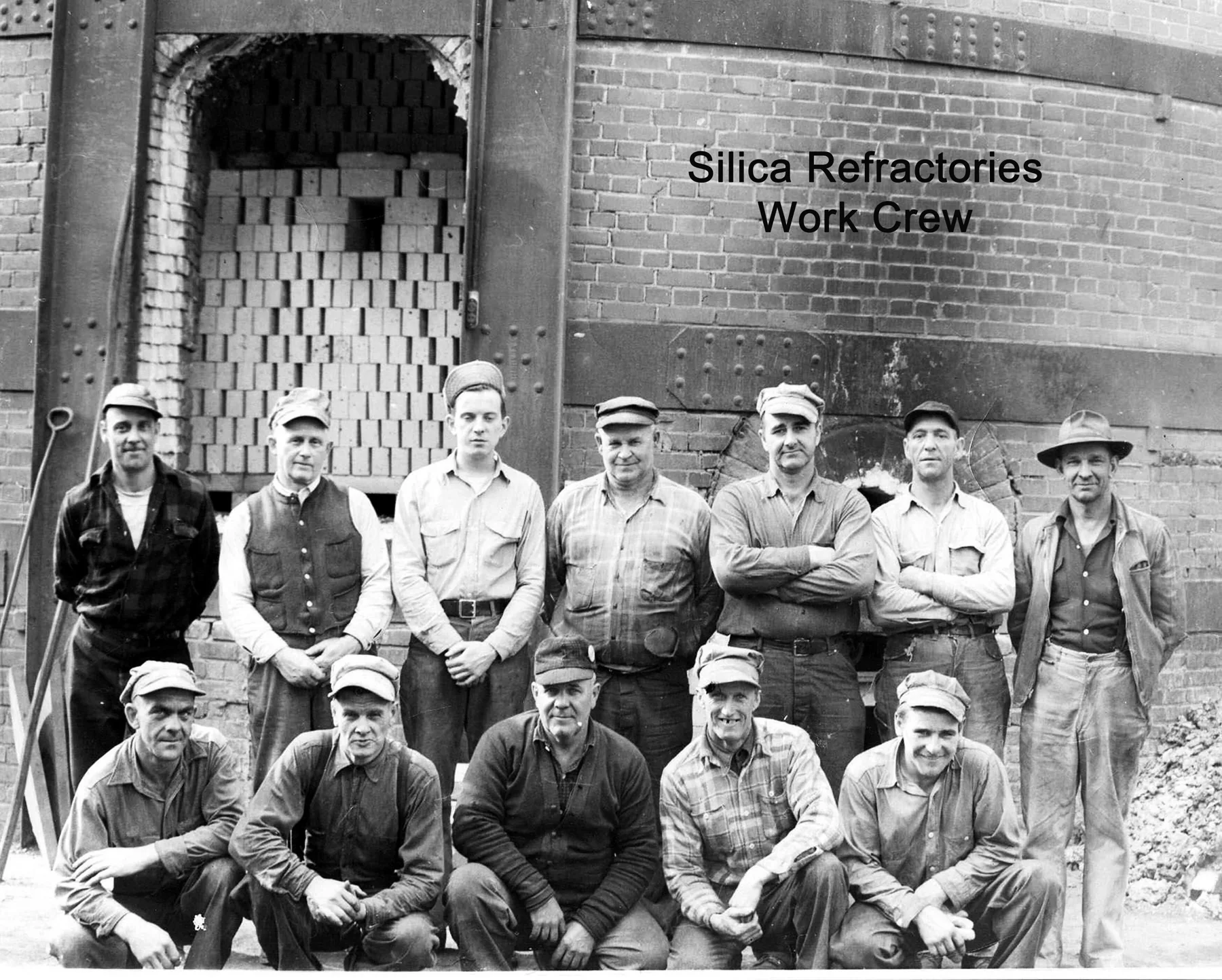
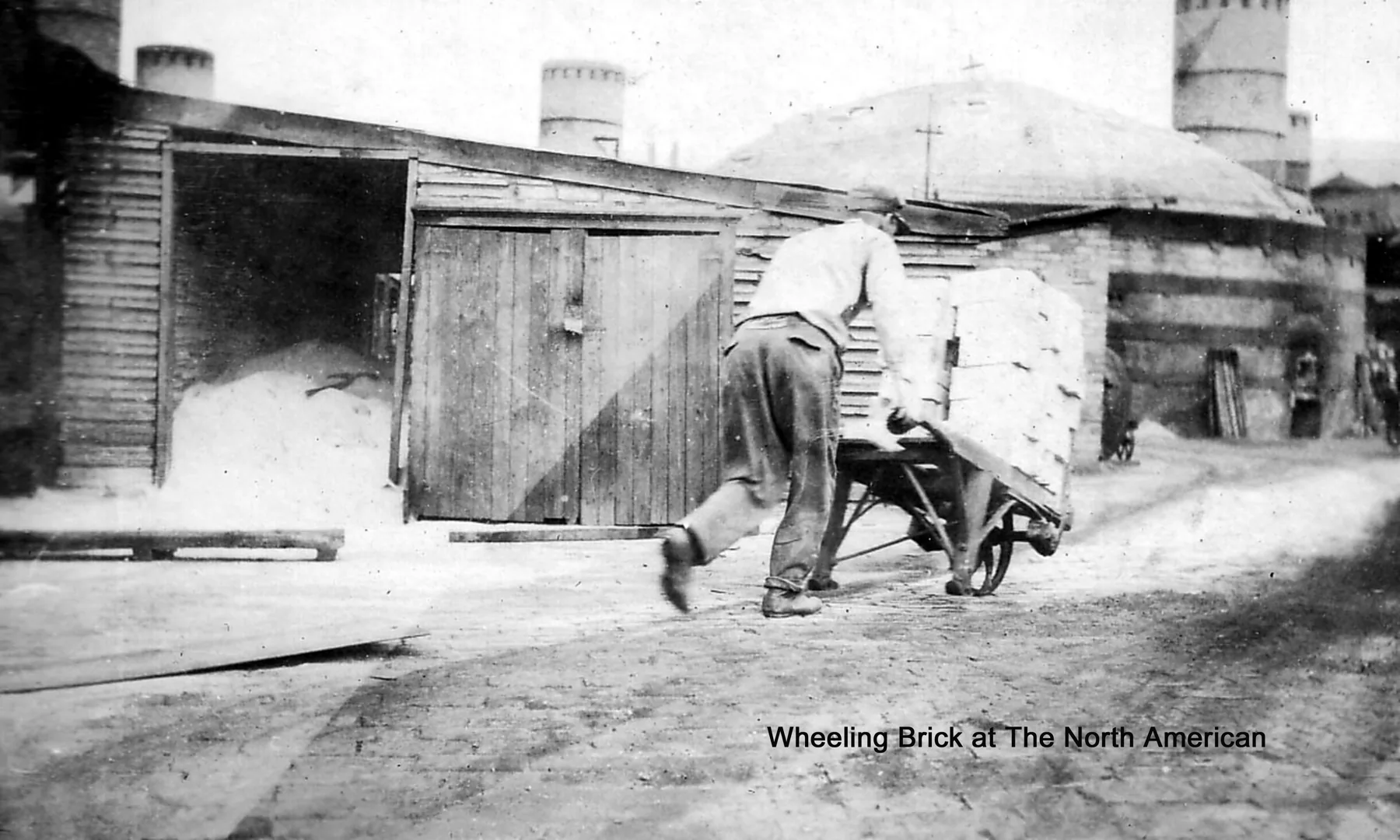
The brick didn't just employ Mount Union — it built the town, brick by brick, and gave it a name known across the industry. Much of the detail below on the industry's founding decade comes from Charles Howard Welch's 1909-1910 History of Mount Union, Shirleysburg and Shirley Township, shared with this project in 2026.
Silica Brick, World-Famous
Beginning around 1899, Mount Union's mills processed ganister — a quartz-rich sandstone quarried from Jacks Mountain — into silica (refractory) brick prized for lining the furnaces of the steel, iron, glass, and railroad industries nationwide. The three plants made Mount Union a major center of silica-brick production. Published estimates of their combined workforce and output vary; the figures need a dated source before they can be treated as a single peak total.
How Much Brick, and When?
Donaldson reports a combined capacity of 415,000 bricks per day and approximately 1,300 workers, without specifying the year. Those figures differ from the roughly 500,000 bricks and 2,000 workers previously summarized here. They are retained as different estimates, not blended into an unsupported total. Welch’s dated figures for individual plants appear below.
Bryan D. Donaldson, Brick Town USA, vol. 1 (2006), printed p. 39 (PDF p. 47). About this source.
Built By the Workers Themselves
Around 1936, Harbison-Walker employees set flat-sided Tuscarora sandstone into Jacks Mountain to improve the quarrymen's daily climb to Ledge Quarry. The workers used the steps; ganister traveled down the mountain over a separate system of narrow-gauge dinky railroad grades and inclined planes. Now preserved within State Game Lands 112 and the Standing Stone Trail, the stairway is both a demanding hike and a monument to Mount Union's quarry and refractory workers.
A Working Town
Refractory brick was the headline industry, but Mount Union's economy also ran on tanneries, coal yards, an explosives plant, foundries, and the East Broad Top narrow-gauge railroad, which hauled goods through the valley until the mid-1950s.
Bricktown Museum
Located at 300 W. Small Street, the Bricktown Museum keeps the story of the refractory era alive for residents and visitors alike — a natural next stop for anyone who wants to see (and touch) the history behind the name.
Happening Now: The Pennsylvania Avenue & Linear Park Project
The East Broad Top's old right-of-way is getting a second life. A streetscape and linear-park project, spanning three blocks of Pennsylvania Avenue between Jefferson, Division, and Franklin Streets, aims to implement goals from the Borough's 1989 Development Strategies Plan: safe pedestrian and cyclist crossings, curb cuts, lighting, and a connection to the wider Juniata River Trail and Raystown Lake recreation area. The East Broad Top Railroad Preservation Association — the non-profit that owns and is “currently refurbishing the tracks to accept freight and tourism trains” — has already built a walking path along the corridor; the Borough is now working on the street-crossing pieces to connect it safely, alongside a separate reconstruction of a retaining wall whose earlier failure closed a Borough road for an extended period. Planet Love Joy, a community action group, is handling tree planting and beautification. The effort is part of the Juniata River Blueprint Communities initiative, which also spans Mapleton Borough and Shirley Township (see the Historic Walking Tours on the Calendar page, hosted with the same partnership).
Sources: Mount Union Borough, “Pennsylvania Avenue Project” (mountunionpa.net); Juniata River Blueprint Communities, “Pa Ave Wall/Linear Park Project” (jrblueprint.org). Neither source gives a project timeline, budget, or completion date.
The Three Brick Giants
Three companies, all drawing on the same Jacks Mountain ganister, built Mount Union's reputation as the world's refractory capital — two founded almost simultaneously at the turn of the century, the third a decade later.
Harbison-Walker Refractories
Started as the W. H. Haws Co. plant in late 1899 and purchased by Harbison-Walker in 1902. The company added its No. 2 works in 1903-04, doubling capacity. Raw ganister came down from atop the mountain by incline cable. By 1909-10 the works ran 29 kilns (each holding about 90,000 brick), had its own electric plant, and employed over 600 men producing 140,000 brick a day — part of a 32-plant national company (Welch 1909-1910, printed pp. 342–349; Wallace 1993, printed pp. 103–104).
Explore the complete Harbison-Walker history and 20-image HAER photographic record →
Mount Union Silica Brick Co.
Founded by Scott Dibert of Johnstown, a pioneer of brick-making in the area; the works made their first brick on November 27, 1901. By 1909-10 the plant ran 18 kilns and was approaching 80,000 brick a day, drawing on ganister reserves along ten miles of Tuscarora Mountain plus holdings on Stone Mountain and Jacks Mountain — reserves Welch says were “enough to last at least 100 years” (Welch 1909-1910, printed pp. 383–389). General Refractories Co. bought the plant in 1915. It eventually owned 41 houses in several parts of town, including Water Street, Pennsylvania Avenue, Wausau Place, Shirley Street and the neighborhood called Shantytown. The plant closed in the early 1950s; its cleared site later became parkland, an athletic field, senior housing and a medical center (Wallace 1993, printed pp. 105, 107 and 132).
Mount Union Refractories Co. — the Third Plant
The town's third major plant was Mount Union Refractories Co., organized by former Harbison-Walker managers R.P.M. Davis and Clinton V. Hackman and opened in 1911-12 with eight kilns. Twenty-one more were added during World War I. The company became U.S. Refractories in 1922 and joined North American Refractories in 1930. Its plant across the Juniata from Kistler continued after the company sold the village houses and finally closed in March 1990 (Wallace 1993, printed pp. 105 and 132–133).
The Neighborhoods the Brick Industry Built
The plants did more than create jobs. They shaped where families lived, how newcomers entered community life and even how a neighboring borough was laid out.
Ganister Hill
Read how the Ganister Hill Sewing Club kept neighbors connected after relocation.
By 1911 Harbison-Walker owned 104 frame houses. All but three stood around the south and west sides of its plant in the neighborhood called Ganister Hill. Workers and their families included eastern and southern European immigrants, African Americans from the South and longer-established local residents. Company housing, rules and “uplift” programs reflected both an investment in long-term family labor and an intrusive effort to supervise employees’ home lives.
During plant modernization in the early 1950s, Harbison-Walker demolished the whole neighborhood instead of selling its houses to residents. Families could buy structures for salvage for about $200; reused materials went into homes in “the flats” along the Juniata, while some displaced residents found housing in Allenport. Much of the flats was later lost in the 1977 flood.
Kistler: A Planned Industrial Village
Beginning in 1916, Clinton V. Hackman and R.P.M. Davis commissioned nationally known planner John Nolen and New York architects Mann & MacNeille to design Kistler across the Juniata River from the plant. The plan used curving streets, a central green and varied house types rather than ordinary rows of company housing. A farmhouse and barn were adapted for community use, while a combined store and school faced the green.
The 1919 Sanborn map recorded 111 residences: 80 single-family houses, 21 duplexes and 10 four-family buildings. Kistler’s residents included eastern European immigrants and African American families recruited from South Carolina. The company paired the housing with a school, playground, garden plots, nursing, sewing and other programs. Those amenities improved daily life, but the study also places them in the paternalistic “Americanization” thinking of the period.
Explore Kistler’s complete history and photographic record →
From Company Property to Homeownership
Kistler’s community building, which contained a theater, poolroom and dance hall, burned in 1933. A substantial WPA-assisted brick school followed in 1936. The first two company houses were sold in 1944, and all were privately owned by 1949. Although additions and new siding changed many buildings, the federal survey found the original town plan and much of its distinctive housing still legible decades later.
How Bricktown Remembered Itself
Paul Rohland’s 1936 post-office mural placed Harbison-Walker’s smoking kilns and Ganister Hill houses at the center of Mount Union’s landscape. In 1990 residents collected bricks from all three plants to build the mailbox platform outside the post office. Together, the mural and brickwork preserve not only an industry, but the neighborhoods and workers that made “Bricktown” a community identity.
Beyond Brick: Tanneries, Banks & Power
Brick was the headline, but it wasn't the whole economy. Welch's 1909-1910 industries chapter documents a much fuller working town.
Mount Union Tanning Co.
Traces to John Bare's first tannery, through Faust family ownership from 1874, to a modern (1909-10) capacity of 250 hides a day, importing hides from South America, China, and British East Africa (Welch 1909-1910, printed pp. 361–370). Even Africa's own 1883 book can't settle the founding date: one passage puts the first tannery at 1850 and the second at 1860; a second passage — inside Richard J. Faust's own biography — puts them at 1859 and 1869 instead, with different production figures attached to each account (Africa 1883, PDF scan p. 435). Rather than pick one, both are preserved here as the genuine, unreconciled discrepancy they are.
Juniata Oak Extract Co.
Extracted tannin from chestnut wood, oak, and hemlock bark for the tanning trade, shipping concentrated tannin nationwide — and as far as South Africa and Australia — in its own tank cars (Welch 1909-1910, printed pp. 370–379).
Central Banking Company & First National Bank
The Central Banking Company survived the financial panics of 1873, 1893, and 1907, and trained tellers who went on to lead banks across the region. The First National Bank opened in 1902 and moved into its own building in 1909 (Welch 1909-1910, printed pp. 307–323). It was organized March 13, 1873 with Thomas H. Adams as president and E.S. Doty as cashier, at the corner of Water and Division Streets (Africa 1883, PDF scan p. 441) — and later occupied its own building at 111 N. Jefferson St. (1902), then a third, Italian Renaissance Revival building as the Penn Central National Bank (1916) (Mount Union Historic District, NRHP nomination, 1994).
Mount Union Water Co. & Light & Power Co.
The water works, after a false start in 1883 and a stalled 1899 franchise, finally reached town in 1900. Electric current followed on August 20, 1905 — the town's first night with electric streetlights (Welch 1909-1910, printed pp. 389–396).
Rummel's Mill & Ewing's Mill
Two long-running mills at the corner of Washington and Water Streets and elsewhere in town, feeding the community through multiple owners across the late 1800s and early 1900s (Welch 1909-1910, printed pp. 339–340, 356–357).
Bottling Works, Chair Factory & Shirt Factory
The Mount Union Bottling Works (founded 1908 by the Faust family), a Chair Factory built from a former tannery building, and the Mount Union Shirt Factory (35 women workers, 90–100 dozen shirts a day) rounded out the town's manufacturing base (Welch 1909-1910, printed pp. 353, 380, 396). A submitted photograph, captioned in-frame, gives this Chair Factory a name Welch's text never does: the Defrehn Chair Company — see the photo below and the Gallery.
Etna Explosives Co.
A federal wartime munitions plant that, along with the refractory works, drew a wave of new residents to town during World War I — part of a broader shift from the largely homogeneous, Protestant Mount Union of before the war (Mount Union Historic District, NRHP nomination, 1994). See History for more on this era's population growth and social change.
The Defrehn Chair Company
Previously just “a Chair Factory built from a former tannery building” in Welch's account — a submitted photo puts a name and a face on the building itself.
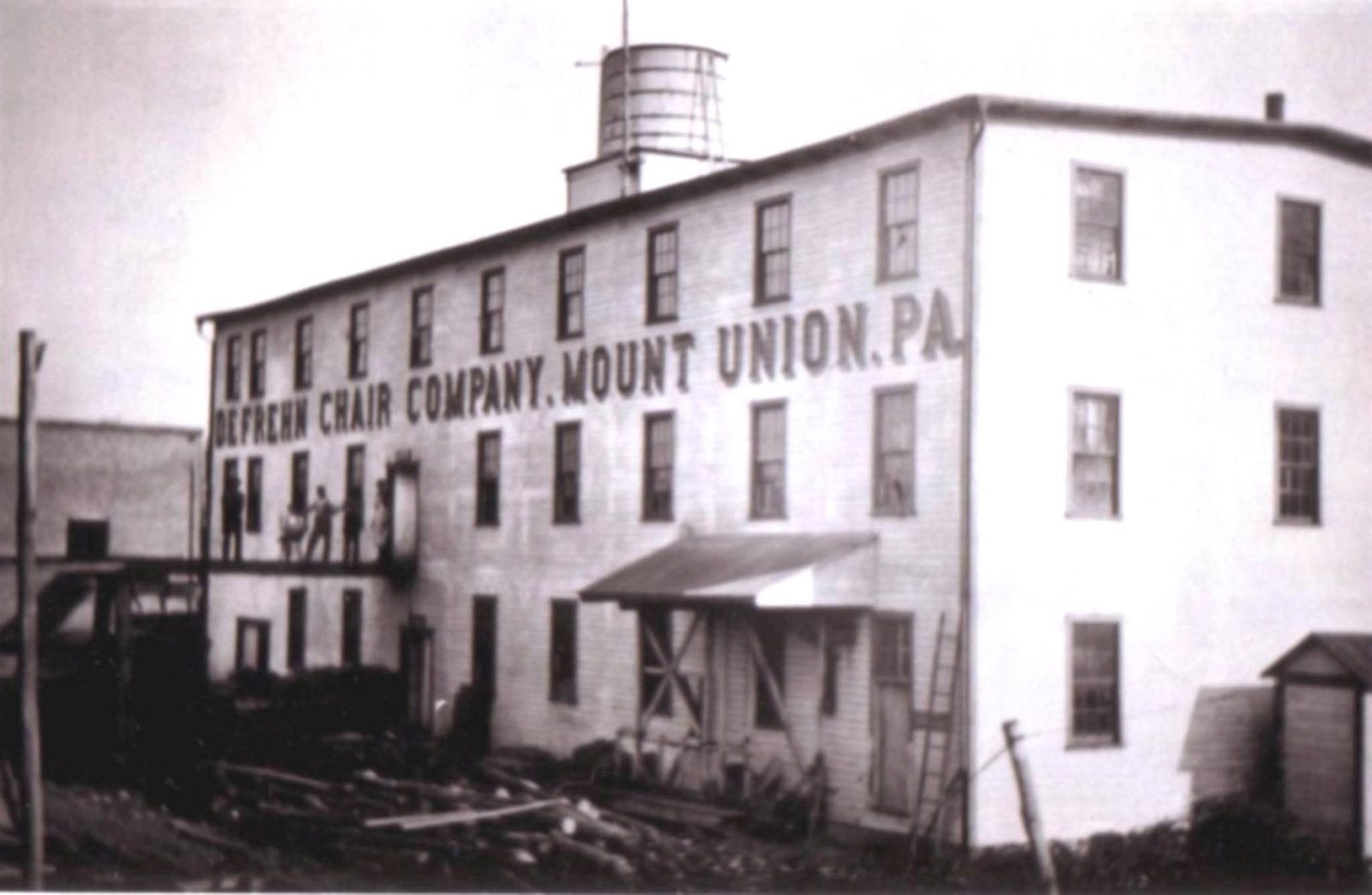
New finding, Aug 2026: this archive's only prior reference to the town's chair-making business was Welch's unnamed “Chair Factory built from a former tannery building” (1909-10, printed p. 380). A submitted photo, painted directly on the building's façade, identifies it as the “Defrehn Chair Company, Mount Union, Pa.” Whether this is the same building Welch described, a successor business, or an unrelated later operation hasn't been confirmed — the name is preserved here as new information rather than merged into Welch's account.
Sources
- Charles Howard Welch, History of Mount Union, Shirleysburg and Shirley Township (Mount Union, Pa.: Mount Union Times Office, 1909-1910), printed pp. 307–397. Page citations above refer to this book's original printed page numbers.
- J. Simpson Africa, History of Huntingdon and Blair Counties, Pennsylvania (Philadelphia: Louis H. Everts, 1883), PDF scan pp. 435, 441.
- Frederick L. Richards, “Mount Union Historic District” (National Register of Historic Places nomination, 1994), National Park Service.
- Jeff Britton, “Middle Division Main Line 279,” The Hobo's Guide to the Pennsy, pennsyrr.com — 1947 refractory-plant car-count figures cited above; see also the History page's 1906-07 viaduct and 1899-1972 timeline entries.
- Kim E. Wallace, Brickyard Towns: A History of Refractories Industry Communities in South-Central Pennsylvania (National Park Service, Historic American Buildings Survey/Historic American Engineering Record, 1993), especially printed pp. 98–135.