The Legend
A persistent tradition of the Juniata Valley tells of a heroic figure called “Captain Jack.” According to the story, Jack lived an idyllic life somewhere on the Juniata River with his wife and children, asking nothing more of the world than to hunt, fish, and live in the wilderness. That happiness did not last. While he was away on a hunting trip, his family was murdered by Indians. Jack immediately renounced his peaceful ways, swore revenge, and spent the rest of his life hunting down Indians in retribution.
At least four books have been built around this story since 1873, each dressing it in real historical events and figures — Braddock's ill-fated campaign, the trader George Croghan, forts up and down the Juniata — to the point that, if the accounts were true, there would be no mystery at all about the life of this man. There's just one problem: a careful search of local histories and sources dealing with the western Pennsylvania frontier in the mid-1700s shows no trace of Captain Jack prior to 1829.
Chasing the Earliest Sources
The earliest published version of the story appeared in 1829, in Samuel Hazard's Pennsylvania Register, framed as an extract from an old provincial letter supposedly dated August 1750:
“The 'Black Hunter,' the 'Black Rifle,' the 'Wild Hunter of Juniata,' the 'Black Hunter of the Forest,' is a white man; his history is this: he entered the woods with a few enterprising companions; built his cabin, cleared a little land, and amused himself with the pleasures of fishing and hunting. He felt happy, for then he had not a care. But on an evening, when he returned from a day of sport, he found his cabin burnt, his wife and children murdered. From that moment he forsakes civilized man; hunts out caves in which he lives; protects the frontier inhabitants from the Indians; and seizes every opportunity of revenge that offers.”
A second, nearly identical account surfaced in 1843, said to be based on notes from a man born in Philadelphia in 1781 — meaning it was almost certainly copied from the same 1829 source, or from a third account now lost, rather than an independent witness.
That earliest account is riddled with problems. It's dated 1750, which would place Jack's entire arc — idyllic life to grieving vigilante — in the 1740s. But every other version of the story places him on the Juniata in the 1750s, generally 1750–1755. And 1750 itself was the year Secretary Richard Peters and trader George Croghan toured the Juniata region specifically to remove white squatters from Indian land — a well-documented sweep whose surviving records name the settlements and cabins burned. Captain Jack's name appears nowhere among them.
A Case of Mistaken Identity: “Captain Joel”
The same 1829 issue of the Register that published Jack's story also printed a second letter, about someone called “Captain Joel” — who organized settlers to defend against Indian raids along the Conococheague and Juniata. The two accounts share some details (fighting Indians, operating on the Juniata) but differ in a telling way: Jack is described as a solitary avenger, while Joel is described as an organizer who rallied others. A later “correcting” letter claims the name should have read “Jack” all along, and not “Joel” — but whether that's a genuine correction or two real people being flattened into one has never been resolved.
The Croghan Letter to Braddock
The most historically significant document tying Captain Jack to real events is a letter Hazard published, supposedly written by George Croghan to the governor in June 1755:
“SIR—Captain Jack has promised his aid in the contemplated attack of Fort Du Quesne. He will march with his Hunters, by a circuitous route and join Braddock. He and his men are well armed, and dressed in hunting shirts, mocasins &c. They are equally regardless of heat and cold. They require no shelter for the night. They ask no pay. If the whole army was composed of such men, there would be no cause for apprehension. I shall be with them in time for duty.”
If genuine, this would be the single piece of hard evidence linking Captain Jack to Braddock's campaign — and it's the reason so many later histories confidently repeat that connection. But the letter has serious problems: it's dated from a fort at Loudoun that probably didn't exist yet in 1755; Croghan was almost certainly already traveling with Braddock's army by that point, not writing from a fort; and the letter's prose doesn't match the numerous misspellings and irregular style found in Croghan's other verified correspondence. One of Croghan's own biographers flatly calls the letter “fictitious and confusing.”
Most tellingly: if Captain Jack really marched with Braddock, some trace of him should exist in the many firsthand, contemporary accounts of that campaign. George Washington was with Braddock for most of the march and kept detailed letters and journals from the period. None of them mention a Captain Jack, or anyone like him. Braddock's own orderly books, and every eyewitness account of the battle examined by historians, are silent on the subject too.
The “Half Indian” Mix-Up
Captain Jack is often called the “Half Indian” in secondary sources — but Hazard's own material is internally confused about whether that nickname belongs to Jack himself or to someone connected to his company. Historian C. Hale Sipe identifies the real “Half Indian” as Andrew Montour, son of the French-Canadian Madame Montour and an Indian father, who was commissioned a captain in 1754 to lead a company of friendly Indian scouts. Montour is well documented; Captain Jack, tellingly, is not. It's a reasonable guess that this mix-up in the old records is exactly where the “Half Indian” label got stuck to Jack's legend.
Why the Pennsylvania Archives Don't Help
Samuel Hazard, the same man who published the original Captain Jack material in his 1829 Register, went on to publish the official Pennsylvania Archives between 1852 and 1856 — a huge, carefully sourced collection of original letters and records. He left every reference to Captain Jack, and to Captain Joel, out of it entirely. If the man who first published the story, and who had two more decades to research it, didn't consider it solid enough for his own official archive, that's a serious strike against its authenticity.
A Local Variant, With Its Own Paper Trail
A different, more locally-rooted version of the legend turned up in 2026 in J. Simpson Africa's 1883 History of Huntingdon and Blair Counties — and Africa, notably, is transparent about exactly where he got it: an oral chain running from Hezekiah Rickets to James Clark, to Clark's son James M. Clark of Shirleysburg, and finally to Africa himself (Africa 1883, PDF scan p. 410). In this version, “Capt. Jack Armstrong” held a contract to cut a road through the Juniata's narrows, and his cabin stood near a spring on the north end of the mountain that now bears his name. He had traded amicably with Native people in the area, and when conflict broke out between settlers and Native Americans he offered his services to Gen. Braddock — an offer Africa says was turned down. Soon after, Africa reports, twelve Native men passed by Armstrong's work crew, seemingly friendly; after they'd gone, the men heard a single rifle shot but thought little of it. When Armstrong failed to appear as expected, his men found him dead near his cabin — “hence the name, Jack's Mountain.”
Africa never states outright who fired that shot, and presents the whole account as inherited local tradition rather than documented fact — which is exactly the same evidentiary problem every other version of this legend has. It's included here not because it resolves anything, but because it's a distinct, clearly-sourced variant, tied specifically to the mountain's name rather than to the Braddock campaign, and it deserves to sit alongside the other accounts rather than be treated as a separate, unrelated story.
Jack Armstrong and the Name of the Narrows
A source supplied in 2026 adds a much firmer historical trail for the place-name. On April 8, 1944, The Daily News of Huntingdon published Albert M. Rung's article, “Murder of Jack Armstrong on April 9, 1744 Marks 200 Years of County's History.” Rung distinguished the documented trader Jack Armstrong from the mysterious Captain Jack of later legend.
Rung quoted John Harris's 1754 description of the route west from Black Log: “Now beginning at the Black Log, Frank's Town Road, to Aughwick ... 6 miles to Jack Armstrong's Narrows, so called from his being there murdered.” Because that wording was recorded only ten years after the killing, it is strong evidence that the narrows between Mount Union and Mapleton were named for Jack Armstrong, not for the later legendary avenger.
The article says Armstrong was an Indian trader who had long worked in the Juniata Valley. On April 9, 1744, he and his aides James Smith and Woodworth Arnold—whose first name is rendered as Woodward in some later accounts—were killed during a confrontation involving a Delaware man named Musmeelin following a dispute over a horse debt. Rung drew on Conrad Weiser's records and William H. Egle's history to reconstruct the case, and noted that the victims were reportedly buried near the scene although the graves had been lost.
This evidence does not establish that every local “Jack” place-name has the same origin, nor does it prove or disprove the separate Captain Jack legend. It does, however, give Jack Armstrong a substantially stronger claim to the name of Jack's Narrows than the legendary Captain Jack has.
A Colonial Whodunit Reexamined
Historian David C. Hsiung of Juniata College later returned to the surviving 1744 records in “Death on the Juniata: Delawares, Iroquois, and Pennsylvanians in a Colonial Whodunit.” His study treats the deaths of John Armstrong, James Smith, and Woodworth Arnold as both a murder investigation and a window into the strained relationships among Delaware communities, the Six Nations Iroquois, Pennsylvania officials, and colonial traders. Unlike later retellings, Hsiung does not force the evidence into a simple story of an unprovoked frontier attack.
The search began after word reached Paxton that the three traders had disappeared. Nine Pennsylvania colonists traveled to Shamokin, where Delaware leader Olumapies and the Oneida diplomat Shickellamy arranged for Native men to assist them. Near the traders' last known camp, the party found human remains and later discovered the mutilated bodies of Smith and Arnold near the Juniata Narrows. The colonists' April 19 deposition preserves what they saw, but it also reveals their fear and suspicion; Hsiung cautions that this account came from one side of the encounter and included two of Armstrong's brothers.
The records consistently place a Delaware man whose name appears in several spellings—including Mushemeelin, Mushemelon, Massemeelin, and Rung's Musmeelin—at the center of the killings. Shickellamy described a deliberate attack, while a report from Lancaster recorded Mushemeelin's claim that Armstrong had retained his horse and gun following a debt dispute, struck him with a stake during their confrontation, and was then killed. The same account said Mushemeelin killed Arnold and that another man, John, killed Smith. Pennsylvania examined John and Jimmy as possible participants, but the chief justice reported that their questioning did not establish involvement. Mushemeelin was convicted in October and hanged in November 1744.
The trial established Mushemeelin's legal responsibility, but the surviving reports disagree about who killed each victim and whether the fatal confrontation was planned, retaliatory, or sparked by violence at the scene. Hsiung therefore presents the case as unresolved in important respects rather than treating one colonial account as the complete truth.
The aftermath also mattered. Delaware and Iroquois representatives offered wampum and skins to express grief, remove the desire for revenge, and restore relations with Pennsylvania. Provincial officials accepted the reconciliation, even while acknowledging the deeper conditions behind frontier violence: traders who supplied alcohol, cheated Native customers, retained their property, and operated far beyond effective government oversight. This context makes the documented Armstrong case more complicated than the later Captain Jack legend and helps explain how a real death in the Narrows could be transformed into a very different story over succeeding generations.
The Name Made Physical: “JACKS” Tower
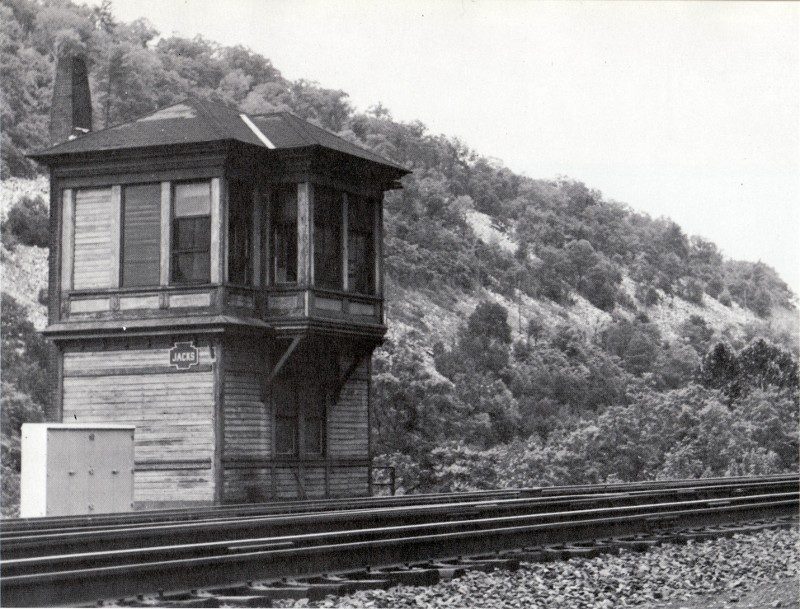
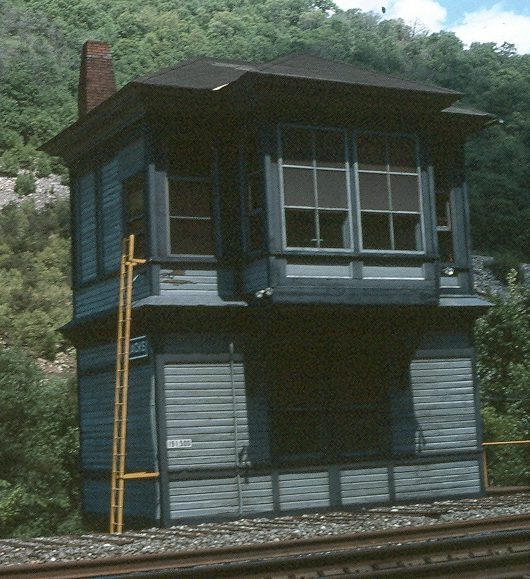
Whatever the truth behind the man, the name stuck hard enough to end up on railroad signage: the Pennsylvania Railroad's interlocking (signal) tower controlling the tracks through Jacks Narrows was itself named “JACKS,” with the name lettered right on the building. Submitted photographs show the tower in two eras — a weathered wood-frame structure from roughly the 1890s, and the same style of tower repainted and still standing decades later. It's a small, concrete reminder of just how deeply “Jack’s” is woven into this valley's place names, independent of which legend (or none of them) is actually true.
So Who Was He, If Anyone?
Wagoner's research surfaces several competing theories, none of them proven:
A concealed identity. Before 1755, it was against colonial law to live in Indian territory or to kill natives without provocation. “Captain Jack” may have been a convenient pseudonym for someone who didn't want to be caught doing either.
The Culberson/Culbertson family tradition. In the southern part of Huntingdon County, oral tradition has long linked Captain Jack to the name Culberson or Culbertson. A Mount Union writer, Charles Welch, noted the association as early as 1909, and an 1873 newspaper serial by a local minister even names Jack as “Jackson Culberson.” No family records have ever confirmed the connection.
Patrick Jack of Chambersburg. A real Colonial and Revolutionary War officer, buried under a monument reading “Colonel Patrick Jack—died January 25, 1821, aged ninety-one years.” That birth year would make him only about 20 during Captain Jack's supposed exploits in the 1750s — and Patrick Jack's documented life (Tennessee, the Cherokee, imprisonment at Fort Loudon) doesn't match the legend at all.
A composite of real frontier captains. Wagoner points to at least three genuine frontier officers whose real, documented careers echo pieces of the Captain Jack story: Captain William Patterson, a resourceful Indian fighter on the Juniata as early as 1750; Captain William Neilson, who commanded provincial rangers stationed at forts across the Juniata region and had himself been an Indian captive; and Captain Brady, the celebrated “Indian Hunter of the Susquehanna,” whose documented exploits read almost exactly like the Captain Jack legend with the names swapped.
The Honest Conclusion
After tracing every version of the story back through its sources, Wagoner's paper lands on an honest, unresolved verdict. Captain Jack may have been a real frontiersman whose story grew taller with each retelling. He may be a composite — several real men's real exploits, merged over a century of storytelling into one figure. Or the frontier may simply have needed a hero like him, and invented one to fit. What can't be done, on the evidence that survives, is prove he was any one specific, real person.
Either way, he's been part of this valley's storytelling for a century and a half — which is its own kind of true.
Sources and Further Reading
- Samuel Hazard, ed., Pennsylvania Register, 4 (1829); 5 (1830).
- Sherman Day, Historical Collections of the State of Pennsylvania, p. 264 (1843).
- William H. Egle, An Illustrated History of the Commonwealth of Pennsylvania, p. 616 (1877); Samuel P. Bates, History of Pennsylvania, p. 58 (1886); Uriah J. Jones, History of the Early Settlement of the Juniata Valley; Charles Howard Welch, History of Mt. Union, Shirleysburg, and Shirley Township (1909-10).
- William A. Hunter, Forts on the Pennsylvania Frontier, 1753–1758; Pennsylvania Archives, Historical Society of Pennsylvania.
- Nicholas B. Wainwright, George Croghan, Wilderness Diplomat, p. 90.
- Chester Hale Sipe, The Indian Wars of Pennsylvania, pp. 171, 312, 316–317.
- Charles Hanna, The Wilderness Trail, p. 57; Albert M. Rung, Rung's Chronicles of Pennsylvania History, p. 102.
- Dale Van Every, Forth to the Wilderness: The First American Frontier 1754–1774.
- J. F. McGinness, OTZINACHSON, or a History of the West Branch of the Susquehanna, pp. 488ff.
- J. Simpson Africa, History of Huntingdon and Blair Counties, Pennsylvania (1883), PDF scan p. 410 — added 2026, for the local Shirley Township oral-tradition variant above.
- Albert M. Rung, “Murder of Jack Armstrong on April 9, 1744 Marks 200 Years of County's History,” The Daily News (Huntingdon, Pa.), April 8, 1944, pp. 1, 7 — scans supplied to BrickTownPA.
- David C. Hsiung, “Death on the Juniata: Delawares, Iroquois, and Pennsylvanians in a Colonial Whodunit,” Pennsylvania History, pp. 445–477. Scholarly analysis of the 1744 depositions, diplomatic records, trial, and competing explanations for the killings.