Along Route 522, just south of Mount Union, the Allenport Fruit Market looked like the roadside business its name suggested: a low building beside the highway, with a sign advertising produce. In February 1984, that familiar place became the local center of a much larger news story. Investigators described a drug-distribution network linking Allenport with Miami and Ohio, supplying customers in Huntingdon, Blair, and Mifflin counties.
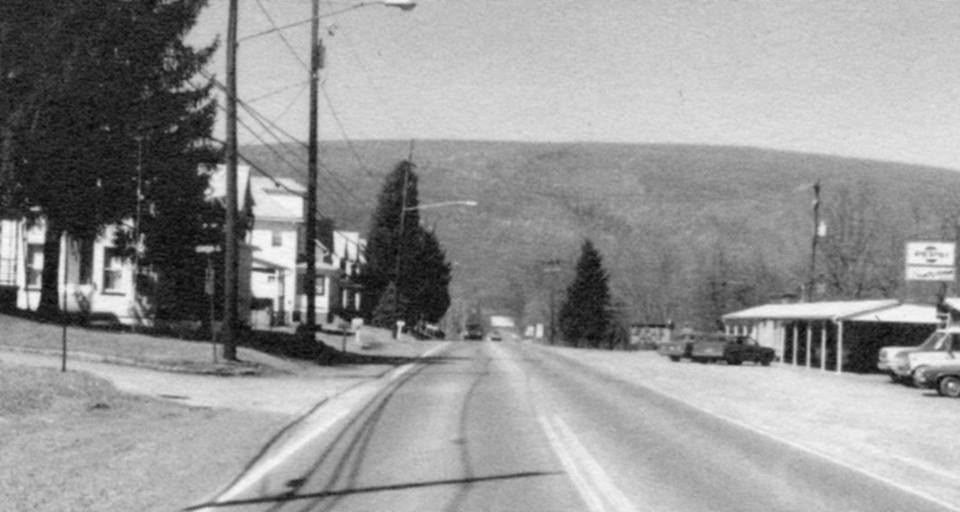
The contemporary reports reviewed for this page consistently call the business the Allenport Fruit Market and place it along Route 522 in Allenport. Some residents remember it simply as the “Fruit Stand,” but that informal name has not yet been confirmed in the period newspaper record.
Before the Groundhog Day Roundup
The investigation preceded the headlines by nearly two years. In the February 2, 1984 account reproduced in the compilation, Attorney General LeRoy S. Zimmerman traced its beginnings to March 1982, when narcotics investigators developed an informant. Information gathered through informants eventually supported an application to the Pennsylvania Superior Court to tap telephones at the market and the Walters residence beside it. [1]
Later trial reporting explained why the telephones mattered. According to narcotics agent John R. Snedden, the site's position along Route 522 made stationary surveillance difficult, while driving past revealed little. Agents testified that the two lines were monitored from a secure office in Harrisburg, sixteen hours a day, between November 21 and December 10, 1983. The calls helped investigators trace suppliers and local distribution. [2]
An Informant's Delivery and a December Raid
Zimmerman's account described an unusual step in the investigation: agents arranged for an informant who owed money to deliver ten pounds of previously seized hashish to the fruit market in place of cash. Investigators said they recovered six pounds during a later search and used the telephone intercepts to follow the alleged distribution of the remainder. State officials described this as the first full use of the reverse-undercover technique by their Bureau of Narcotics Investigations. These were the authorities' statements at the announcement of the case. [1]
The December 10, 1983 raid also brought the arrest of three people arriving from Florida. Officials reported finding cocaine and marijuana in their vehicle. In later testimony summarized during George Walters's sentencing, an agent said roughly $4,000 in marked purchase money was recovered from the Walters trailer. [1] [3]
February 2, 1984: The Case Becomes Public
On Groundhog Day, a strike force from the Attorney General's office and Pennsylvania State Police began a wider roundup. Zimmerman announced warrants for eighteen alleged participants at a Huntingdon County Courthouse press conference. Reports identified George E. Walters, 72, and his son Robert G. Walters, 45, both of Mount Union R.D. 2, as the market's owners and alleged principal local figures. At this stage, the accusations were criminal charges, not findings of guilt. [1]
The compilation preserves the headline “Miami-Huntingdon Drug Ring Broken” and a follow-up clipping dated February 3 showing the market beneath the caption “Tomatoes, Potatoes And Drugs.” The contrast between a produce stand and the investigation gave the story a memorable local setting.
The Preliminary Hearing
On February 14, The Daily News reported that ten defendants had been held for court following a preliminary hearing that lasted approximately fourteen hours. The prosecution's probable-cause presentation included information derived from wiretaps on telephones at the Walters residence and at the Allenport Fruit Market, which the newspaper located along Route 522.
The hearing included testimony about intercepted calls, alleged purchases, and alleged deliveries. Its legal purpose was to determine whether enough evidence existed to send the charges to court. Being held for court did not itself establish that any defendant was guilty.
George Walters's Plea and Sentence
Some of the proceedings moved to Lancaster County after a change of venue. The Daily News reported on July 17, 1984 that Huntingdon County Judge Newton C. Taylor would preside there over the cases of George Walters, John Drolsbaugh, and Sharron Kenneth Carlin. By July 19, the newspaper was reporting guilty pleas rather than a completed jury trial.
Under the headline “George Walters Is Sentenced to 7-20 for Drug Dealing,” the July 19 account said the 72-year-old Walters had accepted a plea agreement the previous day. Taylor imposed a minimum of seven and a maximum of twenty years in prison. The report also described a $20,000 county fine, forfeiture of $5,032 in personal funds as a fine to the Commonwealth, and prosecution costs. The judge agreed to recommend a minimum-security placement; the report does not establish where Walters ultimately served his sentence. [3]
The account opens by describing guilty pleas to twenty-five counts, but its continuation refers to sentencing on twenty-three. That discrepancy is preserved in the source notes below. It does not change the seven-to-twenty-year sentence consistently reported in both passages.
Robert “Bobby” Walters
An October 18, 1984 report in the Tyrone Daily Herald stated that Robert G. Walters of Mount Union received a sentence of ten to forty years in a state correctional institution and a $10,000 fine. The report said the disposition was part of a plea agreement involving the ninety-one counts filed against him.
During trials in 1985, The Daily News identified “Bobby” Walters as Robert Walters and described him as the confessed leader of the multi-county distribution ring. He became a Commonwealth witness, helping explain recorded conversations about the operation and its customers. The trial reports reproduced in the compilation say that he acknowledged testifying under plea arrangements. That context matters when reading his testimony. [4]
What the 1985 Trial Revealed
The March 12, 1985 report in the compilation described the opening of Otis Cook Jr.'s trial in Huntingdon County. Snedden testified that the Walters operation bought at least $30,000 to $35,000 in drugs a week. The report extrapolated annual purchases of roughly $1.56 million to $1.82 million and cited possible gross sales of about $2.64 million to $3.64 million. These were figures presented in trial reporting, not an audited business account; gross sales also do not mean profit. [2]
Recorded calls became a central part of the case. The reproduced trial accounts describe witnesses interpreting everyday expressions as references to drugs. Sandra Walters testified that fruit baskets and potatoes had been used as code words. Bobby Walters and agents explained the calls to the jury, while defense attorney Charles Bierbach questioned the witnesses and the certainty of their recollections. [4]
The Daily News reported on March 18, 1985 that Cook had been found guilty of six drug-related counts after a six-day trial. Its opening summary also reported an acquittal on another two-part count. The newspaper described him as the first person in the case convicted by a jury, following thirteen guilty pleas. That account records the verdict at the time; it does not establish the outcome of any later appeal. [5]
The Market and the Changing Highway
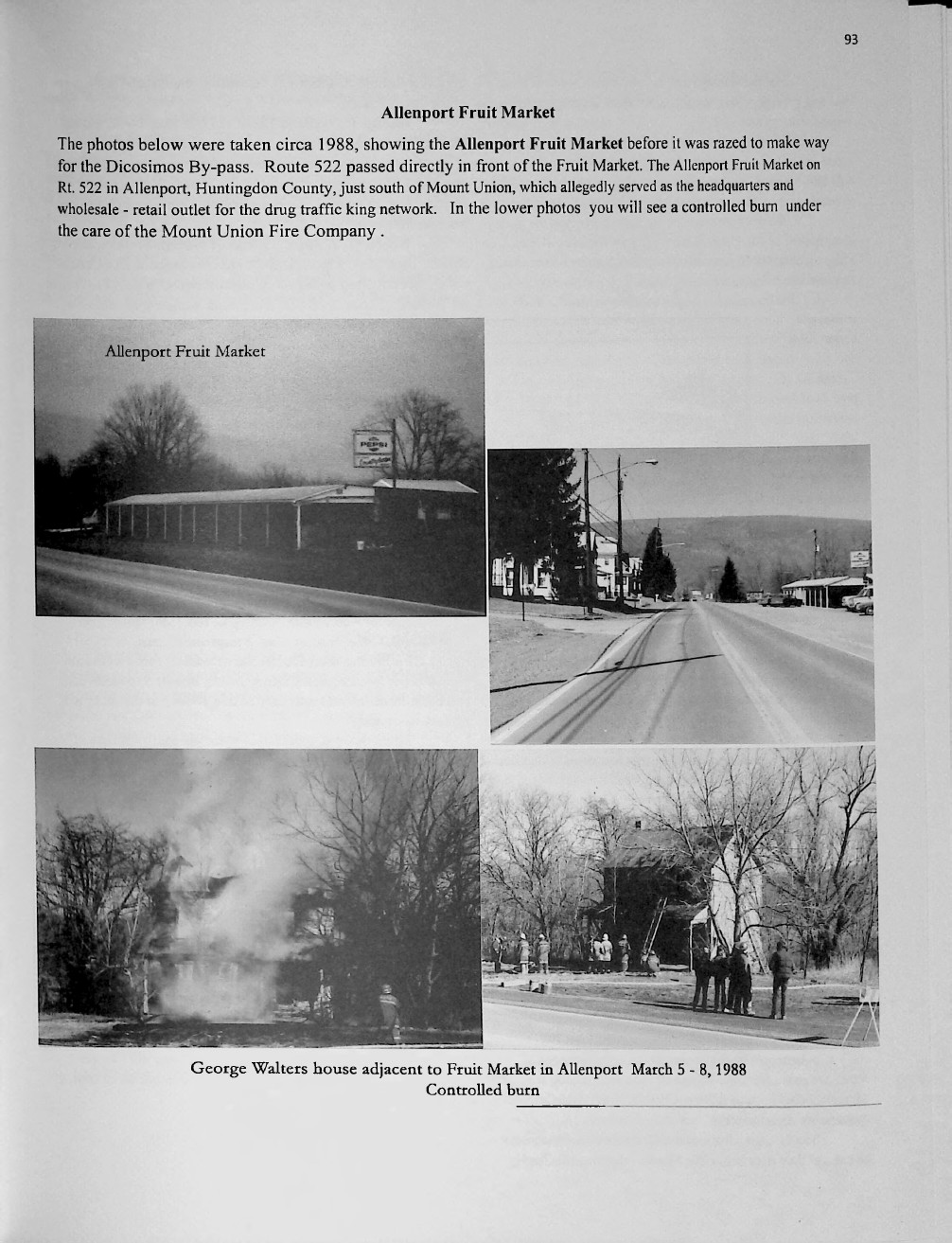
The compilation also preserves a later chapter in the property's history. A page of four photographs, dated circa 1988, shows the market beside Route 522 and identifies the site as having been cleared for the “Dicosimos By-pass.” Its lower photographs show a controlled burn, which the caption identifies as George Walters's house adjacent to the market, under the care of the Mount Union Fire Company. The caption gives the date as March 5–8, 1988. Those identifications come from the compilation; an original photographer's credit and separate highway or fire-company records have not yet been located. [6]
Later Years
George E. Walters died on November 14, 1991, at age eighty in Mercy Hospital, Altoona. His obituary, published under the surname “Walter,” identified him as the retired proprietor of the Allenport Fruit Market and named his surviving son as George Robert Walter of Bellefonte. Obituary source.
His son, Robert G. Walters, died in Las Vegas in August 1998 at age sixty. The Las Vegas Sun obituary gives August 29, 1998, while the contributed Ancestry profile lists August 28; the exact day remains unresolved. The notice records his birth on January 31, 1938, in Altoona and describes him as a self-employed fruit marketer who had lived in Las Vegas for two years. Obituary source and date note.
Why the Story Survived
The Allenport Fruit Market story joins two kinds of local history: a criminal investigation that reached far beyond Huntingdon County, and a roadside landscape that later changed with the highway. The newspapers document arrests, testimony, pleas, and sentences. The photographs preserve the building and its surroundings, allowing the story to be placed back on the road that residents remember.
Sources from the Contributed Compilation
The following material was reviewed in Fruit Market.pdf, a contributed twelve-page scan with printed page numbers 92–103, supplied September 18, 2026. It combines newspaper clippings, retyped reports, and a photo page. The original compilation's title, compiler, and publication date are not identified in the supplied excerpt. Printed page numbers below refer to the compilation, not the newspapers.
- “Miami-Huntingdon Drug Ring Broken: Strike Force Has Warrants to Arrest 18,” dated February 2, 1984; reproduced clipping and transcription, printed pp. 92, 94–95 (PDF pp. 1, 3–4). Printed p. 94 also includes a February 3 follow-up clipping with a market photograph.
- “Drug Ring Grossed Millions per Year,” dated March 12, 1985; reproduced trial report, printed pp. 95–96 (PDF pp. 4–5). Source for the purchasing estimates and the agents' description of telephone surveillance.
- “George Walters Is Sentenced to 7-20 for Drug Dealing,” attributed to The Daily News, July 19, 1984; printed pp. 101–102 (PDF pp. 10–11). The opening and an internal heading say twenty-five counts, while the continuation says twenty-three; the prison term and the $20,000 and $5,032 amounts are consistent across the account.
- “Taped Phone Calls Used to Link Cook to Drug Sale Ring” and “Walters Fingers Cook as Associate,” attributed to The Daily News; printed pp. 97–99 (PDF pp. 6–8). The compilation labels these March 15 and March 13, 1984. Their descriptions of Cook's trial, Walters's existing sentence, and the neighboring March 12 and 18, 1985 reports indicate a year discrepancy. Their precise publication dates await comparison with original issues; the supplied 1984 labels are not treated as verified trial dates.
- “Cook Is Guilty on Six Counts in Drug Trail” [as transcribed], attributed to The Daily News, March 18, 1985; printed pp. 96–97 (PDF pp. 5–6). The opening reports six guilty counts and an acquittal on a two-part count; the continuation inconsistently calls that other count guilty. This article follows the opening summary without attempting to reconstruct the individual verdict form.
- “Allenport Fruit Market,” photograph page, printed p. 93 (PDF p. 2). The page dates the photographs circa 1988, names the bypass project, and captions the adjacent house's controlled burn March 5–8, 1988. Photographer unidentified. The separate Route 522 image in the BricktownPA collection matches the page's upper-right photograph.
Obituary Sources
- “George E. Walter,” The Daily News, November 16, 1991, p. 2. Reviewed from the contributed clipping. Reports death November 14, 1991, birth March 22, 1911, and retirement as proprietor of the Allenport Fruit Market. The obituary uses “Walter” for both father and son, unlike the “Walters” spelling in the earlier reports.
- “Robert G. Walters,” Las Vegas Sun, September 4, 1998. Reports death August 29, 1998, age sixty, birth January 31, 1938, in Altoona, and occupation as a self-employed fruit marketer. The contributed Ancestry profile, headed “George Robert Walters,” gives August 28, 1998. The underlying death-index records have not yet been inspected to resolve the one-day discrepancy.
Additional Newspaper Sources
- “Miami-Huntingdon Drug Link Smashed,” Altoona Mirror, February 2, 1984.
- “Ten Are Held For Court After Marathon Hearing,” The Daily News, February 14, 1984.
- The Daily News, July 17, 1984; report identifying the Walters family as co-owners of the Allenport Fruit Market.
- “Ten Defendants Sentenced for Roles in Cocaine Ring,” Altoona Mirror, July 24, 1984.
- Tyrone Daily Herald, October 18, 1984; Robert G. Walters plea-agreement and sentencing report.
- “Walters Says Trice Was Regular Buyer,” The Daily News, July 31, 1985.
- “Trice Denies Buying Drugs from Bobby,” The Daily News, August 2, 1985.