A Railroad Town—and a Dangerous New Age
The railroad helped transform Mount Union from a canal-era settlement into an industrial transportation center. It also brought nineteenth- and early-twentieth-century rail travel directly through town at a time when signaling, braking, scheduling, and operating rules could fail with catastrophic consequences. Two rear-end collisions, separated by sixty-four years, left the Mount Union area connected to some of the worst railroad losses of their respective periods.
1853: The Men Who Fell Asleep
On the night of March 3-4, 1853, a freight train carrying emigrant cars developed engine trouble near the deep cut on the Mount Union side of Newton Hamilton. According to the Huntingdon Journal, a watchman went in one direction to stop an approaching train, while two other men went up the track to protect the disabled train from traffic coming downhill.
The two men expected a long wait. They walked only a short distance, entered a nearby house to sit beside a warm stove, and failed to place their red warning lamps on the track. They then fell asleep. When the approaching passenger train thundered past, there was no time left to act. Traveling at speed, it struck the standing freight and emigrant cars.
The local newspaper blamed the collision on severe negligence by railroad employees. Its immediate report counted five or six people killed and described others as badly bruised or maimed. Later railroad histories commonly give the date as March 4 and report seven deaths. Without another contemporary casualty list, the difference should remain visible rather than be silently resolved.
The same newspaper column reported another collision only days later: two freight trains met about two and a half miles below town, and another train reportedly ran into them. Cars and engines were smashed, but the paper said no one was injured. Read together, the two reports capture how precarious early railroad operation could be on the still-new main line.
1917: The Mercantile Express in the Fog
Late on February 27, 1917, eastbound passenger train No. 6—the Mercantile Express—approached its regular Mount Union station stop in dense fog. The train included mail and passenger cars followed by four all-steel Pullman sleeping cars. Brake trouble had already delayed it during the trip east.
A freight train followed on the same track. The federal investigation found that its crew received a caution indication near Mount Union, but the engineer interpreted the signal as white and did not reduce the train's speed. He saw the following red signal only when the freight was within a few car lengths. The passenger train's rear was just beyond that signal, leaving virtually no stopping distance.
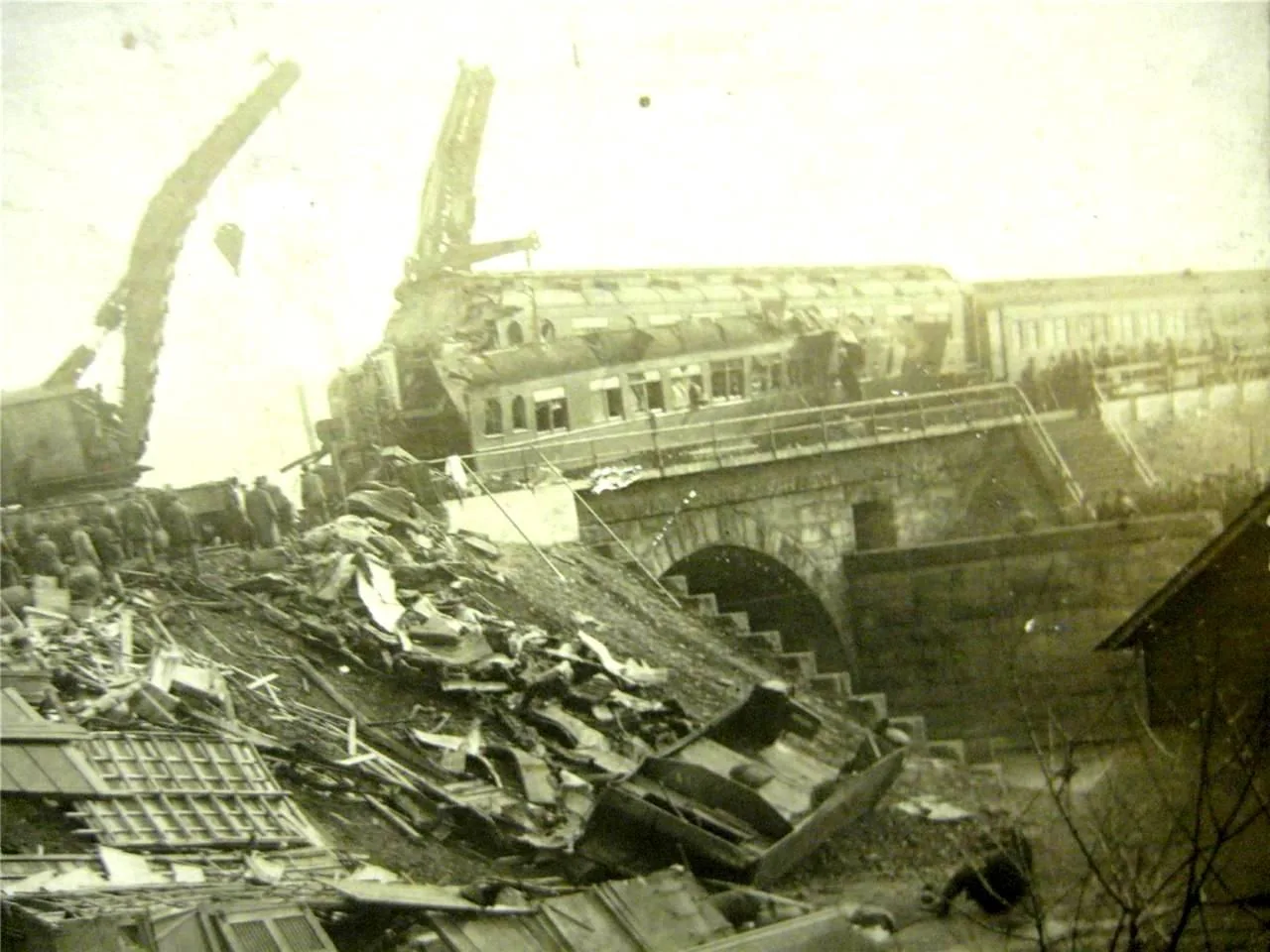
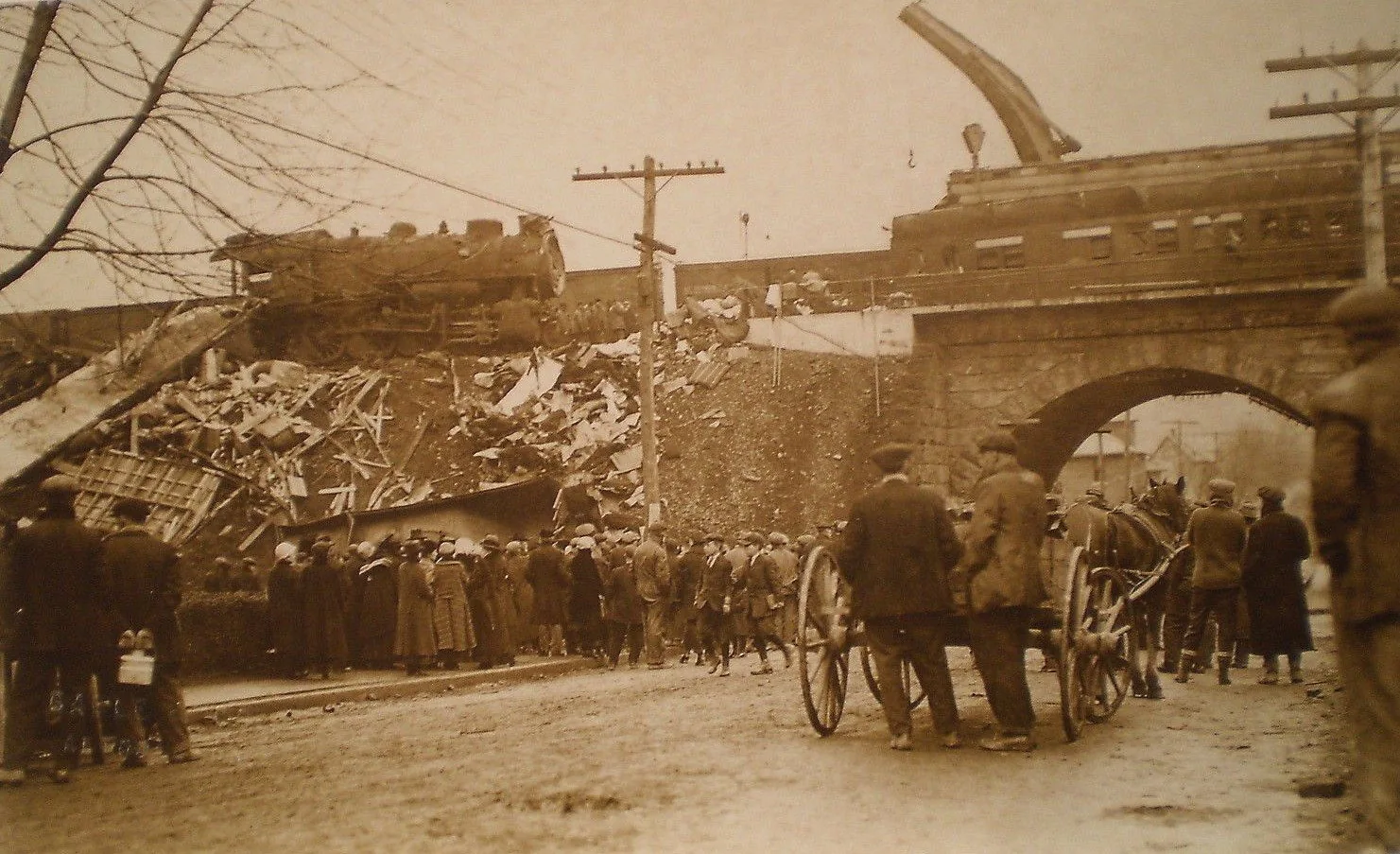
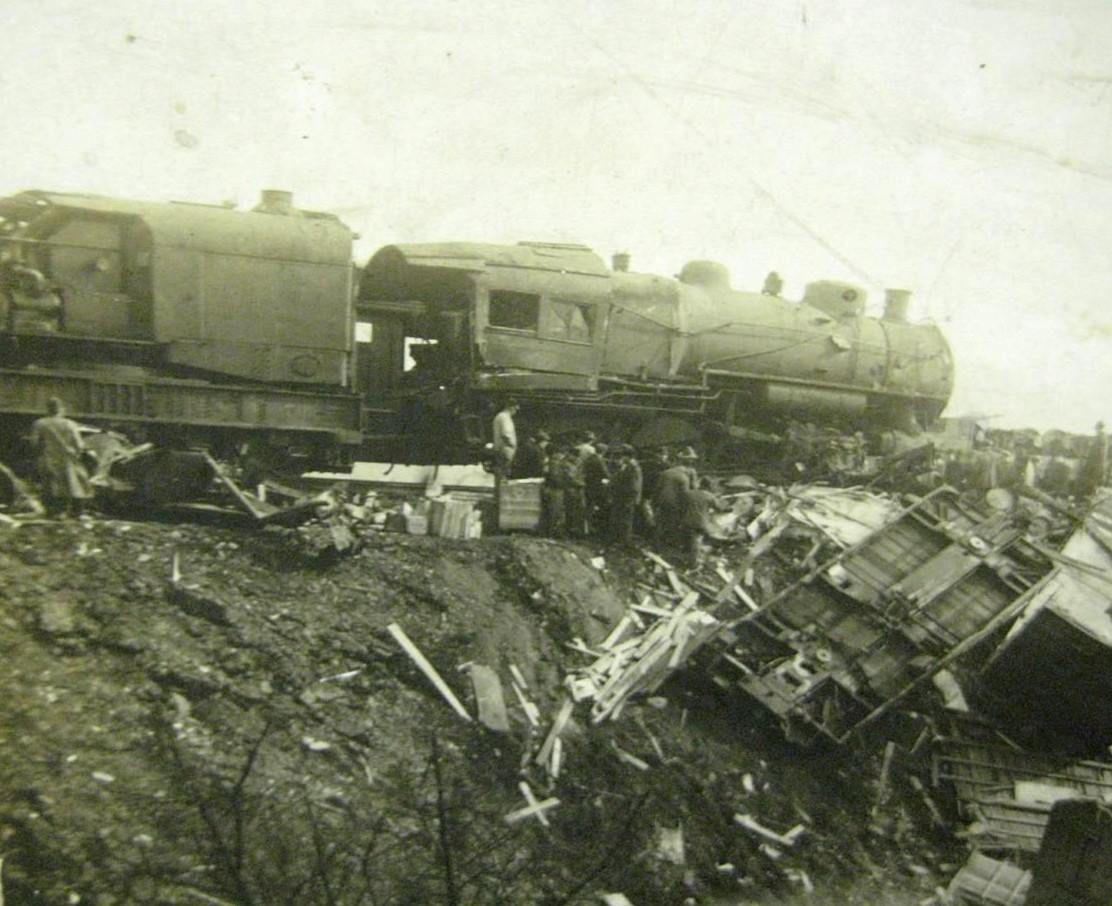
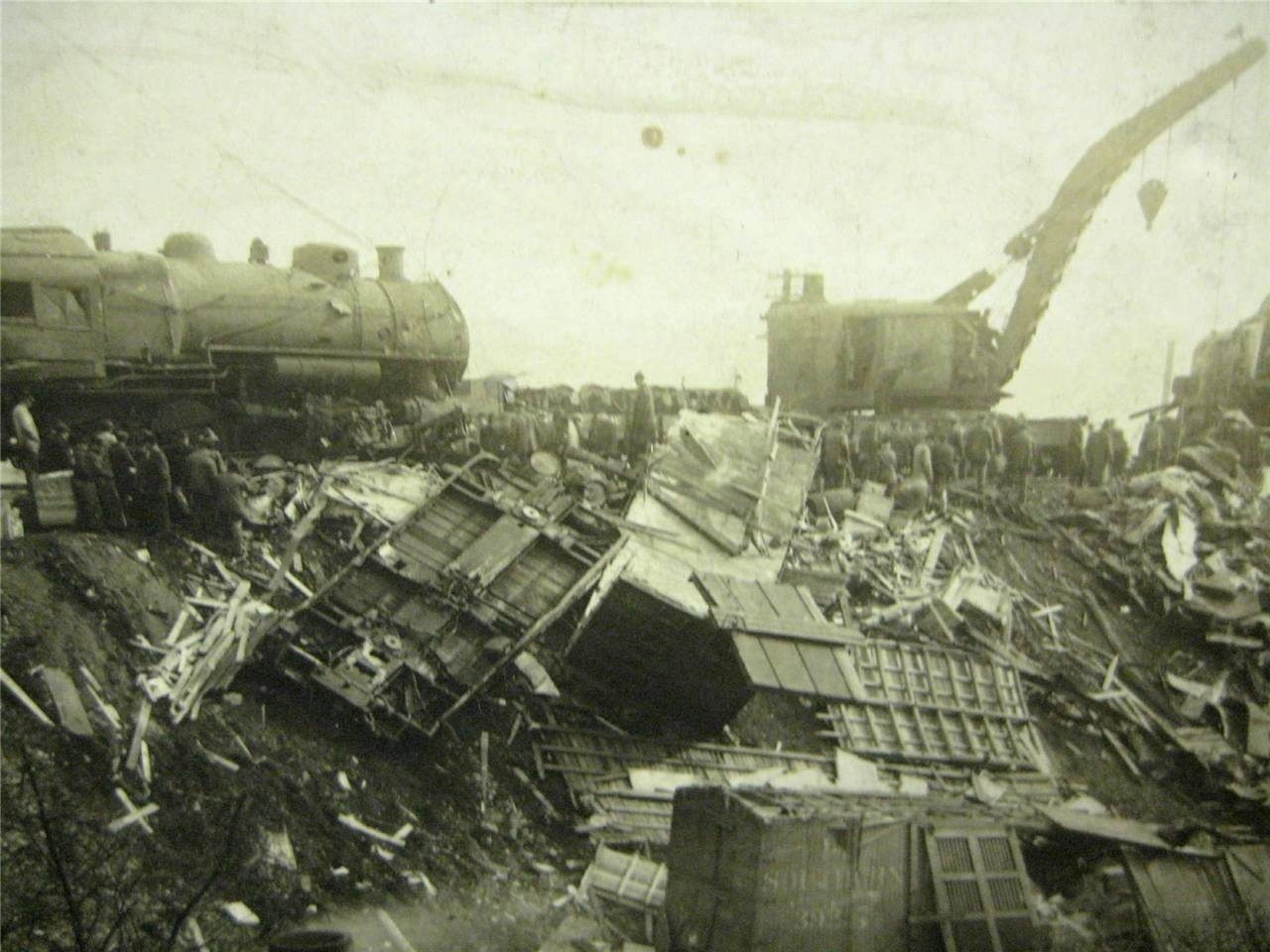
Freight locomotive No. 614 struck the rear sleeping car, Bellwood. The force drove the train forward and telescoped the sleeping car into the car ahead, crushing almost its entire interior into a space near the rear. Coal cars left the track and tumbled down the embankment, while people aboard the locomotive were trapped in the wreckage.
The Human Cost
The Interstate Commerce Commission reported twenty deaths: nineteen passengers and one Pullman porter. Hagley Museum and Library's later description refers to twenty-one passengers aboard the sleeping car. Because those institutional descriptions differ, BrickTownPA uses the federal investigation's itemized total while noting Hagley's alternate wording.
A Family Journey Devastated
Contemporary wire reports show that the loss was not simply a number. Chester A. Minds of Ramey was traveling with his wife, Doris, and their two-week-old son, Chester Jr. The same party included Chester's sister Maude; a brother-in-law whose name appeared in early reports as M. A. Caslisch; Mrs. Minds' maid, A. F. Dellin; and three children identified as Richard, Dorothy, and Jean Owen, ages seven, six, and four. A February 28 report from the University of Pennsylvania described Minds as a prominent 1914 graduate and said the campus mourned his death.
Other names in the first published identification list included Charles Levine, P. B. Pollard, Milton Hymes, J. S. Kelly, H. A. Roeffler, L. W. Montgomery, P. R. Fanning, and Pullman porter N. Bright. These spellings came through rapidly transmitted newspaper reports and should be treated as contemporary identifications rather than a final civil record. The report said every person killed had been riding in Bellwood.
What Witnesses Said That Morning
The first dispatches said the express was stopped while its air brakes were tested and described rescuers struggling to reach people inside three sleeping cars crushed together. Six coal cars were reported thrown down a roughly forty-foot embankment, and the wreck blocked traffic for hours.
Those reports also preserve the confusion surrounding the signal. Freight engineer A. T. Cook said the signal at MU tower appeared white, or clear. His fireman and brakeman reportedly understood it as green, warning that another train occupied the block. Railroad officials told reporters that in fog the engineer was expected to stop and verify an uncertain signal. The later federal inquiry established that the caution signal had been visible to the other two men, that the freight continued at about forty miles per hour, and that its engineer did not react until the next signal showed red.
A special relief train brought a wreck crew from the Pennsylvania Railroad's Altoona Shops, accompanied by railroad officials, physicians, and a coroner. The surviving photographs show the scale of the response and the violence of the impact more clearly than any later retelling could.
How the Federal Inquiry Reconstructed the Collision
The investigation placed the two trains only thirteen minutes apart at MU tower. The passenger train then lost additional time because a brake on its first mail car would not release. A crewman had gone beneath that car to cut out the air and had just emerged when the freight struck at about 12:08 a.m.
The freight was a locomotive, thirty-five loaded cars, and a caboose. Its engineer saw the final red signal only a few car lengths away. The rear of the Mercantile Express stood 276 feet beyond it—too close for a meaningful reduction from the freight's approximately forty-mile-per-hour speed. The impact drove the passenger train forward 193 feet. Bellwood was telescoped into the sleeper Bruceville, compressing nearly everyone and everything inside into about eight feet at the rear.
Breaking-news accounts warned that the death toll could exceed twenty, and some later image descriptions use twenty-one. The ICC's investigated count—nineteen passengers and one Pullman porter—is the clearest official total. This page preserves the other figure as part of the documentary record but does not combine or inflate the counts.
Why These Stories Belong Together
Both disasters were rear-end collisions. Both involved a stopped or slowed train left vulnerable to traffic approaching from behind. In 1853, warning lamps were never placed because the men assigned to protect the train sought warmth and fell asleep. In 1917, modern block signals existed, but fog, a misread indication, speed, and inadequate stopping distance defeated them.
The two events chart the evolution of railroad safety across Mount Union's history. Technology and formal investigation had advanced dramatically by 1917, yet a single misunderstood signal could still turn the main line through town into a disaster scene.
Sources
- “Rail Road Accident,” Huntingdon Journal, March 9, 1853, p. 2. NewspaperArchive scan preserved in the BrickTownPA research collection.
- United States Interstate Commerce Commission, Report of the Accident Investigation Occurring on the Pennsylvania Railroad, Mount Union, PA, 1917.
- Hagley Museum and Library, Hagley Vault account of the February 1917 Mount Union wreck; photographs from the Pennsylvania Railroad negatives collection, accession 1993.300.
- “Killed in a Train Wreck,” Chester Times, February 27, 1917, p. 1, viewed through NewspaperArchive.
- “Campus Mourns Death of Chester A. Minds, '14 C.,” Daily Pennsylvanian, February 28, 1917, viewed through NewspaperArchive.
- Associated Press dispatch, February 27, 1917, reprinted in The Daily Herald (Prince Albert, Saskatchewan), p. 3; contemporary casualty identifications and signal accounts.