Mount Union’s industrial story includes the people at sewing machines and garment presses as well as those at kilns and quarries. Mount Union Manufacturing, remembered locally as L. Greif & Brothers, turned the making of men’s clothing into a major source of work. Factory photographs preserve the scale of the building; employment records and individual lives help explain what happened inside.
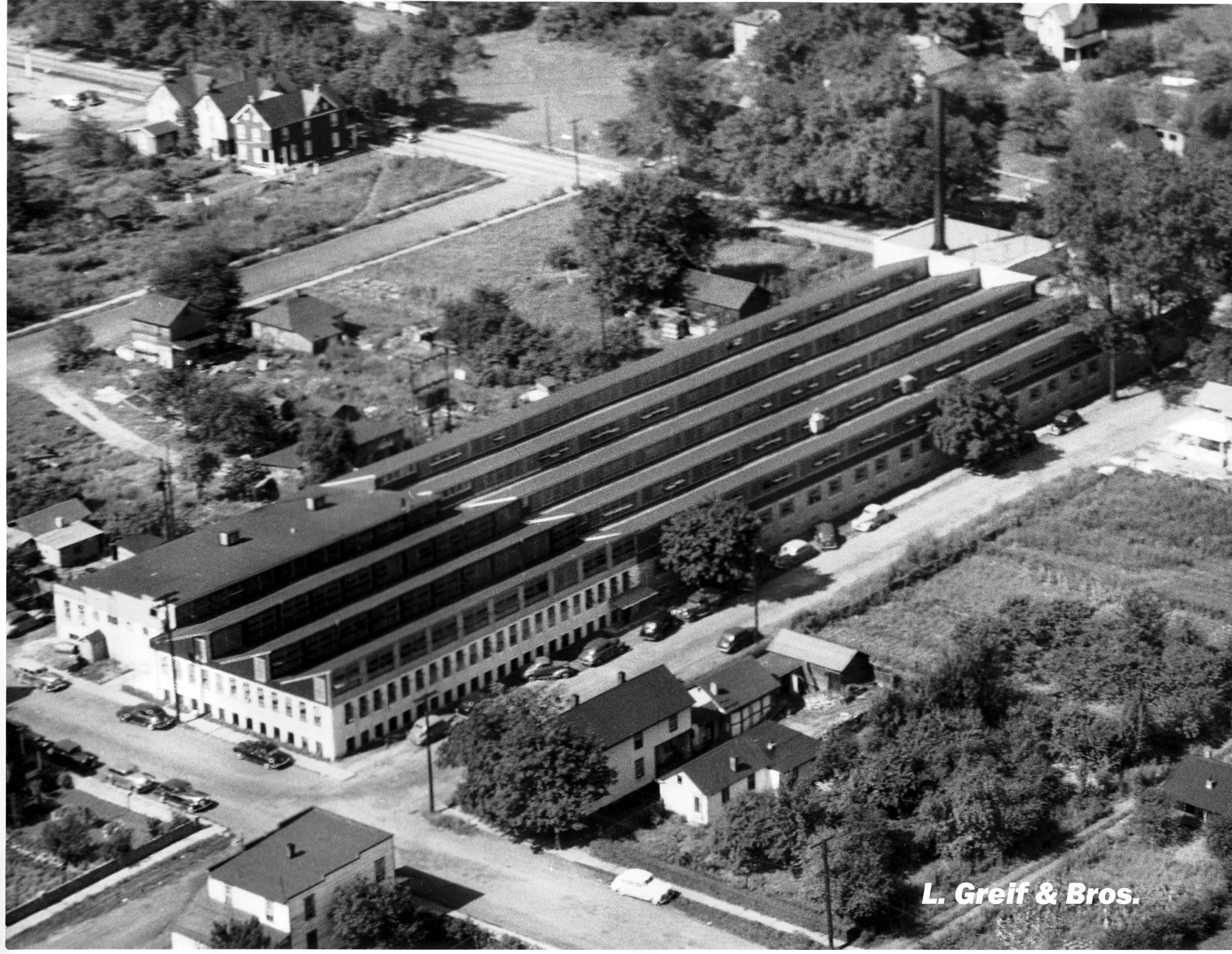
One local factory, several names
Local sources use Mount Union Manufacturing Company, L. Greif & Brothers and shortened Greif names. The Baltimore parent appears in its National Register documentation as L. Greif & Bro., Inc. The family name is spelled Greif. That record identifies Levi Greif as the company’s founder and connects the business with Baltimore’s clothing industry and German-Jewish history. It supplies corporate background; details about Baltimore’s buildings and employees should not automatically be applied to Mount Union. [3]
From a small operation to a major employer
The 1967 centennial account, reproduced by Bryan D. Donaldson, dates the business to October 1919. Nancy S. Shedd’s industrial survey lists construction in 1919 and an opening in 1920. These may describe different milestones; an original opening notice is still needed. [1] [2]
Shedd traces Greif’s purchase to 1922, when 62 women worked there. Employment rose to 174 in 1928, 314 in 1938 and 591 in 1948. Wartime production included army uniforms. By 1959, the survey counts 725 workers—roughly 100 more than the two remaining refractory plants combined. It describes an initially female workforce joined by men as brick-industry employment declined. [2]
The centennial account describes men’s suits and sport coats, reporting 715 women employed, 675 employees active daily and production of 1,200 coats a day. Those categories are preserved as reported: total employment and daily attendance are not the same measurement. They also should not be treated as figures for every year of the factory’s life. [1]
The skills behind the finished coat
A September 1957 federal notice names four kinds of work at Mount Union Manufacturing: sewing-machine operation, final pressing, hand sewing and finishing involving hand sewing. These job classifications show how many different tasks stood between cloth and a finished garment. [4]
The notice authorized a limited learner program, covering up to five percent of factory production workers for normal labor turnover. It specified 480 training hours: at least 85 cents an hour for the first 280 and 90 cents for the remaining 200. The certificate ran from September 1, 1957, through February 28, 1958, for men’s sack coats. These were authorized learner rates, not a statement of what every employee earned. [4]
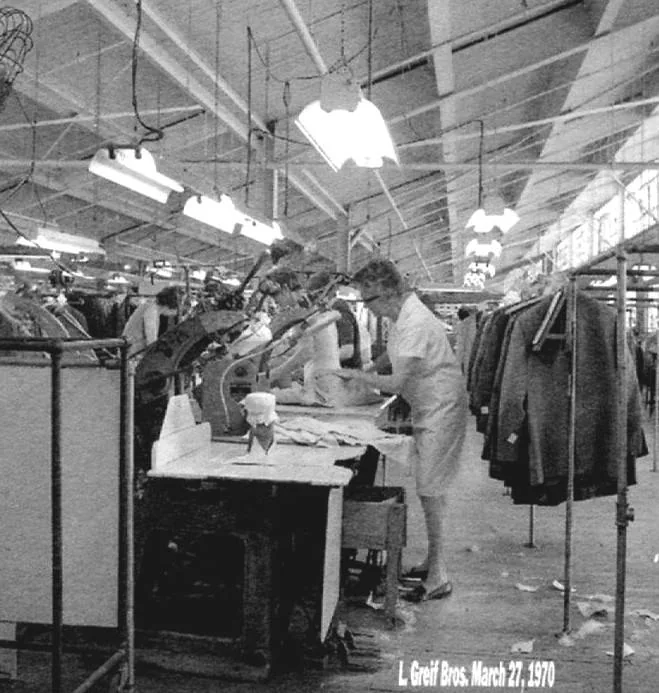
The photograph brings the occupational terms into view: pressing equipment, garments waiting on racks, overhead lights and a worker attending to a piece at the workstation. It cannot tell us the person’s name, rate of pay, production quota or feelings about the job. Those are stories that employee records and firsthand recollections can add.
People whose working lives are documented
Barbara Ann Atherton worked as a seamstress for Greif Industries, according to her family’s published obituary. She later served as an administrative secretary in the guidance center at Mount Union Area Junior Senior High School. Her employment dates at Greif are not specified. [5]
Richard N. Ernest, a 1963 Captain Jack High School graduate, worked more than twenty years at the businesses identified in his obituary as Greif/Dalco Industries. He later became a clothing-manufacturing factory foreman at SCI Huntingdon. The combined employment description does not mean that all those years were spent under Greif ownership. [6]
These are two documented examples, not a complete employee roll. Their histories show how garment work connected with other parts of community life and how manufacturing skills could carry into later careers.
The newer plant and the Genesco question
A dated borough record establishes that the newer location was already part of local planning in 1970. Ordinance 586, dated July 1, 1970, authorized sewer construction from the L. Greif and Bro. plant site in Shirley Township to the borough, with funds transferred to the municipal authority. It documents infrastructure authorization, not the first day of production. [7]
The corporate chronology needs care. Shedd associates Genesco with 1971, but the Baltimore National Register account dates the parent company’s sale to Genesco to 1959. Cornell’s labor-archive catalog also lists Greif under Genesco subsidiaries in records dated 1967. Those records establish that the relationship predates 1971; that year should not be presented as an uncontested first acquisition date. [2] [3] [8]
Closure and a later garment-making chapter
Shedd reports that the old plant made coat components for assembly at the newer factory, that both closed in 1974, and that Dallco occupied the Pine Street building from 1978. This is the survey’s retrospective chronology, not a verified last-shift date. [2]
Donaldson’s overview says early 1970s, while a caption describes closure only months after the March 1970 photographs. Because those accounts differ, this page attributes the 1974 date and leaves the exact sequence open. A contemporary closure announcement could distinguish a move, a departmental shutdown and the end of the overall operation. [1]
Help put names to the working day
Did you or someone in your family work at Greif, Mount Union Manufacturing or Dallco? We welcome photographs, job titles, employment dates, pay envelopes, union material and memories of coworkers. If you recognize the pressing-room worker, please tell us how you know.
Sources and research notes
- Bryan D. Donaldson, Brick Town USA: Mount Union, Pa., volume 1 (2006), printed pp. 87–88, PDF pp. 97–98. Includes the reproduced 1967 newspaper account and dated factory photographs. About the supplied book. Reprinting a newspaper account does not provide independent corroboration of that account.
- Nancy S. Shedd, Huntingdon County, Pennsylvania: An Inventory of Historic Engineering and Industrial Sites (1991), printed pp. 161–163, PDF pp. 177–179. Entry cites county tax assessments, state industrial directories and the 1976 Bicentennial Keepsake. Its descriptions of occupancy refer to the survey period, not today.
- National Register nomination: L. Greif & Bro., Inc. Manufactory, Baltimore, Section 8, especially pp. 1 and 10. Used for name, founder and parent-company context.
- Federal Register, September 13, 1957, p. 7347, learner-certificate notice for Mount Union Manufacturing Company.
- Barbara Ann Atherton obituary, Anderson Family Funeral Homes, January 2026. Used only for the stated employment history.
- Richard N. Ernest obituary, Anderson Family Funeral Homes, April 2026. Source spells the later employer “Dalco”; the industrial survey uses “Dallco.”
- Borough of Mount Union, Legislative Enactments, sanitary-sewer record, Ordinance 586, July 1, 1970.
- Cornell University, ACTWU Research Department Company Records, 1937–1995, Box 44, Folder 82, Greif & Co., financial and general records, 1967. The catalog was reviewed; the underlying folder was not.
Further research: original opening and closing notices; the newer plant’s production-start date; local union and payroll records; named workers and supervisors; and the later Dallco chronology. Photograph identities are not inferred from appearance.