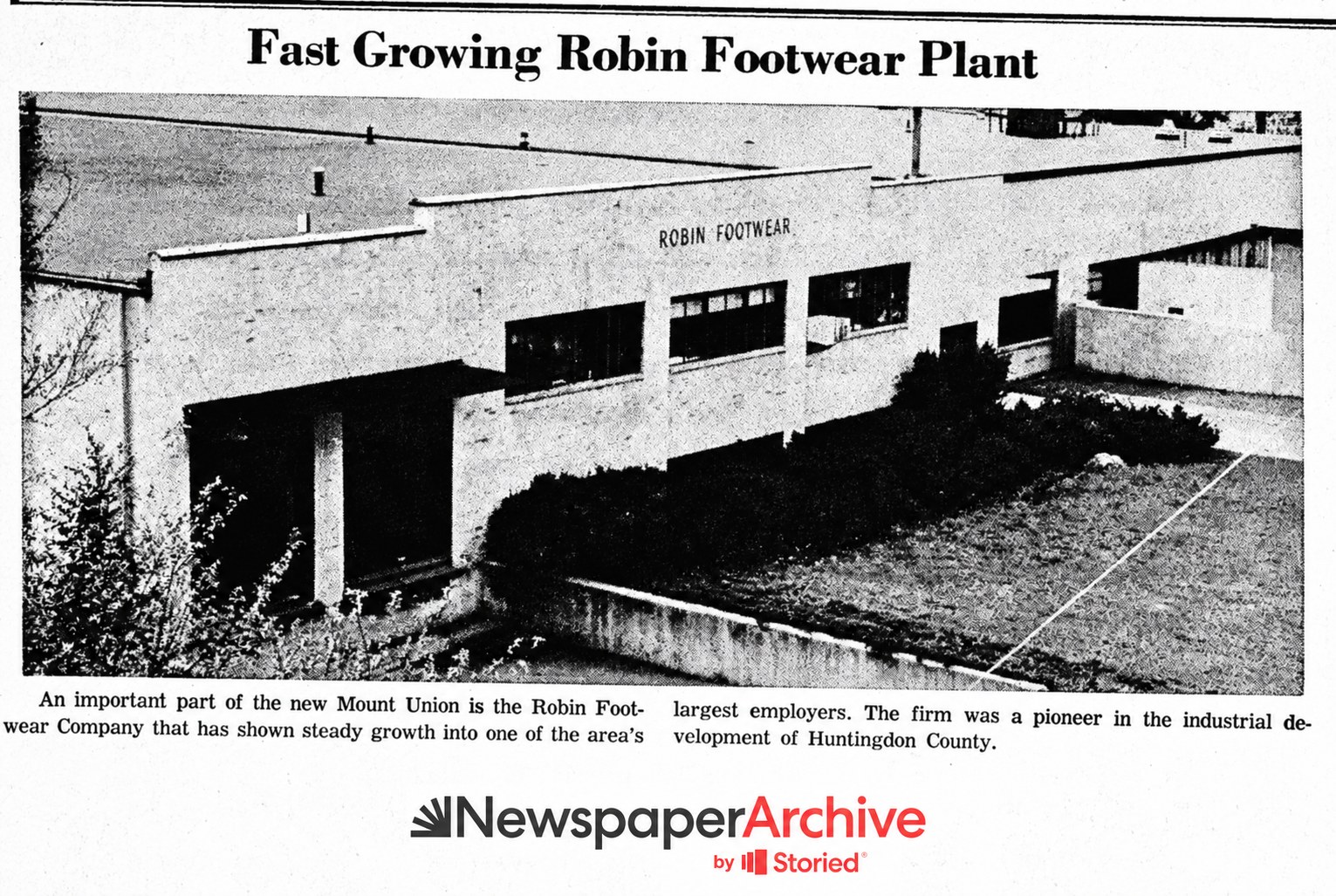
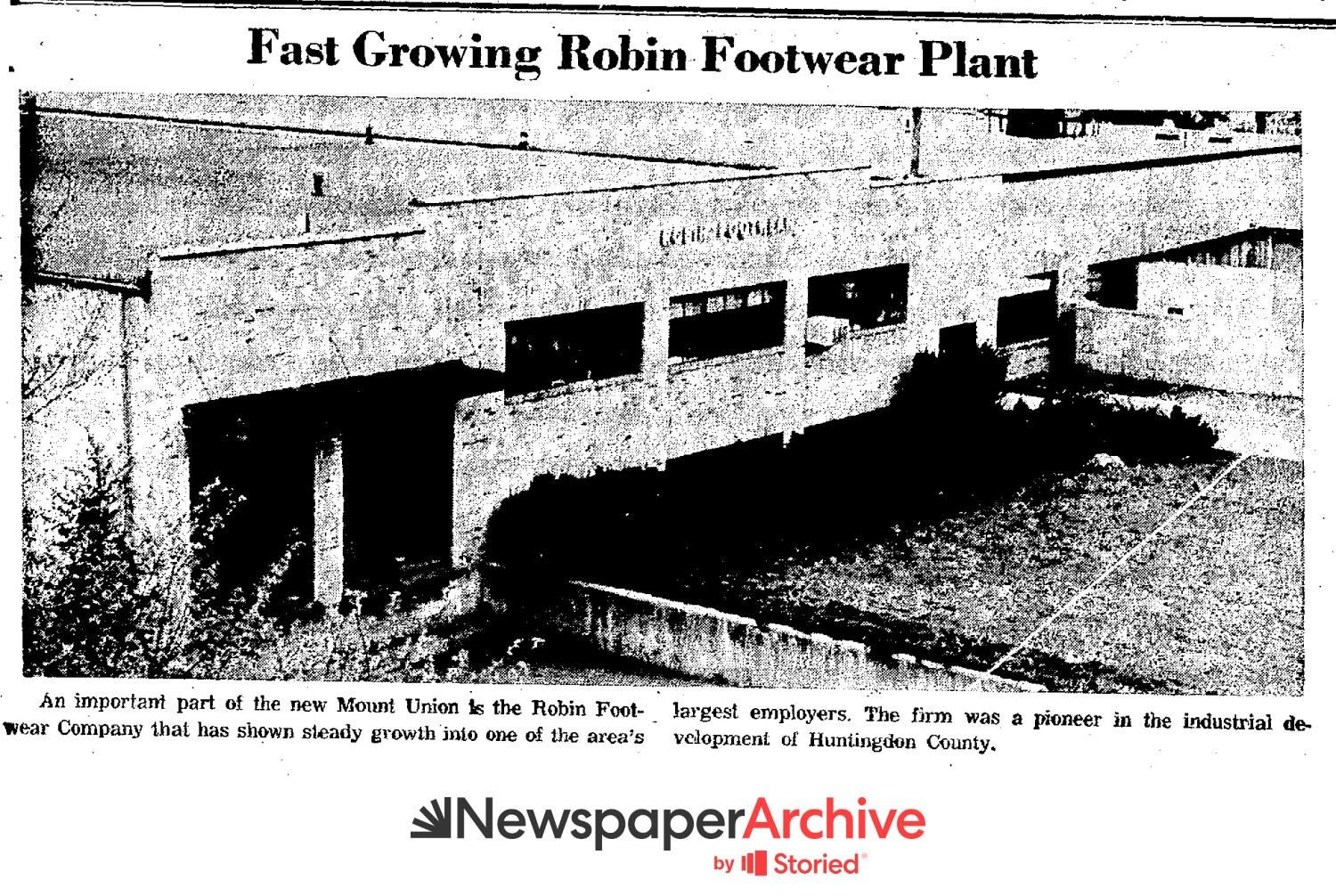
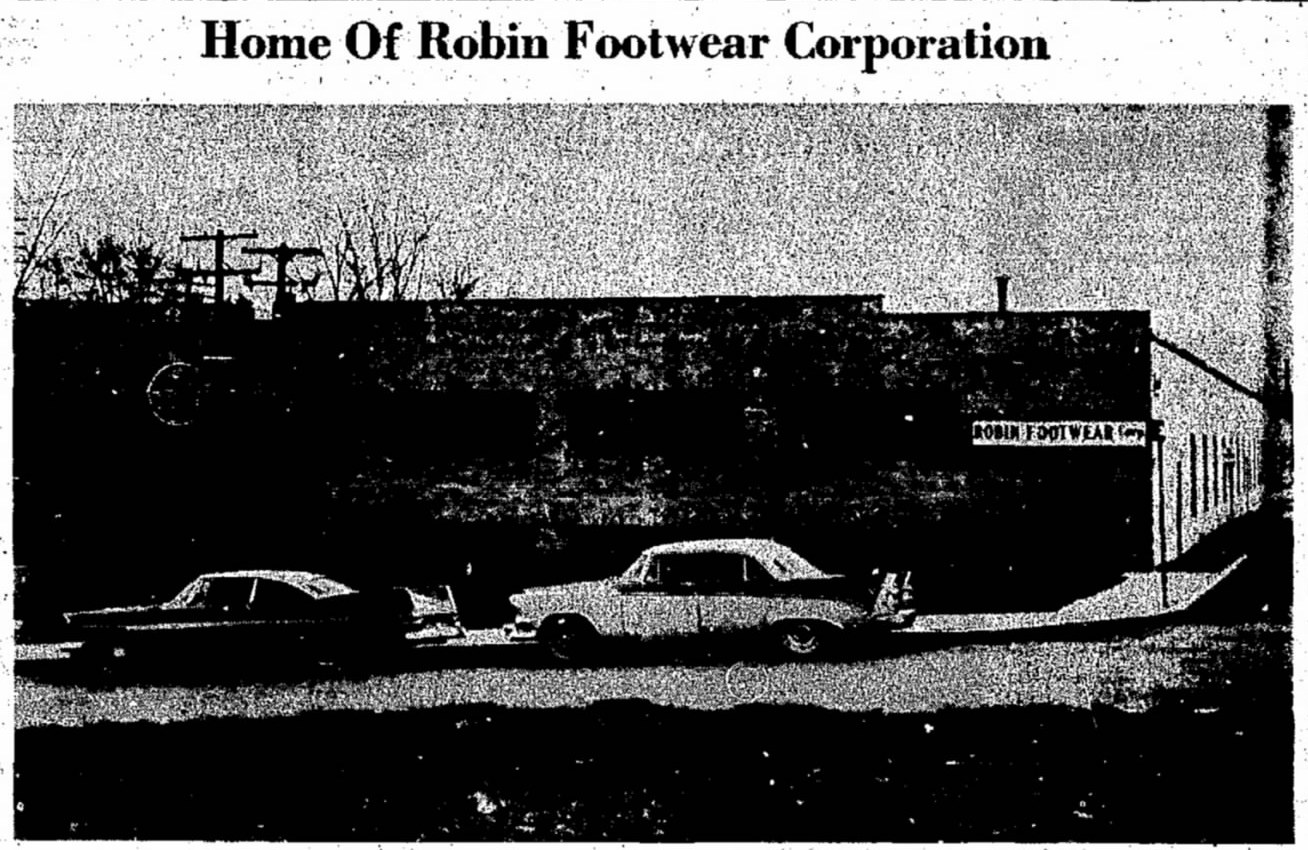
Robin Footwear’s name had a family story behind it. When S. Rosen and Son Company moved from Brooklyn to Mount Union, the business took the name of president Sam Rosen’s granddaughter, Robin, daughter of Mr. and Mrs. Harvey Ginsberg. Her photograph hung in his office. At 208 North Division Street, beside the railroad underpass, the shoe factory became an important source of local employment. [2]
Learning to make shoes in 1958
An August 21, 1958 newspaper welcome described a $230,000 industrial project. An October 4 account reproduced by Bryan Donaldson counted 95 trainees, with training director Charles Johnston hoping to prepare 140 people. Nat Putterman taught cutting, Charlie Femia stitching, and Ralph Rosen cleaning and packing. About 6,000 shoes produced during training went to state institutions rather than into retail sales. The account says shoes, not pairs. [4] [10]
The opening accounts describe different milestones: a 1967 retrospective says operations began in September 1958 with 65 employees; the 1962 feature recalls an initial workforce of 30; the October 1958 training report says regular production still lay ahead. “Established in Mount Union in 1958” is the supported general date. An exact commercial-production opening remains unresolved. [1] [5] [10]
A community invests in work
Mount Union Area Development Inc., led in the 1962 account by president David K. Goodman and secretary Melvin Devin, helped recruit and finance the company. Local banks and the Pennsylvania Industrial Development Authority participated. The original 32,347-square-foot factory was built by J. M. Young of Belleville; the reported building cost was $181,318.80. That narrower construction figure should not be equated with the earlier overall project estimate. [1] [2]
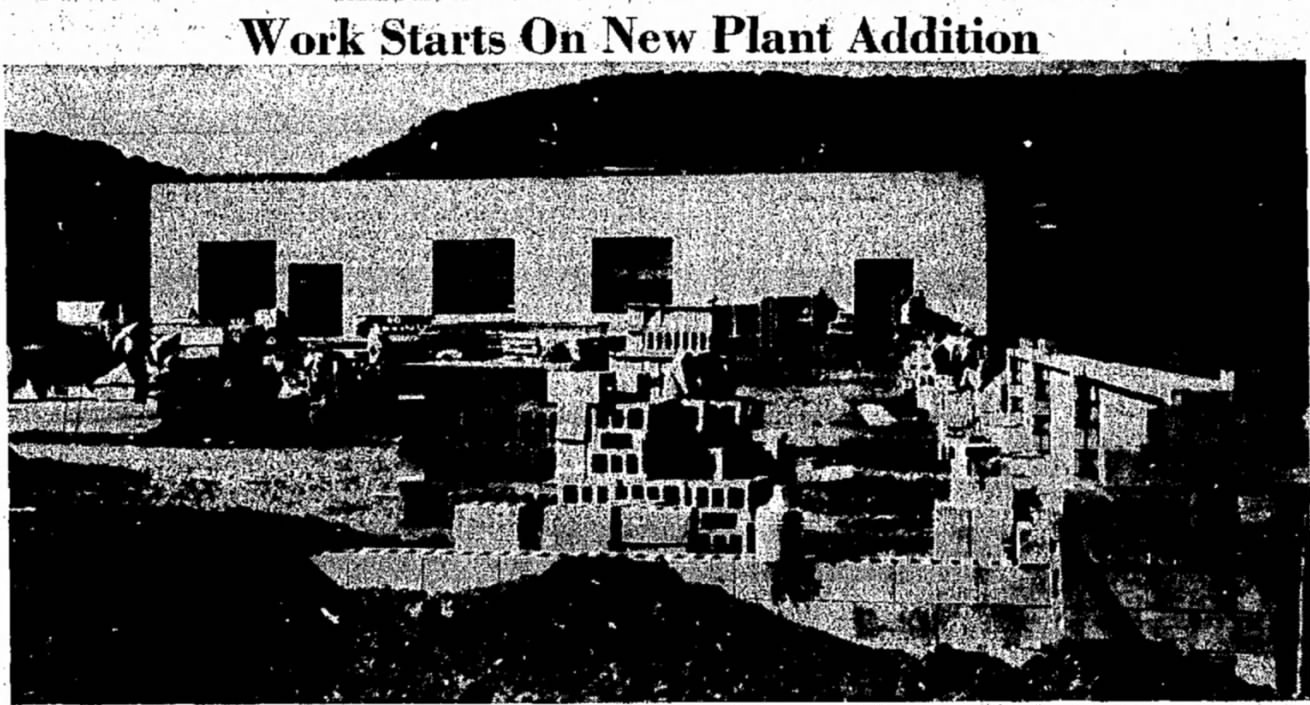
L. C. Anderson & Sons began a 12,000-square-foot addition in October 1961 and turned it over April 1, 1962. Its $68,172 financing comprised $33,000 from local banks, $26,400 from PIDA, and $8,772 from the development corporation; a separate $20,000 machinery fund was also reported. The enlarged building totaled 44,347 square feet, with parking for 96 cars. A May 5 open house offered tours and refreshments from 1 to 5 p.m. [1] [2]
The 1967 retrospective describes another 15,000-square-foot addition, begun in 1965 and finished in 1966 at a cost of $132,000, including an air-conditioned office. [5]
The shoes and the people who made them
In May 1962, the paper reported 250 employees, monthly payroll exceeding $70,000, and women’s leather flats retailing for about $3–$5. Distribution reached all 50 states and South America. Management anticipated 350 employees and an $800,000–$900,000 annual payroll; those were forecasts. [1]
Approximately 50 styles were in production. The line included stadium boots, with or without plush lining. Ralph Rosen and a designer considered fashion, fit, comfort, customers, and manufacturing limits. Cement construction bonded the uppers and soles under pressure. Approval of a training program for 90 workers was reported; completion by all 90 is not established. [2] [3]
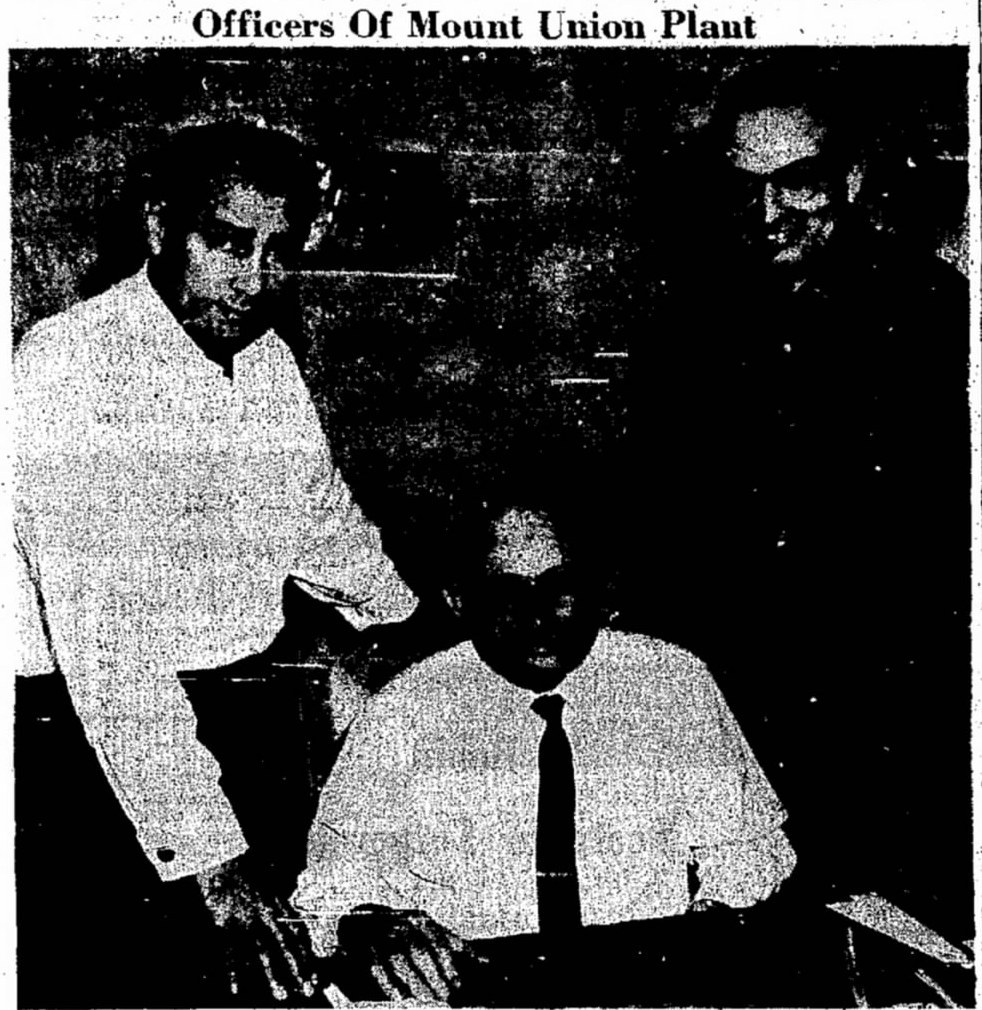
The 1962 officers were Sam Rosen, president; Ralph Rosen, vice-president and secretary; and Charles Femia, superintendent and treasurer. Femia was president by August 1977, when Ralph Rosen remained vice-president. The reviewed sources do not establish the terms of that leadership change. [1] [6]
Donaldson’s April 1962 factory photographs name Samuel C. Skipper Sr., Gerald S. Colbert, and Anna Todaro and credit the Huntingdon County Historical Society. Those names connect the building’s history to the people on its floor. Management’s praise for attendance and trainees should remain attributed to management, rather than being treated as a complete account of workers’ experiences. [10] [3]
Import competition and the effort to keep Robin open
A Boot and Shoe Workers Union petition led to Labor Department investigation TA-W-1152 in October 1976. Employment had declined month by month beginning that February; third-quarter employment was 28% below the preceding quarter and 35% below the same period in 1975. Estimated production from orders fell 10% in the first eight months of 1976 compared with 1975. Customers were buying more imported footwear while reducing Robin orders. [7]
The department concluded that increased imports contributed importantly to worker separations. Its December 23, 1976 certification, published January 4, 1977, covered workers totally or partly separated on or after January 31, 1976. That eligibility date was not a factory-closing date, and the finding does not establish imports as the sole cause of the eventual closure. A separate company assistance petition was accepted March 29, 1977. [7] [8]
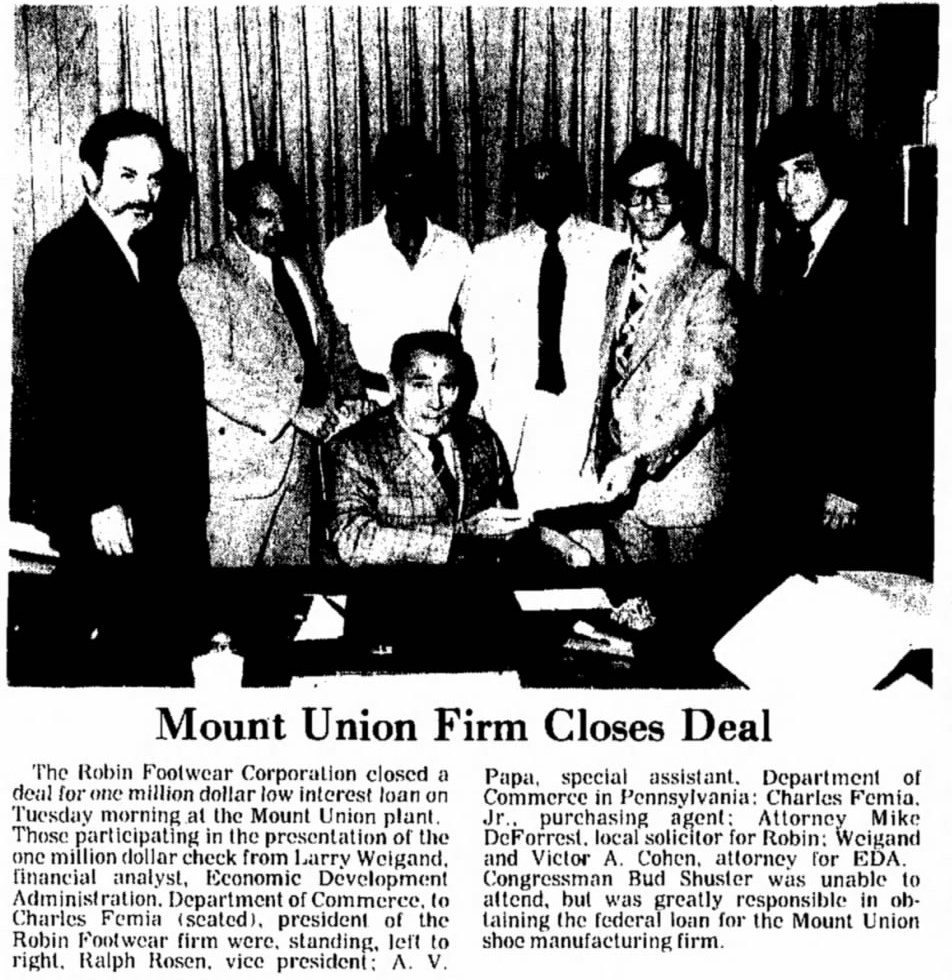
On August 30, 1977, Robin closed a $1 million low-interest federal loan. Charles Femia received the check from Economic Development Administration analyst Larry Weigand and credited Congressman Bud Shuster’s assistance. The stated aims included working capital, materials, orders, and recalling or hiring workers. This documented an effort to recover, not proof that recovery followed. [6]
Closure and the building afterward
Donaldson dates the closure to 1981. A contemporary shutdown announcement has not yet been located, so an exact closing day remains unverified. By July 2, 1984, the newspaper reported the building for sale, owned by the Economic Development Administration and marketed with Huntingdon County Business and Industry. James Ott supplied a sale sign. The article does not establish when or how federal ownership began. [9] [10]
Photographs from the newspapers
Sources and remaining questions
- S1: The Daily News, May 4, 1962, p. 5, open-house feature and officers’ photograph. Archive.
- S2: Same issue, p. 6, name origin, financing, addition, boots. Archive.
- S3: Same issue, p. 7, styles, construction, training, factory exterior. Archive.
- S4: The Daily News, August 21, 1958, p. 3, welcome advertisement. Archive. Viewed in browser; full-page download not retained.
- S5: The Daily News special edition, June 6, 1967, printed p. 14, archive image 28, “New Robin Footwear Aids Growth.” Archive. The reviewed portion is the upper company-history article.
- S6: The Daily News, August 31, 1977, p. 1, million-dollar loan. Archive. Article continues on p. 7, not reviewed here.
- S7: Federal Register, January 4, 1977, vol. 42, p. 895, TA-W-1152. Official PDF.
- S8: Federal Register, April 5, 1977, p. 18119. Government PDF.
- S9: The Daily News, July 2, 1984, printed p. 3, archive image 20, “Robin footwear plant for sale.” Archive. Short item read in browser; no full-page download retained.
- S10: Bryan Donaldson, Bricktown USA, vol. 1 (2006), printed pp. 92–93; local PDF pages 102–103. Includes 1958 newspaper account and April 1962 photographs credited to Huntingdon County Historical Society.
Further records are needed for the exact opening and closing dates, the legal ownership chain, and a full history of wages, working conditions, and employees. Newspaper leads include October 11, 1958 training coverage, November 10, 1959 company coverage, later expansion reports, and 1981 employment notices. Syracuse University’s Frank A. Johnson Papers finding aid lists a 1961 Robin Footwear folder; its contents have not been examined.
Share a Robin Footwear memory, worker identification, or photograph.