A place that survived more than one beginning
On a spring day in 1936, a filing cabinet lay about 200 yards downstream from where it belonged. Inside were the records of the Juniata Valley Colony Club. The flood had soaked them until they could no longer be read. The cabinet had been kept in the John Corson home, which the water demolished; the club’s typewriter was ruined too.
That small scene captures the difficulty of telling this history. The flood carried away homes and possessions, and it also destroyed part of the club’s own memory. What survives must be assembled from newspaper reports, a court opinion, photographs, later recollections and the records of the institution that followed.
Today’s American Legion Country Club grew out of an ambitious 1920s recreation and cottage development near Mount Union. Its story includes a nationally known golf designer, a pioneering woman architect, a financial crisis years before the flood, a failed trustee sale, and a Legion purchase that contemporary newspapers place in April 1938. Almost nine decades later, the property would help the Legion recover from a different disaster.[10], [13], [26]
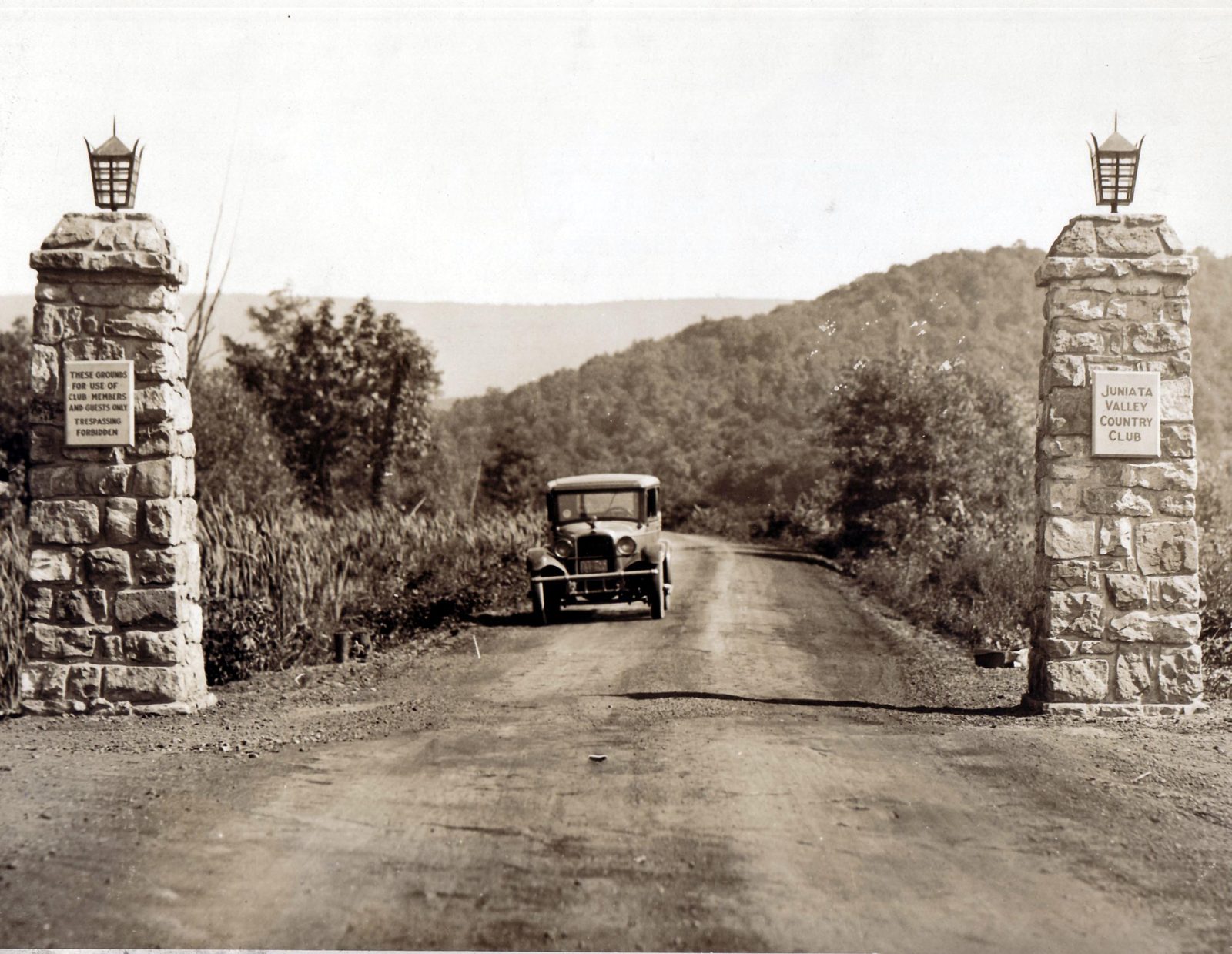
1924: an idea takes shape
The August 29, 1924 Mount Union Times reported that the Juniata Valley Realty Corporation and Juniata Valley Country Club had organized the preceding Tuesday evening—August 26—with 128 stockholders and charter members. R. P. M. Davis was a central promoter. The newspaper gives contemporary support for the organizing date; the corporation’s legal charter date still requires its original filing.[37]
By September, however, the project is firmly visible in contemporary news. The Daily News of September 23, 1924 printed a letter from golf architect Tom Bendelow to Davis. Dated September 18 in Chicago, it followed Bendelow’s visit to the proposed site. Frank Adams had helped secure his involvement.
Bendelow liked what he saw. He had expected the surrounding mountains to make finding suitable ground difficult, but the property offered rolling, varied land that was not excessively steep. He considered it suitable for an eighteen-hole course. The letter gives the project an unusually clear early voice: before the clubhouse, the pool and the cottages were complete, a golf architect was evaluating the land itself.
This is a planning date. It should not be turned into a claim that a completed eighteen-hole course opened in 1924. The contemporary record shows a development built in stages over the following years.[22], [1]
The land behind the dream
The founding-week report identifies the seller of the original tract: Hercules Powder Company. The property was the Walter Gifford farm, formerly the Cowden farm, comprising a reported 300 acres and about two miles of Juniata River frontage. Gifford was the farm’s identifying name; the report names Hercules as the seller. It describes the farm and frontage together, not two separately documented purchases.[37]
By August 18, 1926, The Daily News described 585 acres, including 150 wooded acres, assembled from the W. S. Gifford, David Walls and old Silver Ford farms. Nine days later, Davis’s prospectus claimed the corporation owned 600 acres, bounded on two sides and for three miles by the river. The exact acreage and the individual sellers of the Walls and Silver Ford properties remain to be checked against deeds. Farm names alone do not establish who signed a conveyance.[2], [38]
The Realty Corporation was developing a summer community as well as a golf course. Its 1924 plan called for 1,000 shares at $50 par value, plus 2,000 no-par-value shares. Each initial subscriber purchased four par-value shares, or $200. Stock subscriptions and sales of an initial 400 cottage lots were intended to finance roughly $125,000 in improvements. That figure was a development estimate, not the land’s purchase price.[37]
In his 1926 prospectus, Davis described about 500 potential home sites and plans for 120 rental cottages. He reported 140 subscribers paying $28,000 for stock and $14,000 worth of lot sales. His proposed revenues included home-site sales, cottage rentals, transient visitors and dues. These were the promoter’s claims and plans, not an audited statement or proof that all those cottages were built.[38]
Building a summer community
An August 18, 1926 report described a much larger undertaking than a golf course alone. The development then encompassed a reported 585 acres, including 150 acres of woodland, assembled from the W.S. Gifford, David Walls and old Silver Ford farms. Roads, water, sewer service and places to stay were part of the investment.
The new clubhouse was under construction. The newspaper credited its design to A.W. Kichline of Bellefonte, a spelling variation of Anna Wagner Keichline. The independent architectural biography published by the Beverly Willis Architecture Foundation also identifies the clubhouse as her work. Keichline was Pennsylvania’s first registered woman architect, making this building part of a broader architectural history as well as a local one.
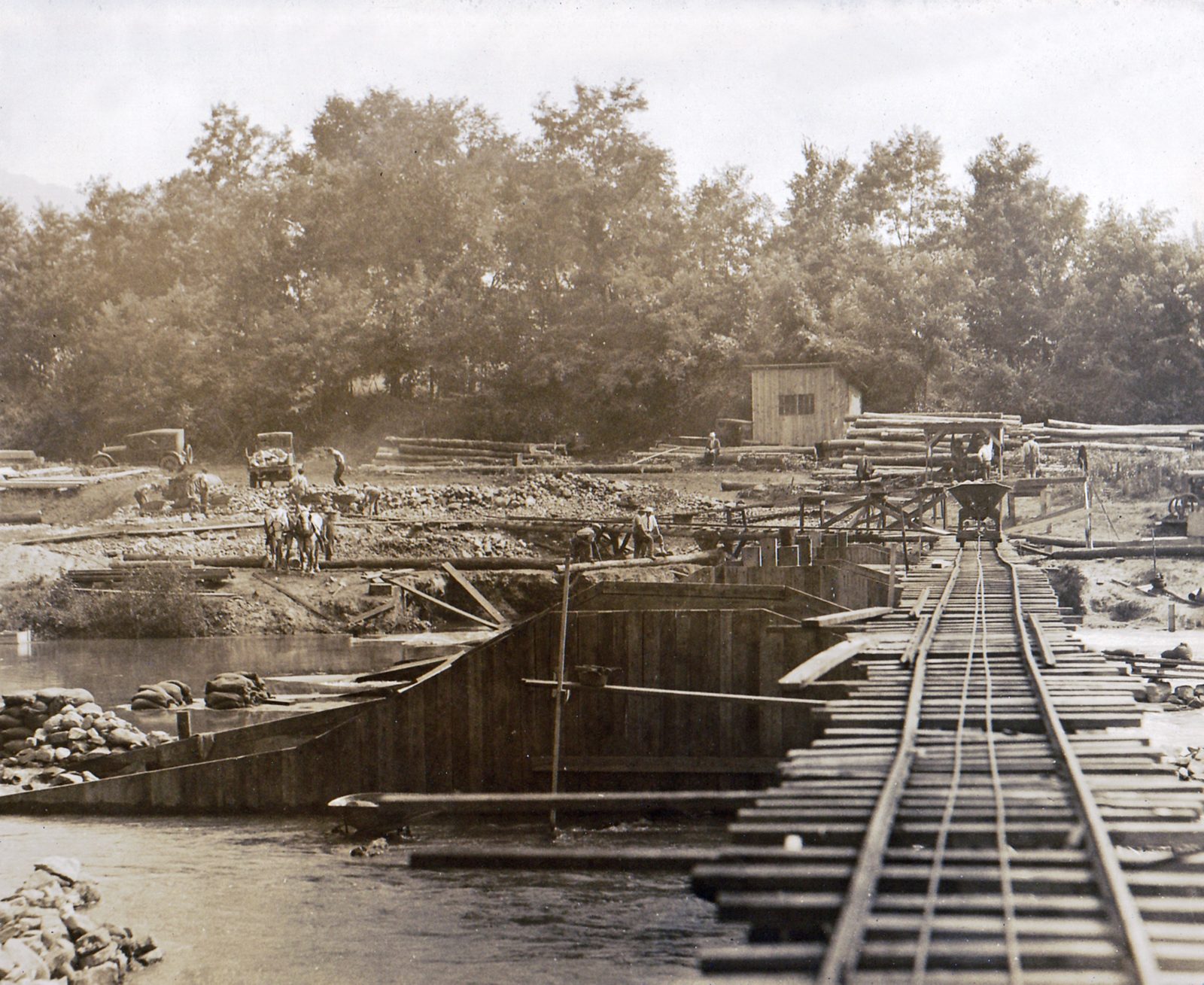
Mount Union contractor Charles H. Baldwin was building a clubhouse described as Spanish in character, with native stone and stucco. Some stone came from abandoned farm buildings and old canal bridge piers. The reuse placed material from the valley’s earlier working landscape into a building intended for recreation.
The plan included broad porches, French doors and a main room reported as thirty by forty-five feet. Below were lockers, showers and other service and recreation rooms. Residents could inspect a miniature model displayed in Laird’s drugstore window. This was a project people in town could watch take shape, both on the ground and in a shop-window model.
The same report explicitly identified Bendelow as the golf architect and Ralph Ganoe as the superintendent who expected the course to be ready the following spring. Tennis, swimming, boating, fishing and trapshooting were among the proposed attractions. The country club was the center of a planned leisure community.[2], [5]
August 12, 1927: the clubhouse opens
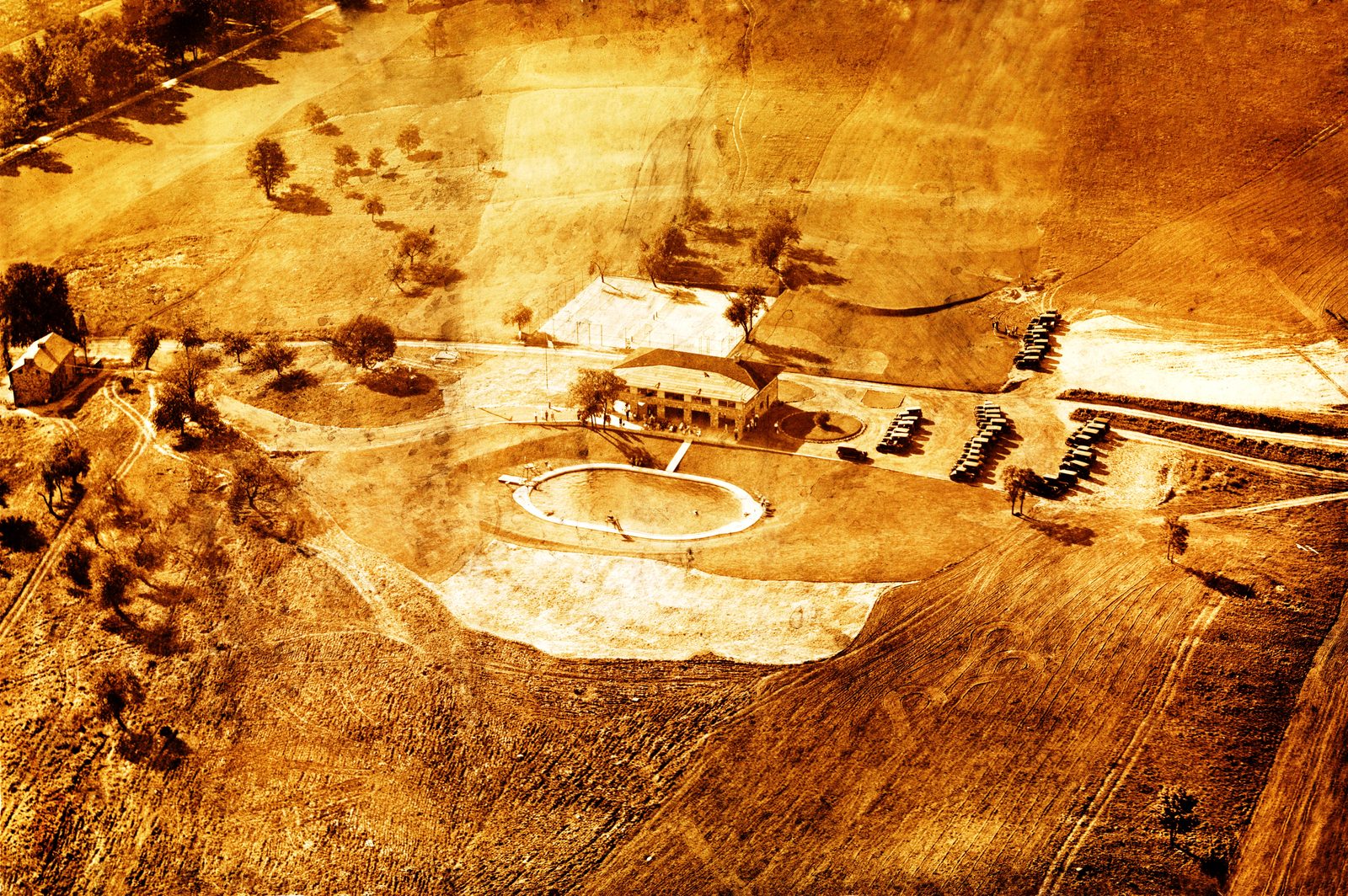
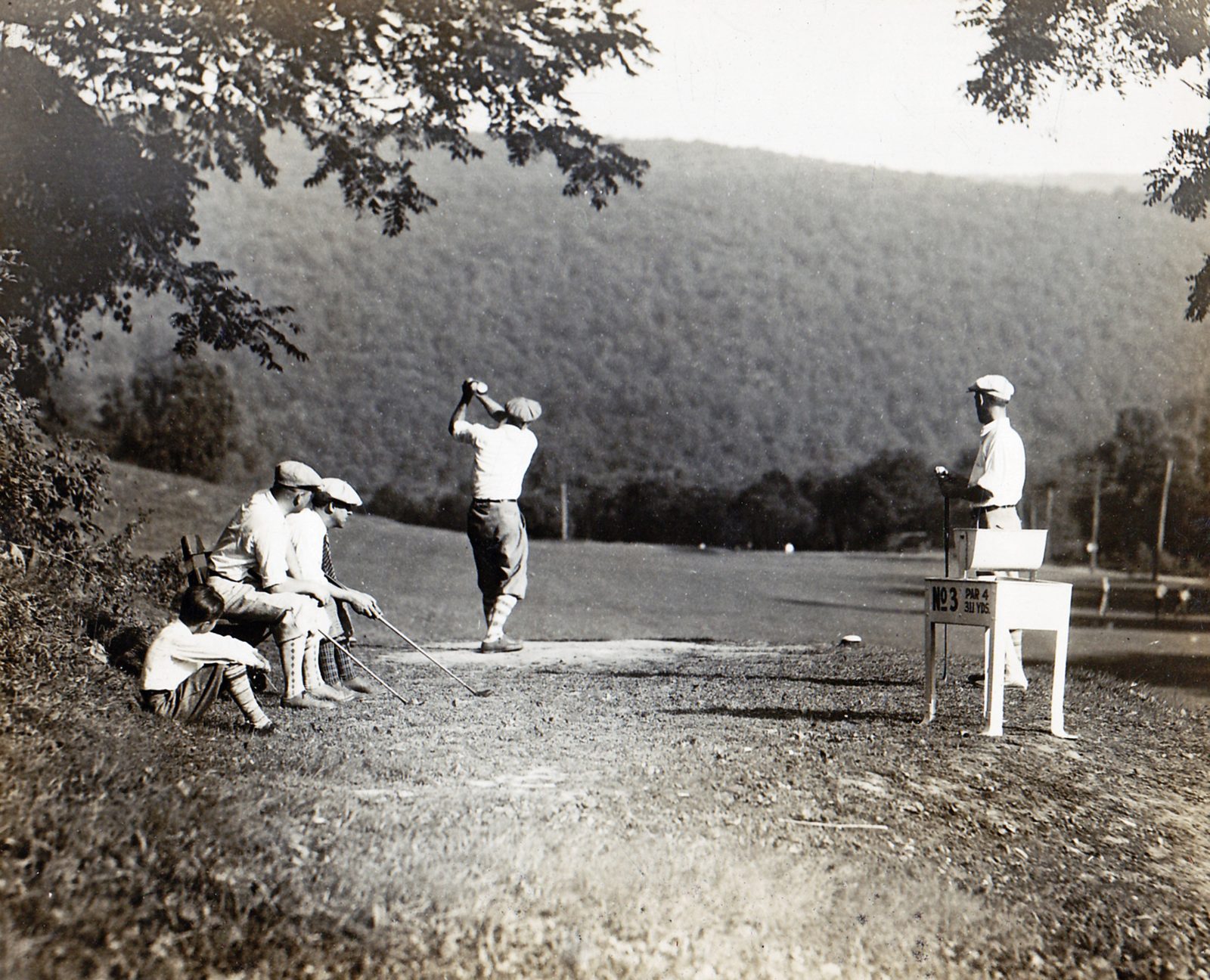
The clearest opening evidence comes from two reports only weeks apart. On July 27, 1927, The Daily News announced a formal clubhouse opening for members on August 12, with a dance. The first nine holes were already in use. A swimming pool, reported as one hundred by seventy feet, was nearing completion, and tennis courts were expected shortly.
The Altoona Mirror of August 18 then reported that the formal opening had taken place the previous Friday night. Together, the announcement and follow-up establish August 12, 1927 as the formal clubhouse opening. References elsewhere to 1926 construction or 1928 activity describe different stages of the same development.
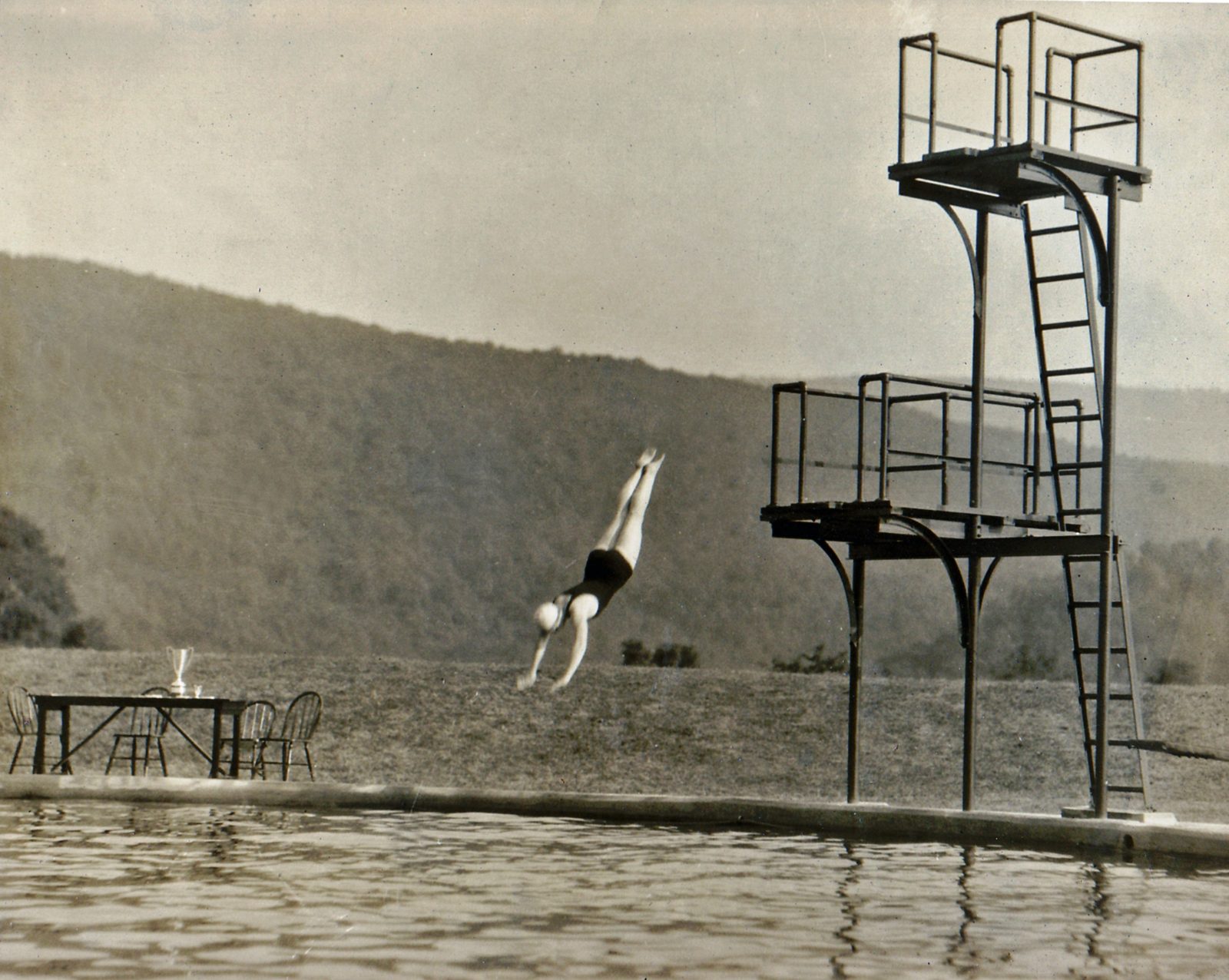
The August account described a concrete swimming pool, diving facilities and lighting for evening use. Nine additional golf holes had been started. Cottages were to have electricity and water; seven rental cottages were expected by the end of the summer. An old manor house had been converted into a tavern accommodating twenty-four people.
The organizers’ ambitions exceeded what was already finished. The July report referred to a proposed twenty-seven-hole course, while the August report described the first nine and work toward another nine. The distinction matters: plans tell us what the promoters hoped to build; opening reports tell us what guests could actually use.[3], [4]
The people who made the place work
The club soon had enough activity to support its own publication. The Altoona Mirror reported that the first issue, dated January 23, 1928, included an aerial clubhouse photograph taken the previous October. Members were invited to suggest a name for the paper. That modest publishing venture suggests an organization trying to keep a dispersed membership connected between visits.
Social notices supply another view of daily life. In September 1928, the Mount Union Times reported that Mrs. Philip H. Jung entertained at a bridge luncheon for Mrs. Charles Poage of Maryville, Tennessee. Such notices preserve the club as a gathering place, where guests, family friendships and summer visits mattered alongside sporting results.
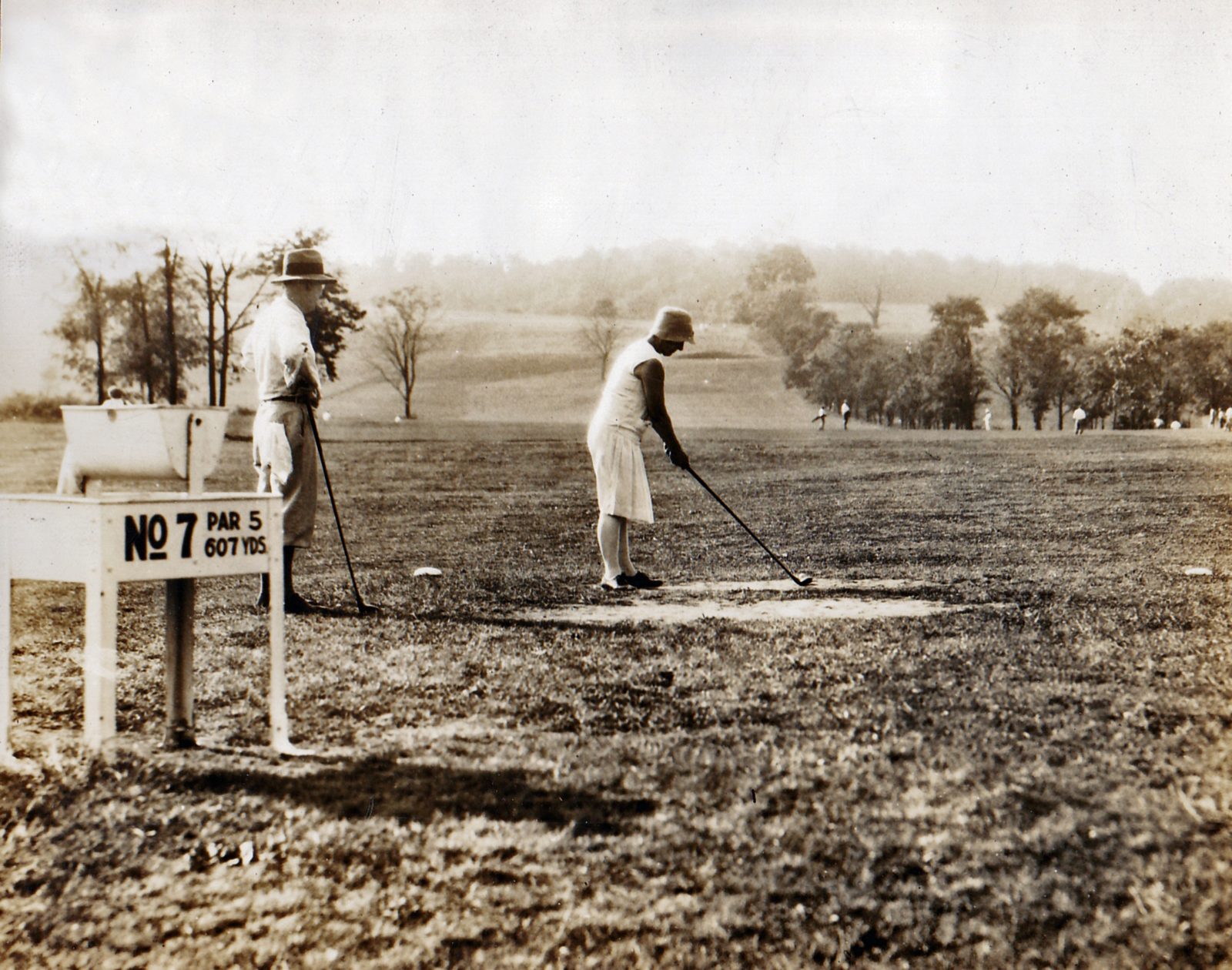
Building the course required continuing work after its first opening. A May 1931 report credited grounds superintendent William H. Griffith with constructing the last nine holes during his three years at the club. It announced his departure for another golf project on Long Island. His later connection there with Alister Mackenzie must not be mistaken for evidence that Mackenzie designed the Mount Union course.
Bob Goodman’s 1967 retrospective added the recollections of Elmer Booher, who began working at the club in 1927 and became head greenskeeper in 1932. It associated early course work with R.J. Rutherford of State College. These accounts preserve several different contributions: Bendelow’s design, local construction and supervision, and the sustained labor needed to turn farmland into playable golf ground.[6], [7], [9], [18]
In June 1930 the club hosted the dinner dance preceding Margaret MacGregor Davis’s marriage to William Matteson Smith of Poughkeepsie. The wedding took place June 25 at Blue Springs, the summer home of Mr. and Mrs. Roy Paul Miller Davis across the river. Darthea Davis Banks of New York City was toastmistress at the club dinner. The occasion connects the recreational grounds to the Davis family’s social life; the guests should not automatically be counted as members or investors.[34]
Financial trouble before the flood
The flood was a catastrophe, but it was not the beginning of the project’s financial difficulties. On December 6, 1929, Davis published a lengthy defense in the Mount Union Times. His letter distinguished two organizations: the Juniata Valley Realty Corporation and the Juniata Valley Colony Club.
That distinction helps explain the project. Creating a recreation community required buying and improving land, financing construction and providing infrastructure. Operating the club was a related but separate undertaking. A busy clubhouse or a profitable season did not by itself settle the development company’s debts.
Davis described borrowing for development beginning in 1927, later credit difficulties, creditor judgments and efforts to arrange a bond issue. He argued that the operating club had made money during the period from 1927 into 1929 and defended the realty corporation’s position. These were the promoter’s assertions in a public dispute, not independently audited conclusions.
The letter changes the shape of the story. By the time the Juniata rose in 1936, the enterprise already had a history of financial strain. A responsible account cannot compress that sequence into a simple tale in which a flourishing resort was ruined financially for the first time by a single flood.[8]
1930: a Penn State president at the helm
Dr. Ralph D. Hetzel held more than an honorary connection to the club. The March 28, 1930 Mount Union Times reported his election as president of both the Realty Corporation and the Colony Club. Hetzel was also Penn State’s president, serving the university from 1927 to 1947.[32], [33], [36]
The realty board’s officers included C. B. Sharpe, vice-president; E. S. Gaster, secretary; and D. Dale Brandt, treasurer. L. K. Chilcote of Rockhill Furnace was the club’s vice-president, with W. C. Kirman as secretary and Brandt as treasurer. The boards drew from Mount Union and a wider region: E. A. Hudson of Three Springs, L. S. Etnier of Orbisonia, Urban Doolittle of Huntingdon and Carl D. Kirk of McVeytown were among those involved.[33]
The fuller April 4 report placed the leadership change beside a vote to increase indebtedness from $42,500 to $75,000, to be covered by a bond issue. It also described plans for thirteen more summer cottages. Expansion ambitions and financing pressures were present together six years before the flood; the report establishes the vote and plans, not the completion of every proposed cottage.[33]
March 1936: the river takes the cottages
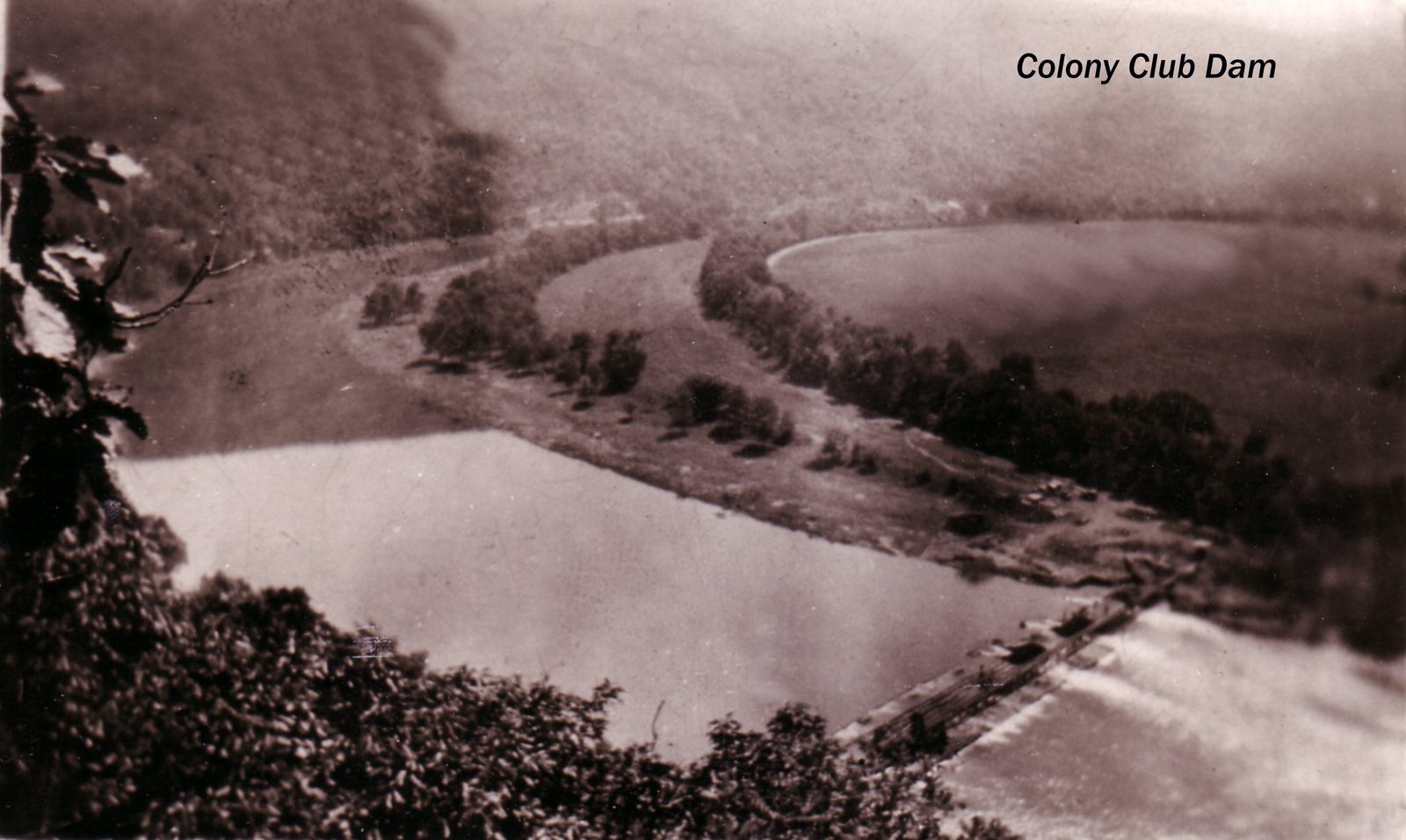
The Mount Union Times of March 26, 1936 carried a devastating headline: “Raging Floods Take Colony Club.” Its account of the St. Patrick’s Day flood described much of the riverside cottage colony swept away, with surviving structures battered by floating debris or filled with mud.
The newspaper named the Corson and Yocum homes among those carried downstream. Furniture, clothing and bathroom fixtures were scattered over the grounds. Some belongings were found at and below Newton Hamilton. The report made clear that this was the destruction of households, not merely damage to a sporting facility.
Even the cottages still standing could be wrecks. The Cherry residence appeared comparatively intact from one direction, but the continuation explained that water had torn away an entire side and stripped its contents. Crosby’s cottage had been lifted and carried toward the clubhouse, lodging near the curve in the approach.
The Fetterolf family’s experience adds a direct human moment: Mr. and Mrs. Fetterolf and their child left their home in a canoe on the morning of the flood. Their car was carried across the road and left in water and mud. The newspaper reported guards at the entrance and the theft of belongings from the damaged properties while owners were trying to recover them.
The club’s lost records appeared in a separate short article on the same front page. Its filing cabinet was recovered near the Cherry cottage, about two hundred yards downstream. The books were unreadable. That loss helps explain why surviving newspapers now carry so much of the burden of reconstructing the club’s early history.
Yet the report also described cleanup already underway and some owners preparing to rebuild. Its sweeping language about devastation should not be read as proof that every facility vanished or that club activity permanently stopped. The next chapter began remarkably quickly.[10]
Correspondent Helen T. Hollingshead recorded the households behind the losses. Mrs. C. I. Robinson returned from Baltimore after learning what had happened to the family’s club home; daughter Jane, attending local high school, was staying with friends. Robert C. Yocum and his wife returned from Pittsburgh to their destroyed summer cottage. Stewart C. Moore and his wife came from Aliquippa to clean mud from a cottage that survived. The C. C. Smith family of Bridgeport also reported losing a summer home.[35]
A sale, a lawsuit, and a second sale
By June 1936, the clubhouse was again serving as a gathering place. The June 11 Mount Union Times reported the high-school senior ball held there on June 5. The same front page announced a trustee sale to a group headed by Robert C. Yocum Jr., for $12,500, at Lewistown on the following day, June 6.
The transaction did not produce a clean, lasting settlement. The surviving opinion in Yocum v. Citizens National Bank records a dispute over whether delinquent taxes were included in the buyer’s obligations. Yocum had paid $3,750 toward the purchase. On July 22, 1937, the Mifflin County Court of Common Pleas ordered the sale set aside and authorized a resale; that decree became final on October 11. A further ruling in February 1938 addressed the deposit refund.
The decisive Legion announcement appeared on April 7, 1938. Under a headline announcing the American Legion purchase, the Mount Union Times reported that the property had been sold at a trustee sale in Lewistown the preceding Saturday. That places the reported sale on April 2, 1938. The purchaser was the Home Association of Simpson-Hunt Post at Mount Union.
The headline gave the price as $12,000. The body described a more complicated transaction: $8,225 for the real property, $200 for personal property and equipment, and the assumption of approximately $4,000 in taxes. The rounded headline should not be mistaken for an exact all-inclusive accounting.
This contemporary sequence is stronger evidence than later accounts assigning the Legion purchase to June 6, 1937. June 6 was the date of the earlier 1936 Yocum sale. The precise recording details of the Legion deed still merit checking, but the 1938 newspaper announcement establishes when the trustee-sale purchase was reported to have occurred.[11], [12], [13]
The Legion’s promise: recreation for families
By April 28, 1938, the new owners were explaining what they intended to do with the property. The Mount Union Times described a development program under the American Legion Memorial Home Association of Simpson-Hunt Post 107, with committees appointed earlier that month.
The proposal emphasized affordable family recreation: golf, swimming, tennis, children’s play, dancing and food. Membership was meant to bring families into the life of the place. Golf required its own annual charge or green fees; it was not included automatically in the basic membership.
The article reported work on greens and fairways, improvements to the pool and tennis courts, and plans to sell cottage sites. Members were already playing. Rather than abandoning the recreation landscape, the Legion set out to use and repair what remained while giving it a new organizational home.
One little-known possibility appeared in September 1940, when the club property was offered as a potential site for a new veterans hospital. Dr. Robert Bell, the Home Association’s secretary, announced an expected inspection by a Veterans Administration construction engineer. This was a proposal, not a hospital opening; it shows how the property’s future was still being considered in wider civic terms.
The club continued on its recreational path. Goodman’s later history records a clubhouse addition opened in 1947. By 1951, members were consciously preserving sporting history: Bob Goodman, Ike Cunningham, Clyde Leighty and Sam Price assembled trophies and plaques in the club bar. Their display linked the early Colony Club champions with the Legion era and recorded the absence of championship play during 1943 and 1944.[14], [15], [18], [16]
The Legion’s home organization had earlier roots. A September 1927 charter-application notice named C. W. Jones, N. L. Simpson, Robert C. Appleby, C. J. McGarvey, O. M. Grove, Angelo Diana, H. P. Miller, Harold V. Shope, Robert E. Bell and Orville A. Bair. This documents an application for the American Legion Memorial Home Association; it does not establish a 1927 country-club purchase.[31]
In 1938, C. W. Jones headed the house or composite board, R. E. Bell served as secretary, and H. V. Shope as treasurer. Membership work reached into neighboring communities through O. G. Donnelly of Mapleton, Carl D. Kirk of McVeytown, E. A. Hudson of Three Springs, Dr. R. C. Stevens of Orbisonia and James W. George of Robertsdale. Committees also handled greens, tennis, social activities and farm property.[14]
Champions, homecomings and another generation
Francis Butler’s 1928 championship and Dick Fetterolf’s 1938 title appear in the 1951 newspaper’s list. Over time, the record became much more than a set of names: it connected generations of players to a familiar landscape and to one another.
Among those players, Elinor Hudson Wible deserves a central place. A 1998 Daily News profile connected her childhood directly to the cottage colony: her father, Ed Hudson, and Dr. Howard Locke had built a summer cottage near the third fairway. Golf was part of the world in which she grew up.
The profile credited Wible with forty-eight club championships, a total also preserved in the club’s current women’s championship records. In 1998 she entered the charter class of the Huntingdon County Sports Hall of Fame. Her story carries the Colony Club’s family life into the decades of Legion golf. Sources disagree about the year of her first title, so that year should be checked against original tournament reports rather than repeated without qualification.
Mount Union also developed a substantial tournament tradition beyond its own championships. An August 1962 advertisement promoted the twelfth annual Mount Union Invitational, welcoming professionals and amateurs and advertising $3,000 in prizes. Local businesses and organizations filled the page with their support. The advertisement makes the event look like a town undertaking as much as a club competition.
A different tournament began in 1975: the Mount Union Invitational Amateur Best Ball event, scheduled for June 28–29. Club professional Frank Stasenko Sr. and tournament director John Remek helped organize it. The entry package included dinner and a dance, and family swimming was available. The advance report noted that former residents planned to return, including Leon Bard, then working in Saudi Arabia.
That event became the club’s June Invitational. Its current history names Don Dimoff Sr. and Butch Yelovich as the first winning pair. It should not be confused with the earlier Open/Invitational tradition simply because the names overlap.
Stasenko’s contribution continued beyond tournament administration. In 2005, at eighty, the former club professional took over Mount Union’s high-school golf team. Denny Sroka’s profile described an experienced teacher determined to keep the program going and help young players learn. The course’s legacy was being passed on through instruction as well as competition.[16], [20], [23], [17], [19], [25], [21]
2026: the country club gives the Legion a place to continue
The present-day American Legion Country Club maintains the eighteen-hole golf course and advertises the StoneHouse Lounge and a calendar of activities. Its role also reaches into community fundraising: Beacon Lodge Camp advertised its tenth annual golf outing there for August 22, 2026, while Huntingdon County United Way advertised the Mark “Iron Man” Kumpf Memorial tournament for May 2. Those organizer notices document planned uses of the grounds; they are not attendance or results reports.
The club’s importance to the Legion became especially clear after the fire that struck Post 107’s Stone House building on January 30, 2026. Byron Mantoan’s February 3 report in The Daily News described the decision to move operations to the country club. Commander Ashley Whitesel explained that the Legion and country club operated as one entity with one board.
The move required adapting to smaller bar space, different kitchen facilities and a new work setting, but Whitesel said no Legion employees would lose their jobs because of it. The country club provided a place to continue serving members while the post considered its future.
The relationship had come full circle in a practical sense. In 1938, the Legion acquired a recreation property that had endured financial trouble, flood damage and a failed sale. In 2026, that property helped the Legion continue after the loss of its own historic meeting place. The clubhouse, fairways and remembered summer colony belong to a long history of local people finding reasons—and ways—to keep gathering here.[27], [28], [29], [30], [26]
The people behind the place
Explore the named builders, officers, families and organizers. Names and initials follow the cited records. Some people held several roles; event attendance alone does not establish club membership.
Builders and early leadership (7 entries)
Roy Paul Miller Davis
Principal promoter; author of 1929 financial defense; father of 1930 bride[8], [34]
Charles H. Baldwin
Construction contractor[2]
Ralph Ganoe
Superintendent in construction account[2]
William H. Griffith
Credited with constructing the final nine holes[9]
J. Frank Moore
Realty Corporation secretary, 1927[31]
Different name from director J. Frank Adams; do not merge.
1930 Realty Corporation board (17 entries)
Dr. R. D. Hetzel
President of both Realty Corporation and Colony Club[32], [33], [36]
Ralph D. Hetzel, Penn State president 1927–1947.
C. B. Sharpe
Vice-president, Mount Union[33]
E. S. Gaster
Secretary, Mount Union[33]
D. Dale Brandt
Treasurer, Mount Union[33]
C. V. Hackman
Director, Mount Union[33]
R. M. Longacre
Director, Mount Union[33]
W. W. Cunningham
Director, Lewistown[33]
R. H. Smith
Director, State College[33]
Dr. G. C. Bliss
Director, Altoona[33]
Dr. Paul Allis
Director, Lewistown[33]
E. A. Hudson
Director, Three Springs[33]
H. M. Rose
Director, Huntingdon[33]
L. S. Etnier
Director, Orbisonia[33]
R. P. M. Davis
Director[33]
W. J. Campbell
Director[33]
J. Frank Adams
Director[33]
J. K. Wiley
Director, Mount Union[33]
1930 Colony Club governors (8 entries)
L. K. Chilcote
Vice-president, Rockhill Furnace; March 28 report spells Chilcoat[33]
D. Dale Brandt
Treasurer, Mount Union[33]
W. C. Kirman
Secretary, Mount Union[33]
T. C. Matthews
Governor, Lewistown[33]
Urban Doolittle
Governor, Huntingdon[33]
Carl D. Kirk
Governor, McVeytown[33]
T. M. Robinson
Governor[33]
R. B. Madden
Governor, Mount Union[33]
1927 Legion Home Association applicants (10 entries)
C. W. Jones
Named applicant for proposed American Legion Memorial Home Association of Mount Union[31]
Application scheduled September 6, 1927; not a claim these men bought the club in 1927.
N. L. Simpson
Named applicant for proposed American Legion Memorial Home Association of Mount Union[31]
Application scheduled September 6, 1927; not a claim these men bought the club in 1927.
Robert C. Appleby
Named applicant for proposed American Legion Memorial Home Association of Mount Union[31]
Application scheduled September 6, 1927; not a claim these men bought the club in 1927.
C. J. McGarvey
Named applicant for proposed American Legion Memorial Home Association of Mount Union[31]
Application scheduled September 6, 1927; not a claim these men bought the club in 1927.
O. M. Grove
Named applicant for proposed American Legion Memorial Home Association of Mount Union[31]
Application scheduled September 6, 1927; not a claim these men bought the club in 1927.
Angelo Diana
Named applicant for proposed American Legion Memorial Home Association of Mount Union[31]
Application scheduled September 6, 1927; not a claim these men bought the club in 1927.
H. P. Miller
Named applicant for proposed American Legion Memorial Home Association of Mount Union[31]
Application scheduled September 6, 1927; not a claim these men bought the club in 1927.
Harold V. Shope
Named applicant for proposed American Legion Memorial Home Association of Mount Union[31]
Application scheduled September 6, 1927; not a claim these men bought the club in 1927.
Robert E. Bell
Named applicant for proposed American Legion Memorial Home Association of Mount Union[31]
Application scheduled September 6, 1927; not a claim these men bought the club in 1927.
Orville A. Bair
Named applicant for proposed American Legion Memorial Home Association of Mount Union[31]
Application scheduled September 6, 1927; not a claim these men bought the club in 1927.
1930 wedding and social life (12 entries)
Margaret MacGregor Davis
Bride; married William Matteson Smith at Blue Springs, June 25, 1930[34]
William Matteson Smith
Bridegroom, Poughkeepsie, New York[34]
Darthea Davis Banks
Toastmistress at club dinner dance preceding wedding; New York City[34]
Helen Kimball
Named wedding-party dinner guest[34]
Event attendance does not establish club membership.
Mary Downing
Named wedding-party dinner guest[34]
Event attendance does not establish club membership.
Lawrence Steere Smith
Named wedding-party dinner guest[34]
Event attendance does not establish club membership.
John Jacob Livingood
Named wedding-party dinner guest[34]
Event attendance does not establish club membership.
Edgar Smith Downing
Named wedding-party dinner guest[34]
Event attendance does not establish club membership.
Richard Kimball
Named wedding-party dinner guest[34]
Event attendance does not establish club membership.
Henry Forrester Taylor Jr.
Named wedding-party dinner guest[34]
Event attendance does not establish club membership.
Graham Lee Sterling Jr.
Named wedding-party dinner guest[34]
Event attendance does not establish club membership.
1936 flood accounts (7 entries)
Helen T. Hollingshead
Mount Union correspondent reporting family losses[35]
Mrs. C. I. Robinson
Returned from Baltimore after learning of flood losses at club home[35]
Given name not established.
Jane Robinson
Daughter attending local high school; staying with friends[35]
Dr. Robinson
Physician in Hollidaysburg; husband in Robinson family account[35]
Do not expand first name without evidence.
Robert C. Yocum and wife
Pittsburgh family whose summer cottage was destroyed[35]
Wife’s given name not established; do not automatically conflate every Yocum reference with Robert C. Yocum Jr., trustee-sale purchaser.
Stewart C. Moore and wife
Aliquippa family cleaning mud from surviving cottage[35]
Wife’s given name not established.
C. C. Smith and wife
Bridgeport family reported to have lost summer home[35]
Wife’s given name not established.
1938 Legion organization (32 entries)
C. W. Jones
House/composite board president; April 7 purchase report calls him Carson Jones[13], [14]
R. E. Bell
House/composite board secretary[14]
H. V. Shope
House/composite board treasurer; social committee[14], [31]
1927 charter gives Harold V. Shope.
Sam Dollinger
House/composite board member[14]
C. J. McGarvey
House/composite board member[14]
R. C. Appleby
House/composite board member[14]
H. W. Gibboney
House/composite board member[14]
V. R. Rosensteel
House/composite board member[14]
J. C. Shapiro
House/composite board member[14]
R. S. Fetterolf
House/composite board member[14]
F. C. Strickland
House/composite board member[14]
C. D. Kirk
Greens committee[14]
M. J. Smith
Greens committee[14]
R. D. Heck
Greens committee[14]
James W. George
Membership committee, Robertsdale[14]
E. A. Hudson
Membership committee, Three Springs[14]
Dr. R. C. Stevens
Membership committee, Orbisonia[14]
Carl D. Kirk
Membership committee, McVeytown[14]
Dr. Wm. A. Doebele
Membership committee, Huntingdon[14]
E. O. Barker
Membership committee, Huntingdon[14]
O. G. Donnelly
Membership committee, Mapleton[14]
Earl E. Ryne
Membership committee, Mount Union[14]
Gerald D. Lukens
Membership committee, Mount Union[14]
B. W. Reeder
Membership committee, Mount Union[14]
A. A. Oeffner
Social committee[14]
J. W. Corson
Social committee[14]
G. D. Lukens
Tennis committee[14]
C. B. Oswalt
Tennis committee[14]
Chas. Huston Jr.
Tennis committee[14]
H. C. Cromer
Farm-property committee[14]
B. W. Reeder
Farm-property committee[14]
E. A. Hudson
Farm-property committee[14]
Later club life (9 entries)
Bob Goodman
1951 trophy/plaque project[16]
Ike Cunningham
1951 trophy/plaque project[16]
Clyde Leighty
1951 trophy/plaque project[16]
Sam Price
1951 trophy/plaque project[16]
Elinor Hudson Wible
Cottage-family connection; 48 women’s club titles[20], [23]
First-title year conflicts between sources; do not choose one without further evidence.
Frank Stasenko Sr.
1975 amateur best-ball invitational organizers[19]
John Remek
1975 amateur best-ball invitational organizers[19]
Ashley Whitesel
Legion commander quoted after January 2026 Stone House fire[26]
Tracy Matthews
Post manager in February 2026 relocation report[26]
Have you seen an original stock certificate?
BrickTownPA is searching for an original Juniata Valley Realty Corporation stock certificate. The 1924 report describes $50 par-value shares and four-share initial subscriptions, as well as no-par-value stock. We have not yet located a verified surviving example or photograph, and its appearance remains unknown.[37]
A certificate, canceled certificate, certificate-book stub, shareholder letter or clear photograph could add an important piece to this story. Check family papers under the corporation’s name, as well as references to the Juniata Valley Country Club or Colony Club. Please include any visible date, certificate number, shareholder name, signatures and writing on the reverse.
Sources & further reading
Original newspaper reports anchor the chronology. Later recollections and the club’s institutional histories add context; dates that conflict are identified in the story. Research updated October 12, 2026. Newspaper services may require a subscription.
- The Daily News, September 23, 1924, p. 1 — Juniata Valley Country Club Is an Ideal Place
- The Daily News, August 18, 1926, pp. 1 and 4 — Juniata Valley Country Club Is Being Planned
- The Daily News, July 27, 1927, p. 1 — Juniata Valley Country Club To Be Opened August 12
- Altoona Mirror, August 18, 1927, p. 13 — Club To Sponsor Sports Meets
- Sarah A. Lichtman, Beverly Willis Architecture Foundation — Anna Wagner Keichline
- Altoona Mirror, January 28, 1928, p. 13 — club publication report
- Mount Union Times, September 14, 1928, p. 11 — bridge luncheon
- Mount Union Times, December 6, 1929, pp. 1 and 20 — R.P.M. Davis public letter
- The Daily News, May 9, 1931, p. 2 — William H. Griffith
- Mount Union Times, March 26, 1936, pp. 1 and 9 — Raging Floods Take Colony Club; Colony Club Loses Records
- Mount Union Times, June 11, 1936, p. 1 — Juniata Valley Club Is Sold For $12,500
- Yocum v. Citizens National Bank, 32 Pa. D. & C. 217 — Mifflin County Court of Common Pleas
- Mount Union Times, April 7, 1938, p. 1 — American Legion Post Buys Juniata Country Club—Price $12,000
- Mount Union Times, April 28, 1938, p. 1 — Legion Launches New Development Program At Country Club
- The Daily News, September 19, 1940, p. 12 — Legion Country Club Offered For Hospital Site
- The Daily News, April 13, 1951, p. 4 — Legion Country Clubbers Display Trophies, Plaques
- The Daily News, August 24, 1962, p. 5 — Mount Union Invitational Golf Tournament advertisement
- Bob Goodman, The Daily News, June 6, 1967, special-edition p. 22 (archive p. 54) — Country Club Started From Scratch
- The Daily News, June 21, 1975, p. 4 — Mount Union Tourney Set
- The Daily News, June 19, 1998, p. 4 — Elinor Wible born into game of golf
- Denny Sroka, The Daily News, August 30, 2005, p. 11 — Stasenko “old hand” at coaching game
- American Legion Country Club — History
- American Legion Country Club — Ladies Club Champions
- American Legion Country Club — June Invitational
- Byron Mantoan, The Daily News, February 3, 2026 — Legion moves operations to country club
- American Legion Country Club — current official website
- Golf Association of Philadelphia — American Legion Country Club directory
- PA Lions Beacon Lodge Camp — Annual Golf Outing
- Huntingdon County United Way — 2026 Mark “Iron Man” Kumpf Memorial Golf Tournament
- Mount Union Times, September 2, 1927, p. 4 — Realty meeting and Legion charter notices
- Mount Union Times, March 28, 1930, p. 4 — Stockholders Meet
- Mount Union Times, April 4, 1930, p. 9 — New Officers Are Elected
- The Daily News, June 26, 1930, p. 9 — Smith–Davis wedding dinner dance
- The Daily News, March 24, 1936, p. 10 — Helen T. Hollingshead’s Mount Union report
- Penn State Research Support — ACOR history
- Mount Union Times, August 29, 1924, p. 4 — Mount Union To Have a Country Club
- R. P. M. Davis, Mount Union Times, August 27, 1926, pp. 1 and 12 — Mount Union’s Country Club
Questions still open
The original deeds are needed to establish exact acquisition dates, prices, boundaries and the sellers of the Walls and Silver Ford properties. Surviving company papers could help resolve the acreage differences and the development’s finances. Wible’s first championship year also remains unresolved between the sources.
The Mifflin County Recorder and Pennsylvania State Archives county-records guide identify the next land-record sources.