A Store Before the Village Plan
Africa traced a store kept by David Snively at Wilson’s Mills to 1828. Trade at the creek therefore preceded the formal ten-lot village plan in his chronology.
Mill Creek’s history connects the waterway that gave it a name with the shops, iron furnace, quarries, churches and railroad station that served a small Juniata River community. J. Simpson Africa’s 1883 county history preserves a detailed snapshot of the village before its later life as a separate borough.
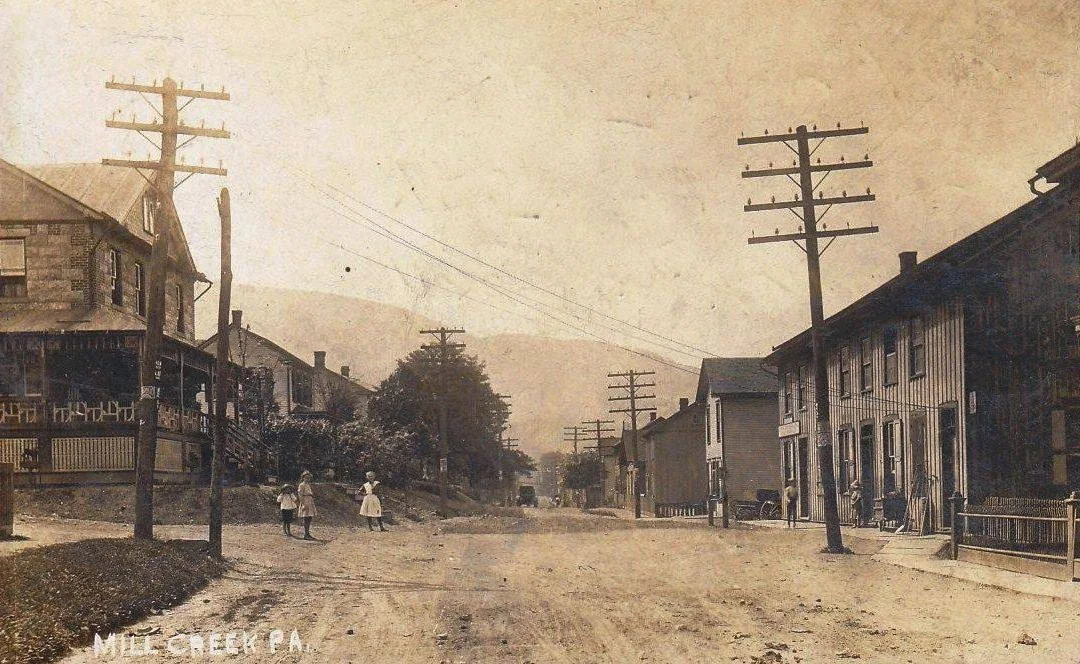
Africa traced an early settlement at the mouth of the creek to Mordecai Gosnell, who was living there when a survey was made on June 20, 1766. This records one early settler; it does not mark the beginning of human history in the area.
Africa recorded a sequence of names: Goslin Run, Pridmore’s Mill Creek and Armitage’s Mill Creek. The changes linked the stream to successive people and milling activity. The shorter name, Mill Creek, became the village’s enduring identity.
In Africa’s account, James Simpson surveyed a village plan for David Zook & Co. on October 12, 1846. Its ten lots measured 66 by 154 feet. The same history reported a village population of 288 when it was published in 1883.
Those details describe a small, deliberately laid-out settlement. They should not be confused with the later incorporation of Mill Creek as a borough.
Mill Creek Furnace was built in 1838 by Dr. Jonathan H. Dorsey and General S. Miles Green, according to Africa. Its location brought together water power, canal transportation and woodland that supplied charcoal. Much of the ore came from Franklin Township, and much of the iron went to Barree Forge for further processing.
At full operation, Africa reported about 120 men employed and more than 40 houses built to accommodate workers. The furnace helped shape a community of households as well as an industrial site.
Its working life included interruptions. Africa recorded a closure in March 1858, a restart by E. A. Green & Co. in 1863, and another shutdown after six years. The National Park Service’s 1991 survey identifies the overall furnace period as 1838–1869.
Quarrying and crushing sandstone became another important source of work around Mill Creek. Africa described Ulrey, King & Co. shipping stone to Pittsburgh in 1854, followed by successful steam-powered crushing at the quarry in 1857. The resulting sand supplied glassmaking beyond the Juniata Valley.
These dates describe the enterprise in Africa’s account, rather than establishing the first shipment from every quarry in the wider region. The sand industry connected local stone, workers and railroad transportation with distant manufacturers.
Africa traced a store kept by David Snively at Wilson’s Mills to 1828. Trade at the creek therefore preceded the formal ten-lot village plan in his chronology.
The account identifies Foust & Son in 1877 and a cooperative store established in January 1881. These entries give us names and dates for the businesses that supplied the surrounding community.
The National Park Service’s 1991 history describes Mill Creek as a canal shipping point in the 1830s and 1840s, with an aqueduct, basin, wharf and storage facilities. The railroad grew into a central part of the local economy during the 1850s; by the 1870s, Mill Creek was a loading point for lumber, flour and grain.
The Pennsylvania Railroad depot put Mill Creek on the main line about five miles below Huntingdon. Africa named A. M. Menold as station agent from the spring of 1880 and noted telegraph and telephone facilities. For a small village, the station was a connection to both transportation and communication networks.
Follow the wider railroad and bridge story.
Africa described an early log school near the later churches, attended by children from local families including the Kelleys, Wilsons, Woolvertons and Armitages. In 1870, a two-story brick schoolhouse was built, measuring 28 by 36 feet and costing $2,500. Those details belong to the Mill Creek building; the chapter’s broader enrollment and school-term figures describe Brady Township.
The Methodist congregation built a brick church in 1852. Africa credited Jesse Meredith and Matthew Gill with the building work and L. G. Kessler with supplying the bricks. The account provides a useful starting point for tracing local builders and church records; it does not by itself establish what survives of that building today.
The Baptist congregation also built a brick meetinghouse in the village, in 1857. Earlier Baptist worship had taken place farther up the creek; an older meetinghouse there later served the Lutheran congregation. Africa’s account describes distinct sites and congregations.
The Pennsylvania state municipal compilation records Mill Creek’s incorporation as a borough on December 13, 1905, from Brady Township. Incorporation gave the community a separate municipal identity long after its mills and village businesses had developed.
The National Park Service’s survey also records a stocking factory in the early twentieth century, later brickyards, and a major flood in 1936. Photographs, business records and contemporary newspaper accounts can help tell these later chapters in more detail.
Have a dated photograph, newspaper clipping, family account or correction? Share it with BrickTownPA. Please include the source and names, places and dates you can identify.
Researched and updated October 10, 2026. Nineteenth-century histories are attributed to their authors and reflect the period in which they were compiled.
Swigart Antique Auto Museum welcomed 166 visitors for September 19 Free Museum Day, according to Ron Morgan’s October 15 report (p. 2).
The October 9 obituary of Phyllis Marie (Atherton) Carter-Thomson (1933–2026) identifies her as chairperson of Mill Creek’s 1978 bicentennial. It also records her work at Travel Pack and L. Greif Brothers. The obituary supplies a valuable lead for finding celebration programs and photographs; the celebration date alone does not establish incorporation or resolve the village’s founding chronology.
Source: The Daily News, October 9, p. 2; October 15, p. 2.