Hugh Brown’s Warrant
The land on which Newton Hamilton stands was part of a 250-acre tract warranted to Hugh Brown. Following Brown’s death, the property passed to his half-sister Margaret Hamilton before 1783.
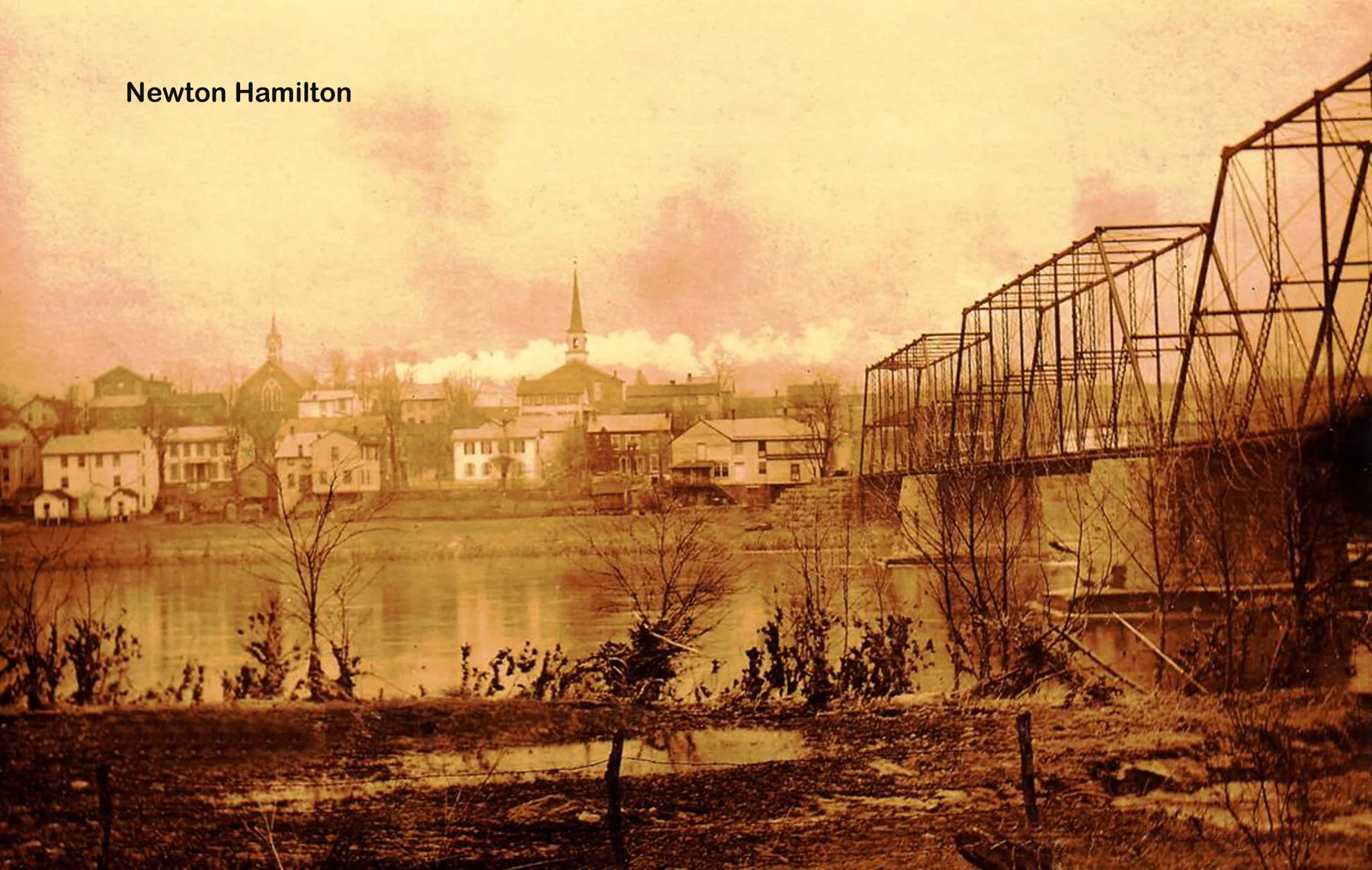
Newton Hamilton grew beside the Juniata River as a canal-era transportation and trading point. The Pennsylvania Railroad later followed the same river corridor, gradually replacing the canal and reshaping the borough’s economy. Today, the community’s historic identity remains closely tied to the river, the Pennsylvania Main Line Canal and the railroad.
The land on which Newton Hamilton stands was part of a 250-acre tract warranted to Hugh Brown. Following Brown’s death, the property passed to his half-sister Margaret Hamilton before 1783.
Margaret began dividing the land into town lots. One early deed described lots on the north side of present-day Front Street as measuring 50 by 150 feet.
The settlement was called Newton Hamilton, apparently after Newtownhamilton in County Armagh, Ireland, reflecting the region’s strong Scots-Irish heritage.
Historical accounts also identify the community as Hamiltonville and, briefly, Muhlenberg. Newton Hamilton became the enduring name.
The Juniata Division of the Pennsylvania Main Line Canal reached this part of Mifflin County around 1829–30. The waterway connected communities along the Juniata with larger eastern and western markets, and Newton Hamilton developed into a transportation and trading point.
The local canal landscape included locks, a lockkeeper’s house, an aqueduct carrying the canal across the river, warehouses and facilities serving canal boats.
Taverns, shops, churches and schools served residents and travelers. Nearby furnaces, a forge and a foundry linked the town to the region’s iron industry.
A contemporary description called Newton Hamilton a “small but smart village on the canal.” It reported about 348 inhabitants, Methodist and Presbyterian churches, and several nearby ironworking businesses.
The Pennsylvania legislature formally created the Borough of Newton Hamilton on April 12, 1843. Residents held their first borough election in March 1844. During the financially difficult early 1840s, the new borough reportedly issued locally circulated notes—sometimes called “shinplasters”—to compensate for a shortage of dependable currency.
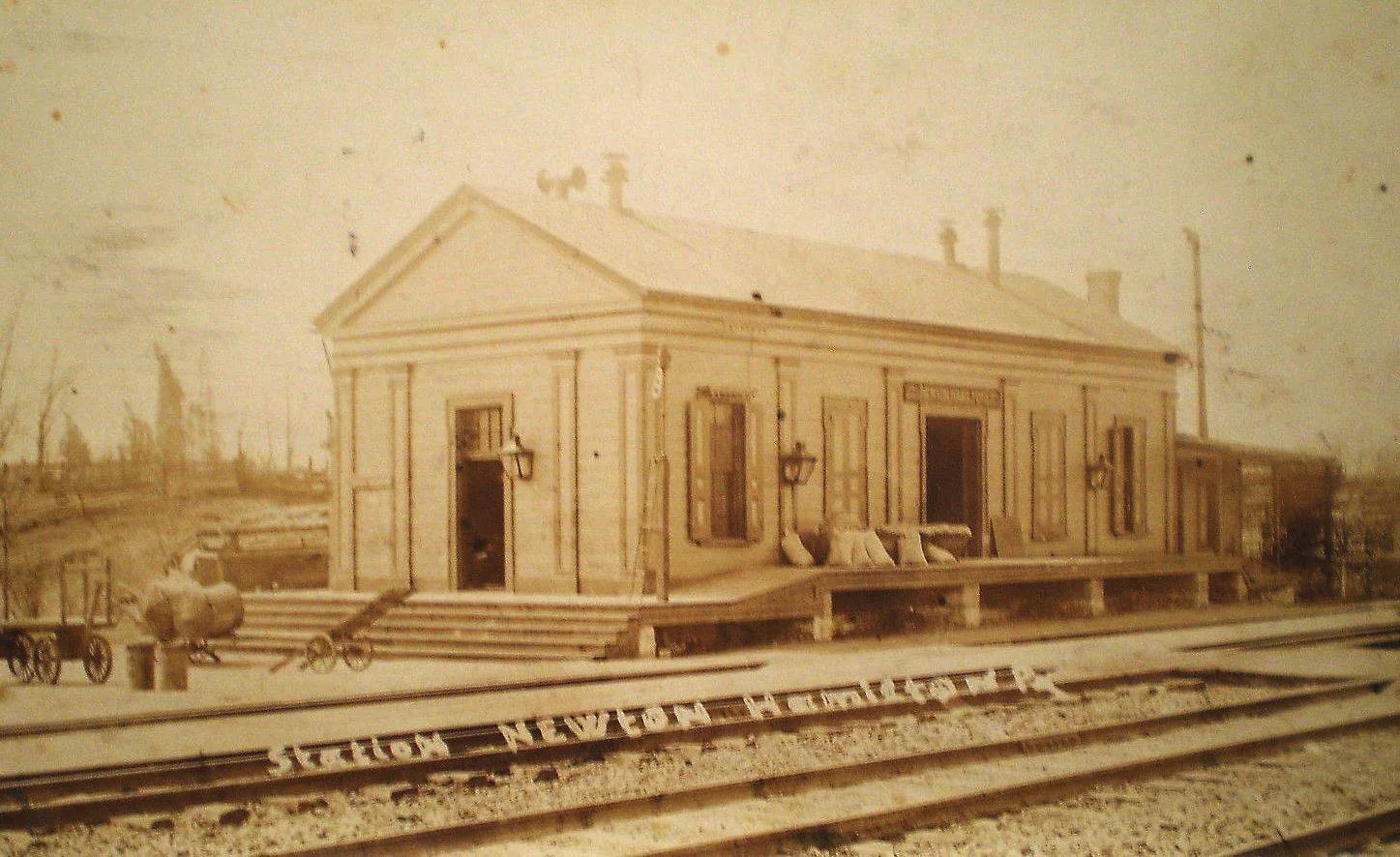
During the middle of the nineteenth century, the Pennsylvania Railroad established its main line along the Juniata River. Trains carried freight and passengers more quickly and operated throughout the year, gradually replacing the canal.
Newton Hamilton remains a railroad stop and local commercial center as rail traffic grows along the Juniata corridor.
Businesses tied to canal traffic weaken as the railroad becomes dominant. Severe flooding contributes to the abandonment of much of the Juniata Division.
The schoolhouse later preserved by the Newton-Wayne Historical Society becomes a lasting community landmark on Water Street.
The historical society acquires one of the surviving canal lockkeeper’s houses for preservation.
In 1872, a stock company organized the Newton Hamilton camp meeting grounds. Ellis’s 1886 history recorded incorporation on April 23, capital of $16,500 and a 36-acre property, with twelve acres improved. He described an annual ten-day meeting in August.
The grounds gave Newton Hamilton a seasonal gathering place beyond its canal and railroad businesses. These are historical activities; current programs should be checked with today’s organizers.
Source: Ellis (1886), Newton Hamilton: camp meeting grounds.
Ellis reported that the Juniata bridge washed away on October 8, 1880. G. W. Keiffer of Sunbury built its replacement, completed February 11, 1881, at a cost of $14,895. This earlier flood-and-rebuilding episode adds to the community’s long relationship with the river.
Source: Ellis (1886), Newton Hamilton: bridges.
B. E. Morrison’s Flea-Bite first appeared on Christmas Day 1879 as a five-by-eight-inch newspaper. It became the Watchman in March 1880 and continued to grow in size. Read the newspaper’s unusual story and publication timeline.
Source: Ellis (1886), Newton Hamilton: newspapers.
As transportation, employment and commerce became concentrated in larger communities, Newton Hamilton gradually became predominantly residential. Its physical size—approximately 0.2 square mile—also limited expansion.
The borough had about 353 residents in 1850, 317 in 1880, 280 in 1970 and 287 in 1990. By the 2020 census, the population had declined to approximately 196–197.
The society preserves photographs, household and church objects, railroad materials and local memorabilia in the former 1897 schoolhouse at 766 Water Street. The museum is open by appointment. Contact: (814) 669-9233 or newton1843@hotmail.com.
Newton Hamilton Bible Church announced its first Cancer Care Ministry meeting for October 4, 2026, from 4:30–5:30 p.m., continuing on the first Sunday of each month. The gathering offers emotional and spiritual support for people facing cancer and complements the third-Sunday meetings at McConnellstown Church of the Nazarene.
Contact Newton Hamilton Bible Church for directions and schedule updates. See upcoming meetings on the calendar.
Source: The Daily News, September 25, 2026, pp. 1, 3.
Follow the region’s transportation story on Railroads & Bridges, explore neighboring Kistler and Mapleton, or return to the Locations homepage.
The October 15 county heritage report said attendance figures for the Newton-Wayne Historical Society Canal Lock House and Bricktown Museum were still pending after September 19 Free Museum Day. No attendance total was published for either site in that report.
Source: The Daily News, October 15, p. 2, Ron Morgan, “Roundtable hears museum day report”.